
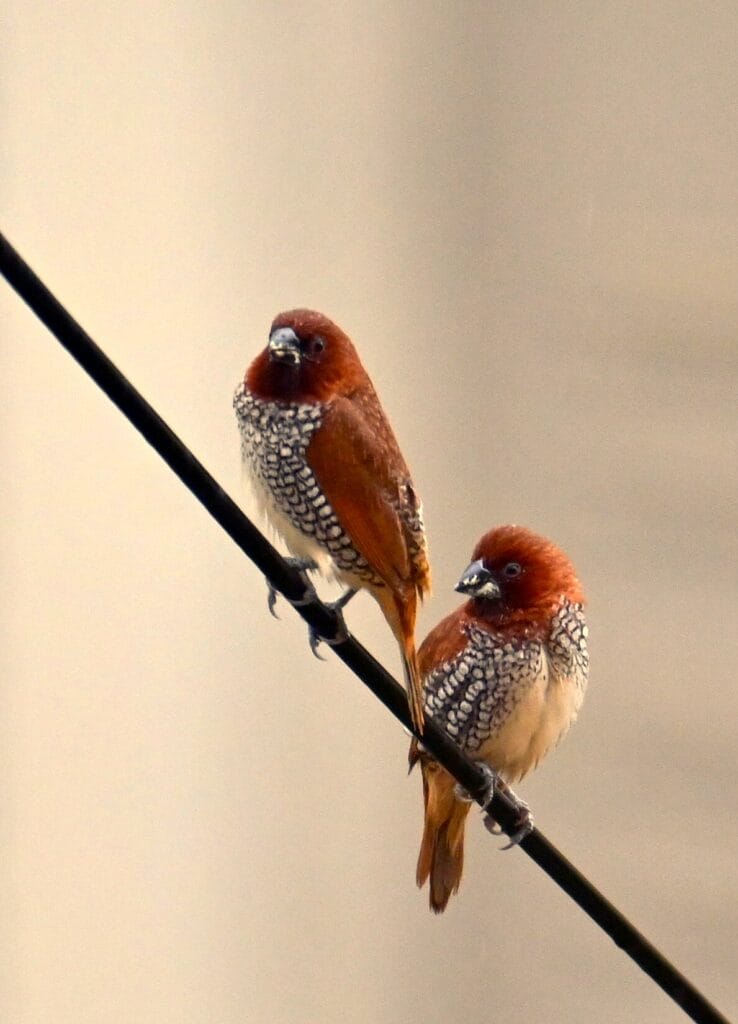
Nutmeg Mannikin

Munia birds sitting on a wire in the city during summer

Munia birds sitting on a wire in the city during summer, clicked during a rare moment of stillness.

I clicked this picture when two Scaly-breasted Munia birds were sitting quietly on a wire. These birds are mostly seen in summer around the city. I didn’t even know their name at first — I just noticed how small, shy, and fast they were.

These birds never sit in one place for long. In Hindi, you can say “yeh ek bilkul nahi tikti.” They are always on go to have something flying here and there.
So you need patience if you want to click them. Normally, by the time you raise your camera, they fly to another spot. But this time got lucky. They were thinking for a few seconds, and I clicked this.

It’s a simple, natural moment — the kind of thing you only see when you slow down and really look around the city. The Scaly-breasted Munia is not a long-distance migrant like cranes or flycatchers. Instead, it is what bird experts call a local or short-range mover. This means it usually stays within the same region all year, but shifts around depending on food, weather, and breeding.

In summer, they appear more often in city gardens, wires, empty plots, and small parks.

In monsoon, they shift to places with tall grasses, paddy fields, and areas full of seeds.

In winter, they stay in flocks and travel short distances to find warmth and steady food.

If you enjoy small stories of nature like this, you can explore more bird articles here:
https://travelontales.com/category/birds/

The bird that colonised the world by accident

The Scaly-breasted Munia is native to South and Southeast Asia. It now also lives wild in Hawaii, Puerto Rico, Australia, Japan, southern California, Florida and a scattering of other places.

None of those populations arrived on their own. Every one of them began with cage birds that escaped or were released.

Why this species in particular

Munias were traded in enormous numbers under the names “spice finch” and “nutmeg mannikin”. They are small, cheap, hardy, and they breed readily in captivity — everything the trade wanted.

They are also generalists. A bird that eats grass seed, tolerates heat, breeds with the rains and lives happily on the edge of farmland does not need much help to establish itself somewhere new.

  • Hawaii: established in the 1860s, now widespread across the islands.
  • Australia: feral populations around several east-coast cities.
  • California and Florida: more recent, spreading through suburbs and parks.
  • Japan and Puerto Rico: long-standing introduced populations.

Is that a problem?

Mostly it appears not to be, which is unusual for an introduced bird. Munias eat grass seed and do not compete strongly with native species for nest holes or animal prey — the resources that usually cause conflict.

The concerns that do exist are about seed predation in agriculture, and about introduced birds carrying parasites or diseases into populations with no resistance. Neither has proved dramatic.

It is worth contrasting this with the Rose-ringed Parakeet, another Indian export via the pet trade, which competes directly for the nest cavities native hole-nesters need. Same route out, very different consequences.

The trade in India today

Trapping and selling native Indian birds is prohibited under the Wildlife Protection Act. Munias were historically among the most heavily trapped species, taken in mist nets from grassland and sold live in city markets.

If you see native birds offered for sale, that is illegal, and buying one — even with the intention of releasing it — funds the next round of trapping.

Watching them at home

You do not need a reserve. Munias turn up wherever grass is allowed to seed: field margins, waste ground, canal banks, an unmown corner of a garden.

  • Let grass go to seed if you have any say over a patch of ground. That alone brings them.
  • Look at dusk for the huddled roosting lines.
  • Do not put out seed for them specifically. Concentrating birds at feeders spreads disease.

Frequently asked questions

Why are Scaly-breasted Munias found outside Asia?

Escaped and released cage birds established feral populations in Hawaii, Australia, the United States, Japan and elsewhere.

Is it legal to keep munias in India?

No. Native Indian birds are protected under the Wildlife Protection Act and cannot be kept or traded.

Are introduced munias harmful?

Less so than many introduced birds. They are seed eaters and do not compete for nest cavities, though there are concerns about crop damage and disease transmission.

What is a spice finch?

A trade name for this same species, Lonchura punctulata, alongside “nutmeg mannikin”.


Related: How to identify the Scaly-breasted Munia, Munia nesting and roosting behaviour and Rose-ringed Parakeets in urban India.

Scroll to Top