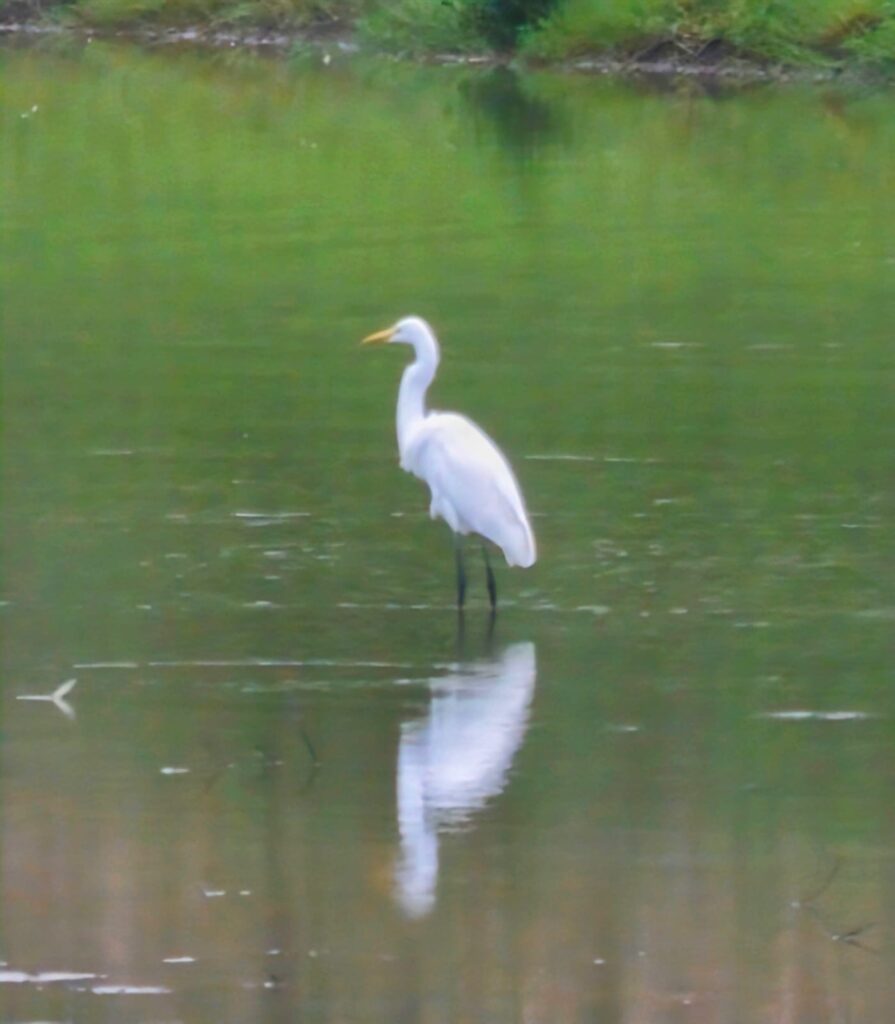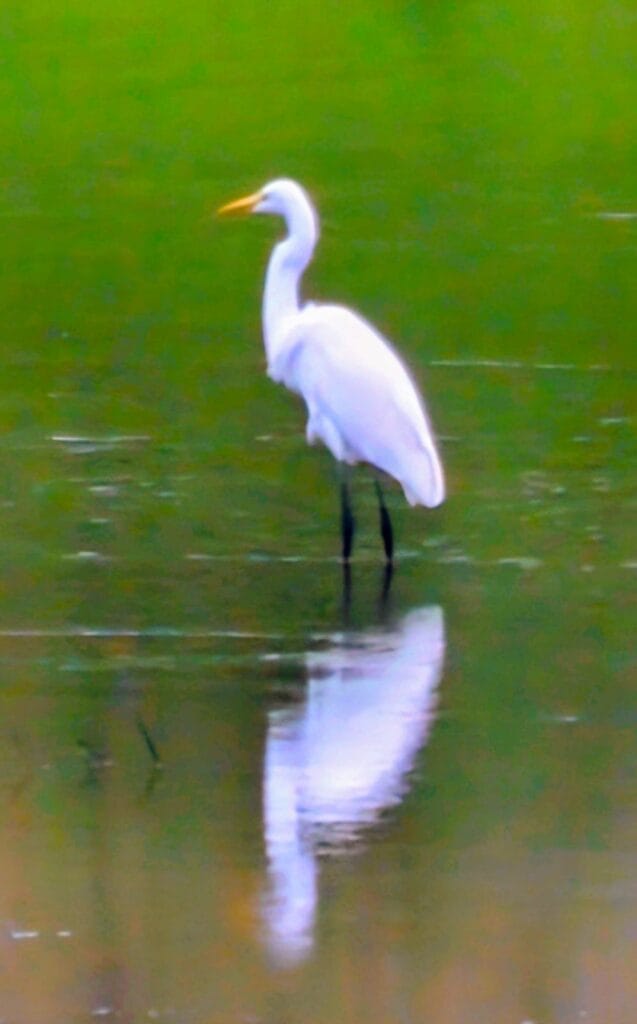
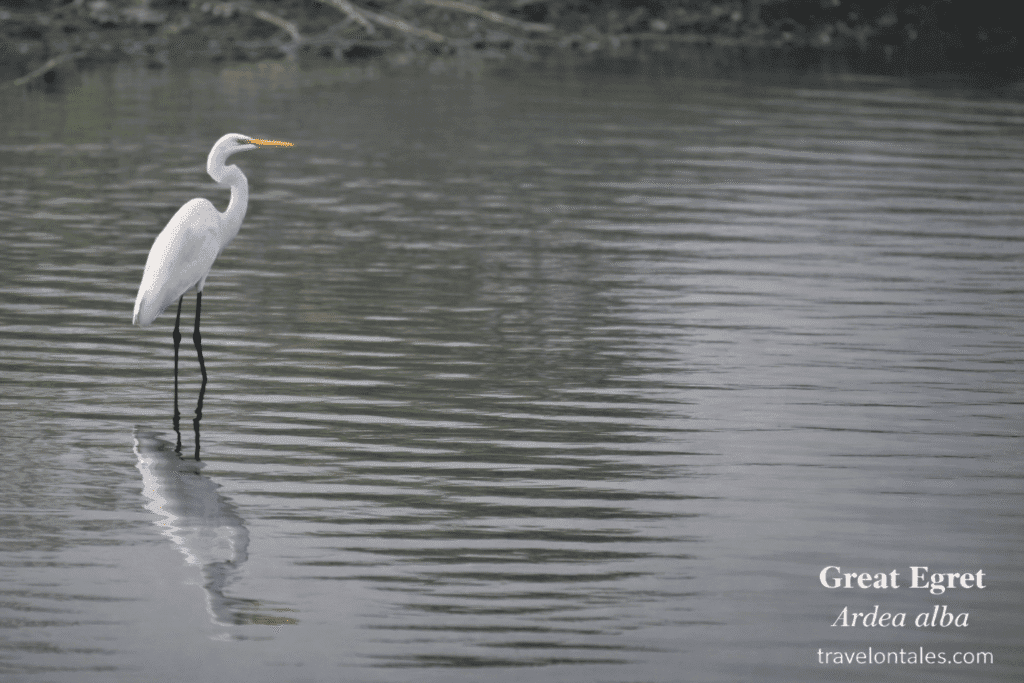
The Great Egret (Ardea alba) is the tallest and most elegant of the white waterbirds you will meet in India: pure white, long black legs, a straight yellow bill, and the patience of something that has decided standing still is a strategy rather than a waste of time.
Neither of the sightings behind this piece came from a reserve. One was a roadside pond on the drive to Alibaug. The other was the wetland near Seawoods in Navi Mumbai, where crowds gather for flamingos and walk straight past a bird that is standing in the open a hundred metres away. Between them they cover the two situations in which most people actually see this species — beside a road, and on a tidal creek.
Identifying a Great Egret
- Completely white plumage, no markings
- Long black legs, built for shallow water
- A straight yellow to orange bill
- A pronounced S-kink in the neck when alert
- Slow, deliberate walking — it does not hurry
Size alone separates it from the smaller egrets on most urban water. Against a Little Egret the difference is obvious: the Little is smaller, with a black bill and yellow feet. The one that catches people out is the white morph of the Western Reef Heron, which has a heavier yellowish bill, duller legs, and runs and lunges after prey instead of stalking slowly.
Where they live
Great Egrets are adaptable and depend on water rather than forest cover, which is why they turn up on ordinary journeys.
- Freshwater wetlands and marshes
- Rivers, lakes and ponds
- Estuaries and coastal lagoons
- Mangroves and backwaters
- Flooded agricultural fields
- Roadside canals and water bodies
The species has one of the widest distributions of any waterbird — the Indian subcontinent, Southeast Asia, Africa, seasonal in Europe, the Americas and Australia — and is listed as Least Concern by the IUCN. Most Indian birds are resident, with local movement following water.
How they feed
Inland the diet is small fish, frogs and tadpoles, crustaceans, aquatic insects and the occasional small reptile. The technique is sit-and-wait: stand motionless, let the prey come close, strike once. It conserves energy, and it is the reason the bird is such a forgiving photographic subject.
On the coast, they fish the tide
The same species behaves differently on a tidal creek, because the food arrives on a schedule. A Great Egret on a coastal mudflat is working the tide, not a patch of water.
The productive window is the falling tide and the first hour of the rising one. On a full high tide the birds stand about in mangrove roots doing nothing, and visitors conclude the place is poor. It is not; the timing is wrong.
Where to look on a creek
- The receding edge, where fish are trapped in shrinking pools.
- Mangrove channel mouths, which funnel prey on the outgoing tide.
- Fish farm and saltpan bunds, which hold water when the flats are dry.
- Wet sand at the surf line, though they use this less than the smaller egrets do.
What they eat there
On the coast the diet shifts to mudskippers, gobies, small crabs and prawns. Mudskippers in particular are a challenge — they see well, they are quick, and they retreat into burrows, so the egret switches from stalking to ambush and will stand motionless over a burrow entrance for minutes.
The company they keep
A tidal creek gives you comparisons a lake cannot. On the same flat you will often have Great, Intermediate and Little Egrets together, which is the easiest way there is to learn the size differences. Alongside them: Western Reef Heron in both dark and white morphs, Grey and Purple Heron in the channels, Painted Stork and Lesser Flamingo on the bigger flats, and waders in numbers — godwits, curlews, redshanks, sandplovers — working the same falling tide.
Find the roost
Egrets on the coast usually roost communally in mangroves and fly out to the feeding grounds at first light. Finding the roost is worth more than finding the birds: a mangrove stand with a hundred white birds coming in at dusk beats anything the mudflat offers at noon.
Behaviour and breeding
Great Egrets feed alone but gather to nest and roost, and are most active in the early morning and late evening. They are calm birds, non-aggressive, but territorial around a good feeding spot.
In India breeding coincides with the monsoon, when water rises and food is abundant. Birds develop delicate ornamental plumes for courtship, nest colonially in trees near water alongside other waterbirds, and both parents feed the chicks. Those same plumes were the reason for heavy hunting a century ago — which is what produced some of the first bird protection laws anywhere in the world.
When to go
They are present year-round. Sightings increase through the monsoon and post-monsoon months when wetlands are full, and at a place like Seawoods they become easier again in winter, when water levels steady and the flamingo season brings the whole wetland to life. On the coast, ignore the calendar and read the tide table instead.
Photographing them
- Keep your distance and use a telephoto; the bird is calm, not tame.
- Expose for the whites. A white bird on a bright flat will blow out if you let it. Protect the highlights and lift the shadows afterwards.
- Use the reflection. Still water doubles the subject and gives you a composition for nothing — as in the photograph above.
- Shoot early. Soft morning light holds the feather detail that midday destroys.
- Be patient. The bird stands still for minutes. That is your advantage, not your problem.
Why it is worth noticing
A Great Egret feeding well is a fair sign that the wetland under it still works. At Seawoods, where the headlines belong to flamingos, it is easy to walk past the resident birds that are there all year and that indicate whether the system is healthy. In a city that keeps expanding, watching one stand undisturbed near the flamingo grounds is a reminder that wildlife still finds room — if it is left any.
Frequently asked questions
What is the difference between a Great Egret and a Little Egret?
The Great Egret is much larger and has a yellow bill. The Little Egret is smaller, with a black bill and yellow feet.
How do I tell a white Western Reef Heron from an egret?
The reef heron has a heavier yellowish bill and duller legs, and it runs and lunges after prey instead of stalking slowly.
When is the best time to watch egrets on a creek?
The falling tide and the first hour of the incoming tide. High tide is the least productive time to be there.
What do they eat in coastal wetlands?
Mudskippers, gobies, small crabs and prawns, rather than the freshwater fish they take inland.
Are Great Egrets migratory?
Most Indian birds are resident, though they move locally depending on where the water is.
Why do they stand still for so long?
It is a sit-and-wait hunting strategy. Standing costs almost nothing; chasing costs a great deal.
Do egrets roost in mangroves?
Yes, usually communally, flying out to the flats at first light.
Related: The Great Egret of Tadoba.
A note on names: we identify these birds ourselves and we do not always get it right. If you think we have called one wrongly, tell us — we would rather fix a name than leave it standing.
More Photographs from Our Trips