
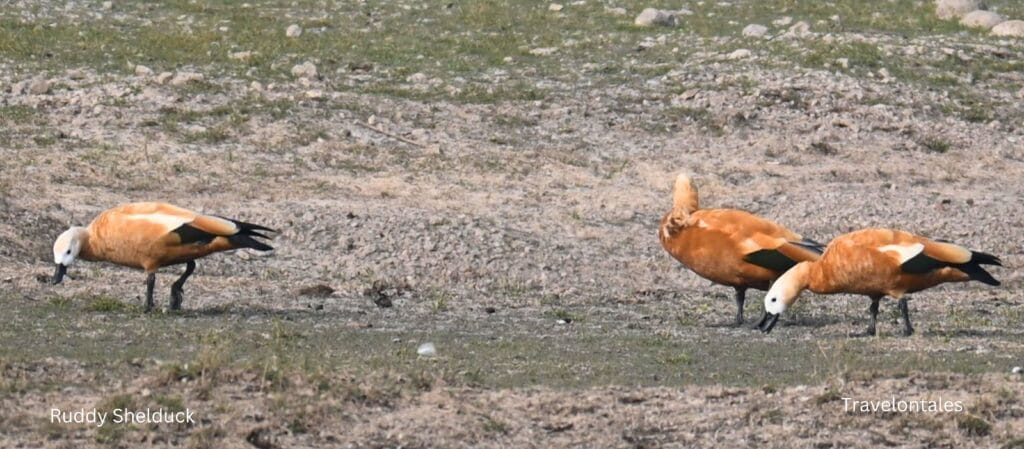
Ruddy Shelduck: The Bird That Refuses to Blend In
Some birds disappear into nature. Others stand out and quietly own it.
This moment wasn’t about drama. No flight, no splash, no sudden movement. Instead, it was calm — almost still.
However, that stillness is exactly what draws you in. Three Ruddy Shelducks move slowly across a dry wetland, relaxed yet alert. At first glance, it feels simple. But the longer you observe, the more the scene begins to unfold.
Unlike many birds that rely on camouflage, these stand out immediately. Their deep orange plumage contrasts strongly with the muted earth tones around them. As a result, your attention goes straight to them.
Meet the Ruddy Shelduck
The Ruddy Shelduck (Tadorna ferruginea), also known as the Brahminy Duck, is one of the most recognizable waterbirds in India. It is commonly seen across wetlands, rivers, and open landscapes.
If you are planning to explore birding hotspots like Bhigwan, this species is almost guaranteed to be on your list. In fact, the complete Bhigwan Bird Sanctuary guide covers where and how to spot such wetland species across different habitats.
Not Camouflage — But Confidence
Interestingly, these birds do not try to hide. Instead, they rely on visibility.
Because they live in open landscapes, early detection of danger becomes more important than blending in. Therefore, their strategy is simple — stay aware, stay together, and move early.
Moreover, their bright coloration helps in identifying partners and maintaining pair bonds over long distances.
Behavior: Always in Sync
Ruddy Shelducks are rarely seen alone. Instead, they are usually found in pairs or small groups.
At the same time, their coordination becomes visible even in simple moments. One moves, the others follow. One pauses, the rest adjust. It’s subtle, but it creates a rhythm in the frame.
Because of this strong bonding behavior, they appear calm yet connected — something that adds depth to even the simplest photograph.
The Landscape Matters
Meanwhile, the environment plays an equally important role in this image.
The dry ground, soft textures, and open space create a clean canvas. Without visual clutter, the subject stands out clearly.
As a result, the photograph feels balanced — not forced, not staged, just naturally composed.
Scientific Name: Tadorna ferruginea
Common Name: Brahminy Duck
Habitat: Wetlands, rivers, lakes
Diet: Omnivorous (plants, insects, aquatic life)
Behavior: Strong pair bonding, often seen in groups
Status: Least Concern
Why This Moment Works
Wildlife photography often focuses on action. However, moments like these highlight something different — stillness and presence.
Ultimately, this is what makes the image work. A simple scene, natural behavior, and a subject that doesn’t need to hide to be noticed.