
Why the Short-toed Snake Eagle Draws Birders to Bhigwan
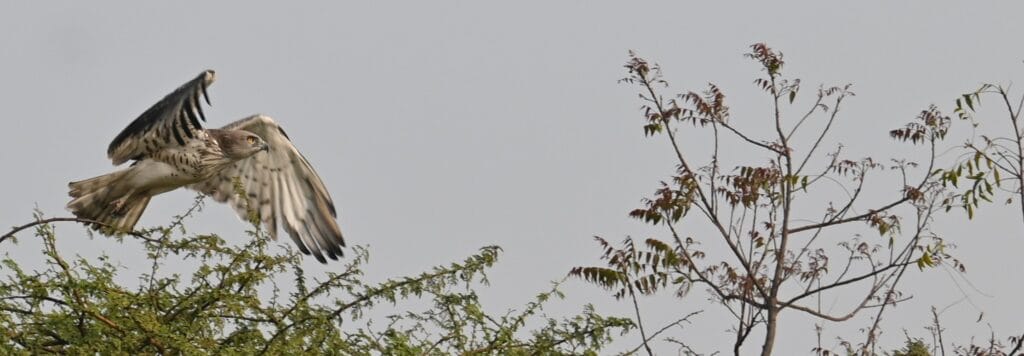
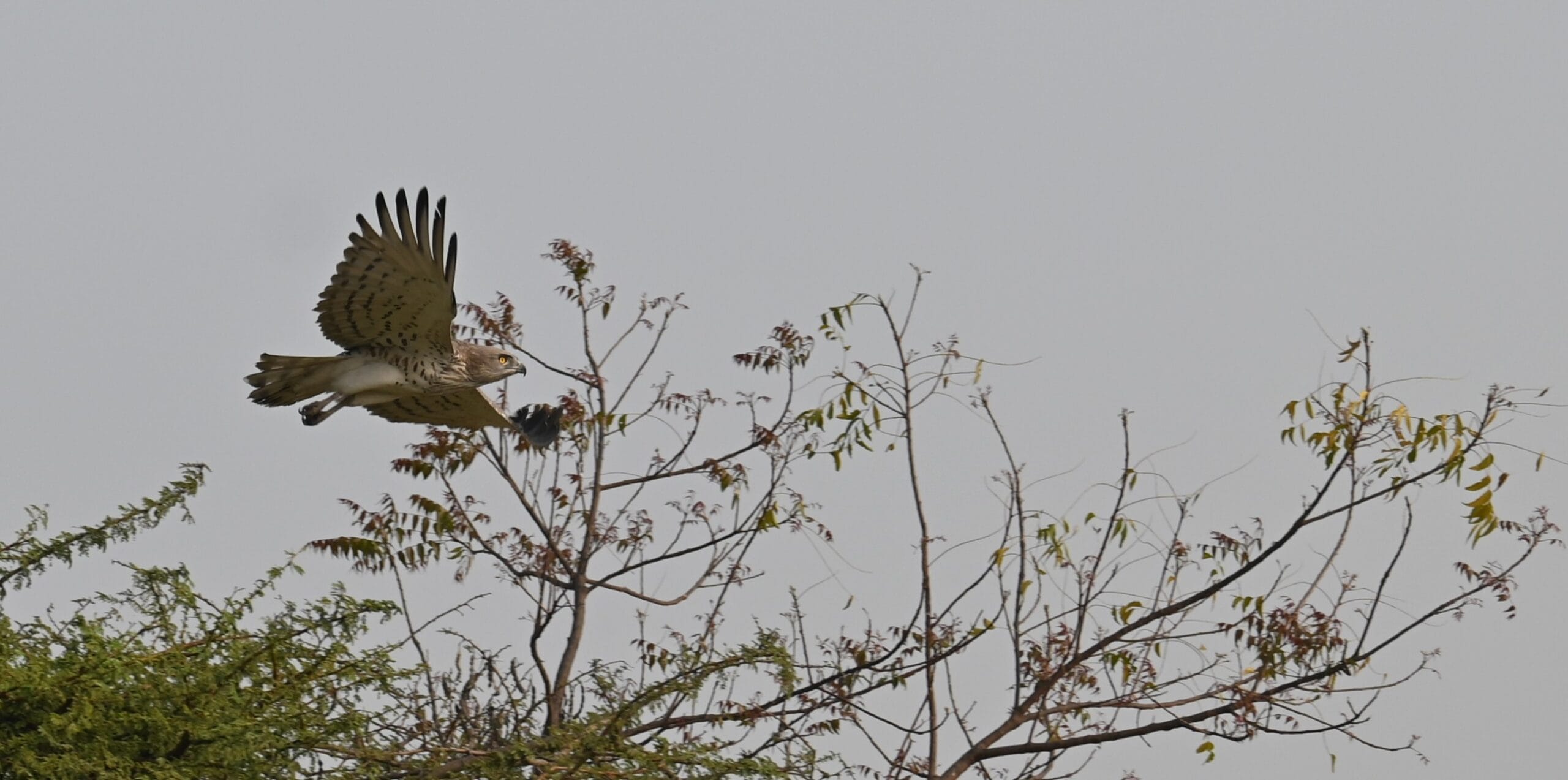
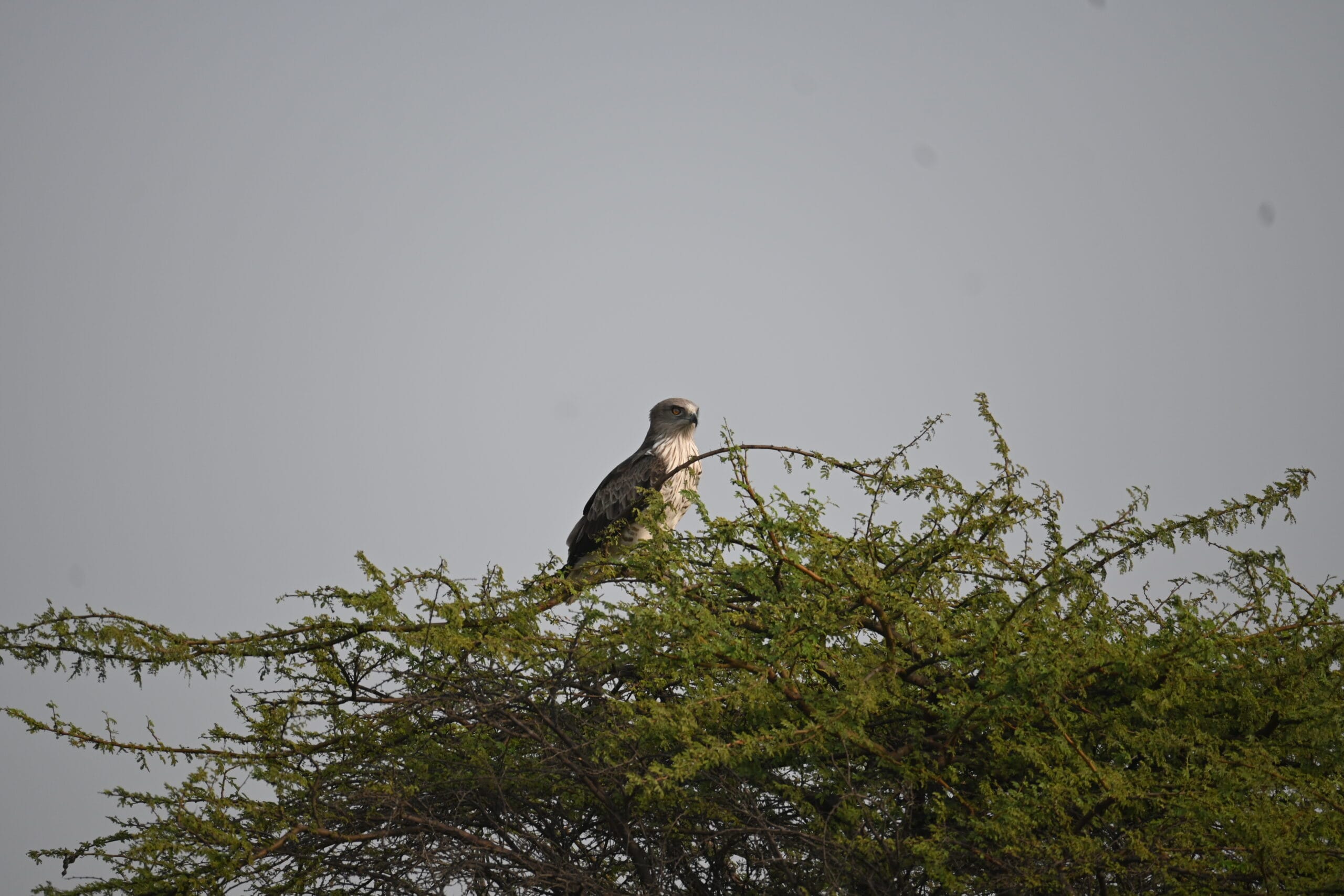
There are moments in wildlife photography that stop you mid-breath. One winter morning at the Ujani backwaters near Bhigwan, Maharashtra, I watched a large pale raptor lift silently from the crown of a thorny acacia and bank against a steel-grey sky. Its yellow eye caught the flat light. Its wings — broad, barred, effortlessly powerful — spread wide as it climbed. A Short-toed Snake Eagle (Circaetus gallicus), one of the most commanding birds of prey you can witness in peninsular India, was beginning its morning patrol.
Bhigwan, often called the “Bharatpur of Maharashtra”, is celebrated for its flamingos, pelicans, and waders. But the scrubland edges and agricultural fields ringing the reservoir quietly host a cast of raptors that most visitors overlook. The Short-toed Snake Eagle is arguably the most impressive of them — a large, pale eagle that specialises almost entirely in reptiles, particularly snakes, and one that rewards patient observation with extraordinary behaviour.
This guide covers everything you need to know to find, identify, and photograph this bird at Bhigwan — from field marks and hunting habits to the precise locations where sightings are most consistent.
Field Identification: How to Recognise This Eagle
The Short-toed Snake Eagle is a medium-to-large eagle spanning roughly 62–67 cm in body length, with a wingspan that stretches between 162 and 195 cm. In flight it is unmistakable if you know what to look for — but it can fool beginners who mistake it for an Osprey or a pale Steppe Eagle at distance.
Quick ID Card — Short-toed Snake Eagle
Key Field Marks
- Large, rounded head: The head is disproportionately large and owl-like — a characteristic visible even at distance when the bird is perched.
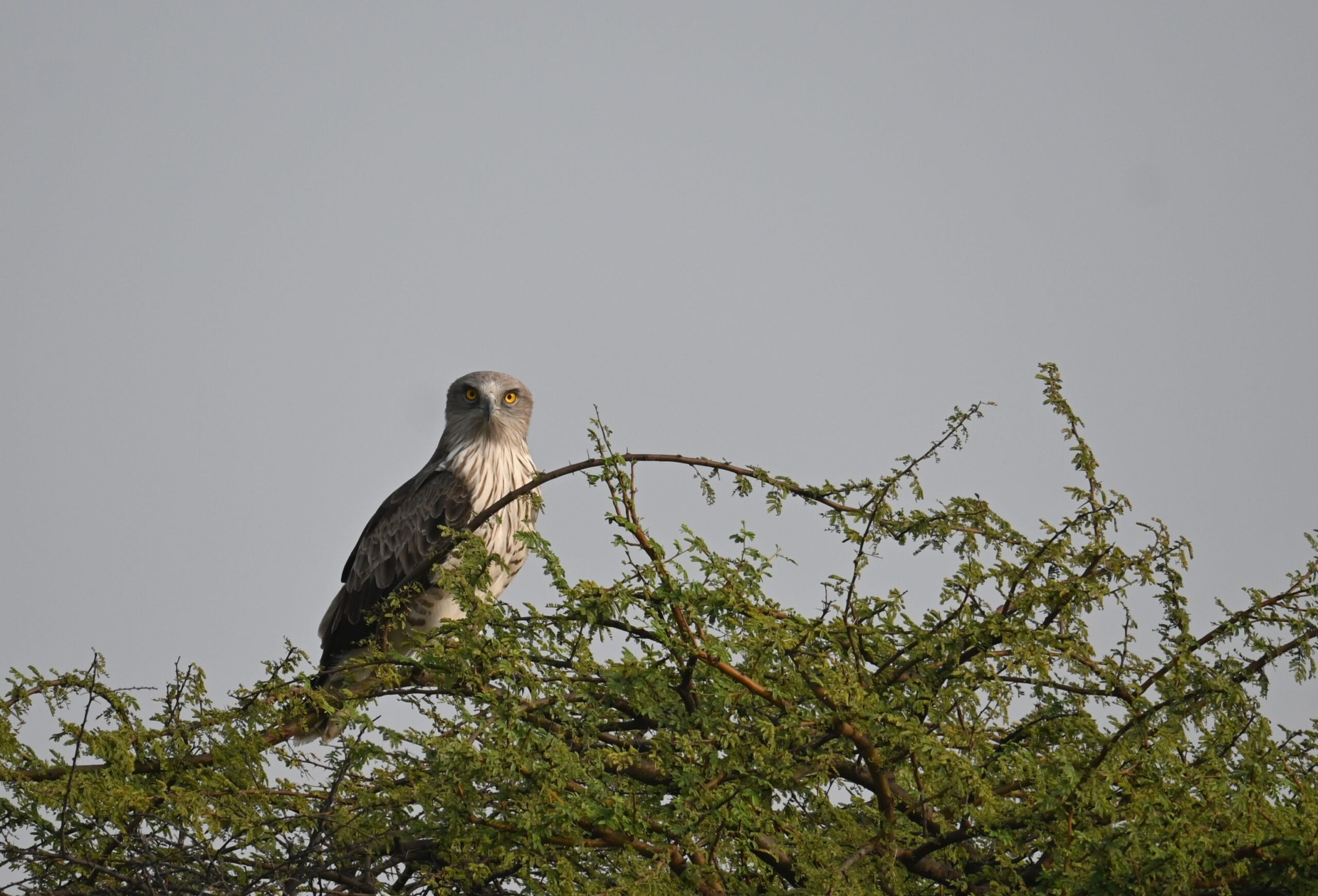
- Brilliant yellow eye: This is the single most striking feature at close range. The iris is a vivid, deep yellow that gives the bird an intensely alert expression.
- Pale underparts: The belly and underwing coverts are predominantly white, with a darker brown breast band of varying density. Immature birds tend to be more streaked below.
- Dark carpal patches: In flight, look for dark patches at the bend of the wing on the underwing — a reliable feature when looking up at the bird against the sky.
- Broad, rounded wings: The wings are wide and slightly rounded at the tips, giving a more buoyant flight style than many other large eagles.
- Short tail with fine barring: The tail appears relatively short compared to the wingspan, with subtle dark barring.
“That yellow eye is the giveaway — once you’ve seen it, you won’t confuse this eagle with anything else. It has the gaze of something ancient and unhurried.”
How to Distinguish from Similar Species
The Osprey shares the pale underpart and dark carpal patch pattern, but has a distinctive dark eyestripe, a more kinked wing shape in flight, and is almost exclusively found near water. The Short-toed Snake Eagle is more likely over open scrub. The Booted Eagle (pale morph) is much smaller. The Bonelli’s Eagle has a dark belly and different wing proportions. The Short-toed’s distinctive large head is the clincher at almost any distance.
Behaviour, Diet & Hunting Strategy
The Short-toed Snake Eagle is, as its name leaves little doubt, a specialist predator of reptiles. Snakes — including venomous species — constitute the vast majority of its diet. It also takes lizards, small mammals, and occasionally frogs. The ability to prey on venomous snakes is facilitated by thick, scale-like feathering on the legs and feet that provides protection from strikes, as well as exceptional visual acuity for detecting prey from height.
Hunting Behaviour
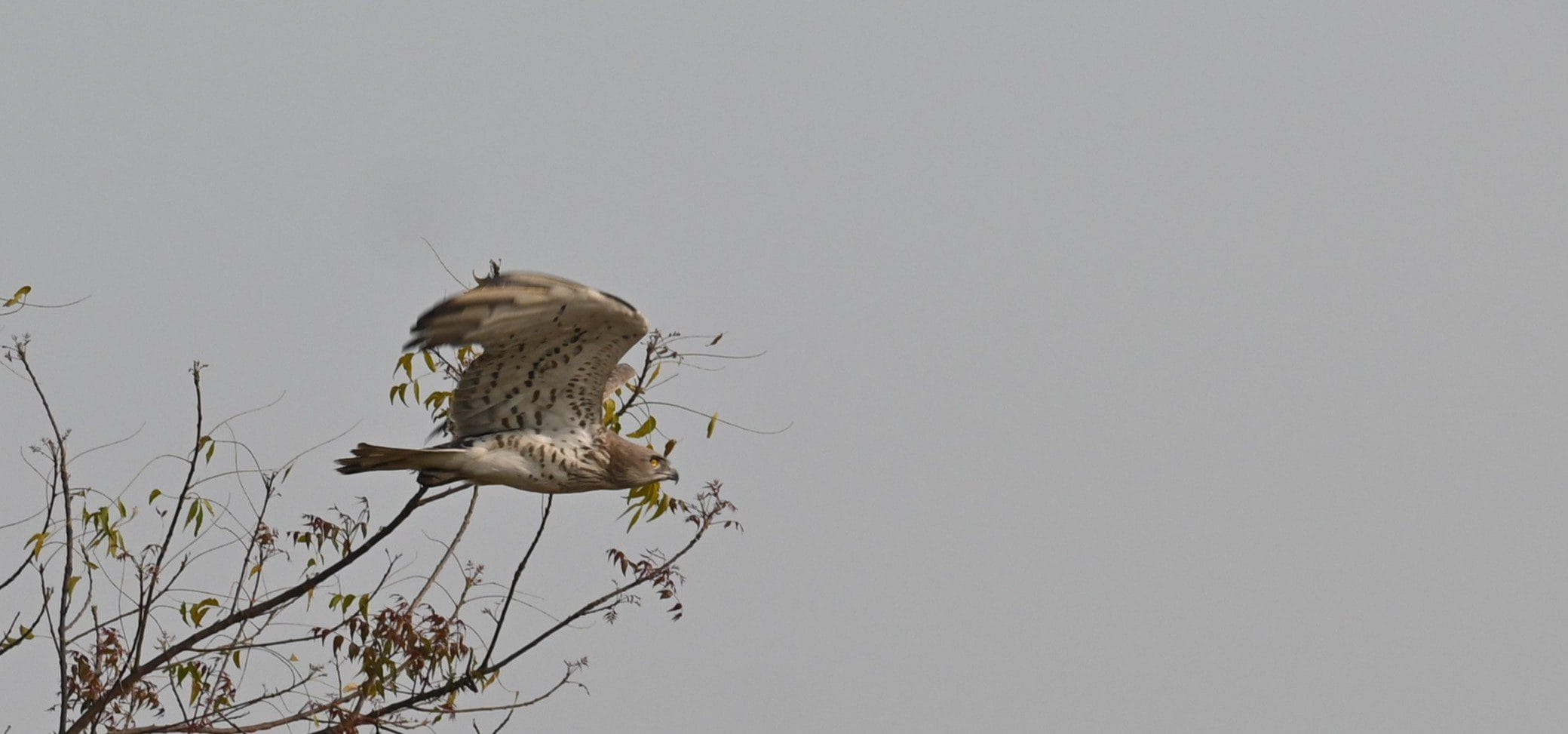
This eagle employs two primary hunting strategies that are both fascinating and highly photogenic. The first is quartering flight: the bird glides low and purposefully over open ground, scanning the substrate below, ready to stoop sharply when a snake or lizard is detected. The second, and more dramatic, is hovering: the eagle will hang in the wind, wings beating steadily and tail fanned, holding a near-stationary position above a promising patch of ground for extended periods before diving or moving on. This hovering behaviour is reminiscent of a large kestrel and produces outstanding photography opportunities.
Once prey is located, the strike is swift and powerful. The snake is typically seized behind the head to prevent a bite and carried back to a perch to be swallowed whole, often head-first, a process that can take several minutes with a large specimen.
Perching Behaviour
Between hunting bouts, Short-toed Snake Eagles favour elevated, exposed perches — the crown of a thorny acacia, a lone dead tree, a fence post or electrical pylon. They tend to remain stationary for long periods, making them relatively easy to observe once located. The bird is generally tolerant of slow-moving vehicles, making Bhigwan’s jeep-track network particularly productive for close observation.
Why Bhigwan is Perfect Habitat for the Short-toed Snake Eagle
The Bhigwan area sits within the semi-arid Deccan plateau, where the Ujani Dam has created a vast reservoir fringed by a mosaic of scrubland, dry deciduous forest fragments, and agricultural fields. This landscape is precisely the habitat mosaic that Short-toed Snake Eagles thrive in — open ground with sufficient reptile prey, tree cover for perching and roosting, and minimal human disturbance.
The Deccan plateau’s warm, dry winters are ideal for snakes to remain semi-active on sunny days, and the combination of basalt rock outcrops and agricultural margins supports a healthy herpetofauna — including rat snakes, keelbacks, and occasionally cobras — that sustains a resident or wintering eagle population reliably year after year.
The scrubby edges around the reservoir, particularly on the western and southern approaches to the backwaters, transition from wetland to agricultural land with scattered Acacia and Prosopis thickets. These ecotones are the sweet spot for raptor activity at Bhigwan and where Short-toed Snake Eagles are most regularly encountered.
Where to Spot the Short-toed Snake Eagle at Bhigwan
Bhigwan is roughly divided between the Diksal and Bhigwan villages, with the main birding action spread across several productive zones. For Short-toed Snake Eagles specifically, the following areas consistently produce sightings:
1. The Scrubland Margins Between Bhigwan and Diksal
The jeep tracks connecting the two villages pass through open scrubland and dry agricultural fields that are prime Short-toed habitat. Scan fence posts, dead trees, and the crowns of roadside acacias systematically. Morning hours (7:00–10:00 am) are most productive when birds are actively hunting.
2. The Western Bund Road
The elevated bund road offers excellent elevated vantage points over both the wetland and the drier scrub inland. Eagles regularly soar on thermals above this zone in late morning, and the bund’s trees serve as perch sites.
3. Agricultural Edges Near Kumbhargaon
The fields around Kumbhargaon, particularly after harvest when ground cover is low, are excellent hunting grounds. The elevated wires and lone trees here are favourite perches. This area can also yield Booted Eagles, Long-legged Buzzards, and occasionally Steppe Eagles — worth a slow scan.
4. The Open Scrub South of Bhigwan Village
The tracks heading south-east from Bhigwan village into open, stony terrain with scattered trees are perhaps the most reliable zone for hunting Short-toed Snake Eagles — the substrate here is ideal for reptiles and the open sightlines make the hovering behaviour easy to observe.
🦅 Quick Tips for Finding the Eagle
- Start early — the first two hours after sunrise are the most active hunting period
- Scan systematically: fence posts, dead trees, pylons, and bare upper branches first
- Watch for a large pale bird hanging in the wind over open ground — the hovering is distinctive
- Look at the size relative to common perched birds like crows and mynas for scale
- Overcast mornings often keep eagles perched and more approachable than bright sunny days
- Move slowly and stop the vehicle — engine noise and sudden movement flush birds quickly
Photography Tips for Flight and Perch Shots
The Short-toed Snake Eagle is one of the more achievable large raptor subjects for Indian wildlife photographers — it perches openly, tolerates vehicles reasonably well, and the pale underparts photograph cleanly against overcast skies. That said, like all raptors, it rewards preparation and patience.
Camera Settings for Flight Shots
- Shutter speed: Minimum 1/1600s for flight; push to 1/2000–1/3200s for sharp wing tips in active flapping sequences
- Aperture: f/5.6–f/7.1 to keep the full wingspan sharp without losing too much light
- ISO: Don’t be shy with ISO 800–1600 on overcast days — clean images matter more than noise purity
- AF mode: Continuous AF with subject tracking. On the Nikon Z50, the 3D tracking or Auto AF Area works well for birds against plain sky
- Burst mode: High-speed continuous — a single wing beat sequence can yield the decisive frame
Composition Considerations
The overcast flat light typical of Bhigwan winter mornings is actually an advantage for raptor photography — it eliminates harsh shadows and allows detail in both dark upper parts and pale underparts simultaneously. Expose to retain highlight detail in the white belly; the grey sky can slightly overexpose without harm. For perched birds, position the vehicle so the bird’s eye is caught by whatever directional light exists — that yellow iris, when it catches even soft light, transforms a good image into a great one.
For flight shots, tracking the bird before it takes off pays dividends. Watch the bird’s body language — a characteristic tensing of the body, a slight lean forward, and a glance downward often precede a take-off by 5–10 seconds. Being already on the bird, tracking it at the moment of launch, is the key to capturing the full wing-spread departure frame.
Best Time to Visit Bhigwan for Short-toed Snake Eagle
The Short-toed Snake Eagle is present at Bhigwan primarily as a winter visitor from October through March, with peak activity in the cooler months of November through February when migratory populations are at maximum numbers. Some individuals may be seen into early April as they begin moving north, though numbers thin considerably.
Within the day, the best observation windows are:
- Early morning (6:30–10:00 am): Active hunting; birds move between perches frequently, giving multiple flight opportunities
- Mid-morning (10:00 am–12:00 pm): As thermals develop, soaring behaviour increases — excellent for overhead flight photography
- Late afternoon (4:00–6:00 pm): A second, shorter activity window before roost; light quality also improves in the golden hour
Avoid visiting during and immediately after the monsoon (June–September) — the vegetation is dense and ground visibility for raptors is poor. The post-monsoon period from October onwards, as the land dries, coincides precisely with the arrival of wintering raptors.
Getting to Bhigwan
Bhigwan lies approximately 105 km south-east of Pune on the Solapur Highway (NH 65), making it comfortably accessible as a day trip or overnight excursion from Pune. The drive takes roughly 2–2.5 hours depending on traffic conditions.
- By road from Pune: Take NH 65 towards Solapur; exit at Indapur and follow signs to Bhigwan (approximately 15 km further)
- From Mumbai: Approximately 4–4.5 hours via Pune; best combined as a 2-day trip with overnight stay at Bhigwan
- Local transport: State buses operate from Pune to Indapur; auto-rickshaws and local jeep operators cover the final stretch
- Accommodation: Several homestays and modest lodges operate in Bhigwan village; booking in advance during peak birding season (November–January) is strongly advised
For serious wildlife photography, a hired jeep with a local naturalist guide is strongly recommended. Local guides know current raptor locations, can navigate the track network efficiently, and help in securing the best positions for approachable subjects.
Frequently Asked Questions
Is the Short-toed Snake Eagle common at Bhigwan?
Yes — it is a reliable winter visitor to the scrubland zones around the Ujani backwaters, typically present between October and March. Experienced local birders regard it as an expected species in the right habitat during this window.
How do I tell the Short-toed Snake Eagle from an Osprey?
The Short-toed Snake Eagle has a much larger, rounded head without the dark eye-stripe that gives Ospreys their “masked” look. Its underparts are more uniformly pale, and it is typically found over dry scrub rather than over open water. The bright yellow iris is a conclusive identifier at close range.
What is the best season to see raptors at Bhigwan?
October to February is the prime raptor season. Winter visitors including Short-toed Snake Eagle, Booted Eagle, Long-legged Buzzard, and Steppe Eagle are present alongside resident species such as White-eyed Buzzard and Black-shouldered Kite during this period.
Do I need a permit to bird at Bhigwan?
No special permit is required for birding along the roads and tracks around the Ujani backwaters. Hiring a local naturalist guide is strongly recommended for both access and locating species efficiently — and it supports the local birding community directly.
What camera gear do I need for raptor photography at Bhigwan?
A telephoto lens of at least 400mm equivalent is recommended; 500–600mm provides a real advantage for flight shots. A crop-sensor camera such as the Nikon Z50 (with its 1.5x multiplication factor) paired with a 200–500mm or 500mm prime is a highly capable combination. A vehicle-mounted beanbag is more effective than a tripod for tracking birds from a jeep.