
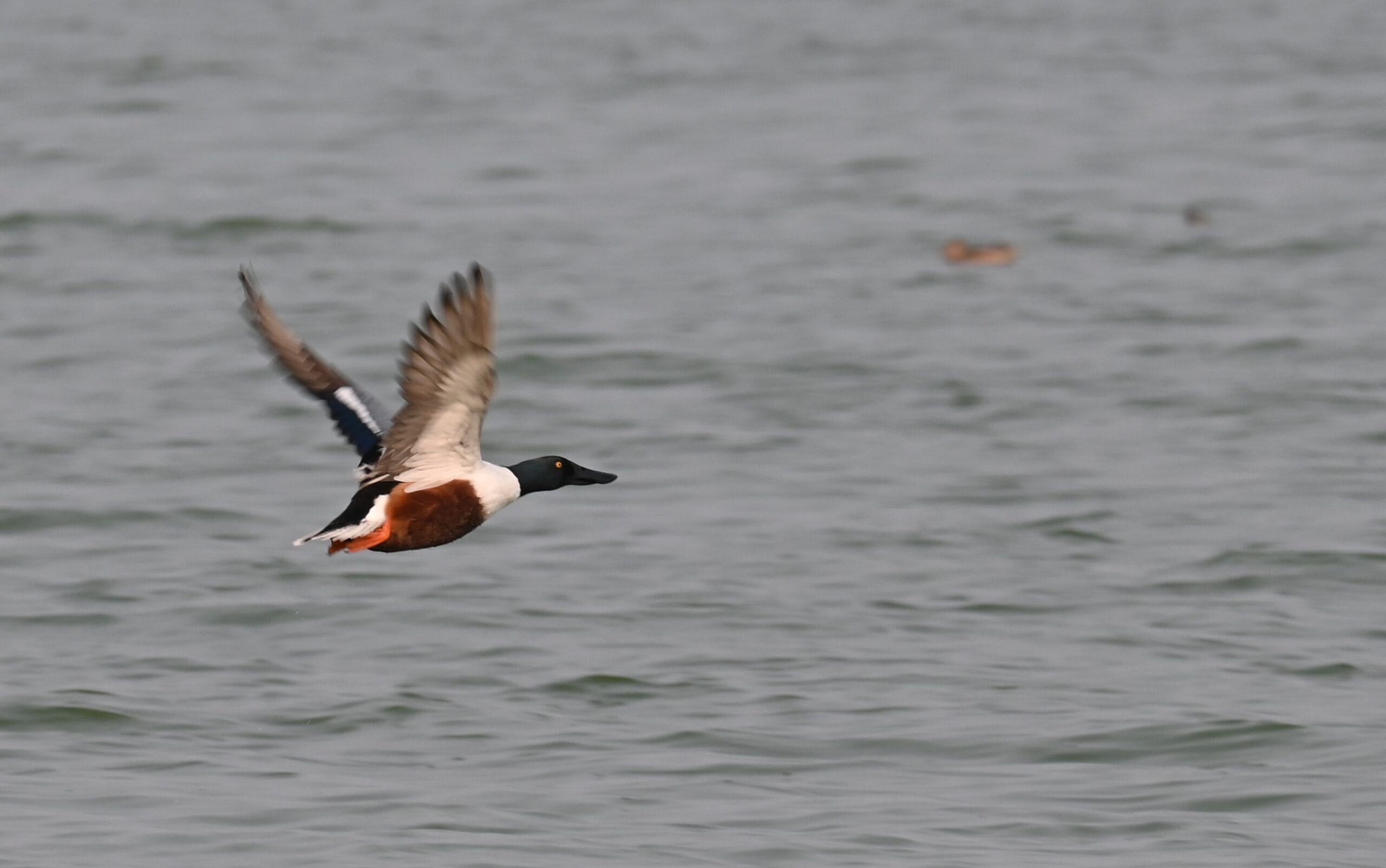
The boat had barely cleared the shore when I saw it — a flash of chestnut, white, and dark green breaking low over the steel-grey water of Ujani Dam. One beat of the wings, then a smooth glide. Then another. The light was still soft, the mist still sitting on the far bank, and right in the middle of it all was a Northern Shoveler male in full breeding plumage, flying directly into my frame.
I pressed the shutter. The Nikon Z50 locked on. And I got the shot.
If you have been to Bhigwan Bird Sanctuary in winter, you know the Northern Shoveler is one of the faces of this place. It is everywhere — on the open water, in the shallows, wheeling overhead in small groups. And yet, despite its abundance, most birders have never properly photographed one in flight. That image — the full plumage, the spatulate bill in profile, the wing pattern frozen mid-beat — is one of Bhigwan’s most accessible and most beautiful photographic trophies.
This is my field journal entry for the Northern Shoveler at Bhigwan. Everything I know from my Ujani backwater sessions, condensed for anyone planning a birding visit.
| Common Name | Northern Shoveler |
| Scientific Name | Anas clypeata |
| Family | Anatidae (Dabbling Ducks) |
| Status at Bhigwan | Abundant winter visitor (Oct–Mar) |
| IUCN Red List | Least Concern |
| Best Spot | Ujani Dam backwaters, Kadbanwadi |
| Peak Season | December – February |
| Photography Difficulty | ⭐⭐ Easy to moderate |
Identifying the Northern Shoveler: What to Look For
The Northern Shoveler is a medium-to-large dabbling duck — roughly 44 to 52 cm in length — and the adult male in breeding plumage is one of the most visually striking waterfowl at any Indian wetland. Here are the field marks to lock in before your first Bhigwan boat ride.
Male Breeding Plumage (October–March)
- Head: Iridescent dark green to black, appearing almost ink-dark in flat light but flashing emerald in good sun. The orange-yellow iris is a standout field mark even at distance.
- Breast: Bright, clean white — a sharp contrast between the dark head and the rufous body below.
- Flanks & belly: Rich chestnut-rufous, warm and saturated. This three-tone pattern of dark head, white chest, and rusty flanks is visible from 100 metres.
- Bill: The signature feature — a broad, spatula-shaped bill, longer and wider at the tip than the base. Dark grey-black in colour. Even in silhouette, a shoveler’s bill shape is enough for a confident ID.
- Wings in flight: Pale blue-grey forewing, a white border, and a green speculum (secondary feathers) — the wing pattern you are trying to freeze in a photograph.
Female and Eclipse Male
Females are streaked brown — similar to many dabbling ducks — but the large spatulate bill immediately separates them from Mallard or Gadwall. Eclipse males resemble females but retain the blue wing panel. By October, most males visiting Bhigwan are already transitioning to full breeding plumage.
Behaviour in the Field
Shovelers feed by skimming the water surface with that remarkable bill, lined with fine lamellae that strain out invertebrates, seeds, and plant matter. Watch for the characteristic head-down, bill-forward posture as they swim in tight spinning groups — a feeding behaviour called rotating or whirling, where flocks circle together to bring food-rich water to the surface. It is one of the more hypnotic spectacles on the Ujani backwaters and worth photographing in its own right.
Photographing the Northern Shoveler at Bhigwan: My Field Notes
We had three primary zones to cover: the open Ujani Dam backwaters by boat, the Kadbanwadi Grasslands on the western edge, and the Shirsufal area near Baramati. The Northern Shoveler was present in all three zones, but the boat section on the backwaters — departing just after first light at 6:30 AM — gave the best flight photography opportunities.
The birds were not particularly shy. As the boat drifted, small groups would lift off the water ahead of us, fly a short arc, and settle again about 100 metres further on. That flight arc, with the morning light behind us, was the window I was waiting for.
Best Spots for Shoveler Photography at Bhigwan
- Ujani Dam backwaters (boat section): The primary zone. Flocks of hundreds of shovelers resting, feeding, and flying. Boat access gives you eye-level angles impossible from shore.
- Kadbanwadi Grasslands: Smaller pools and water channels attract feeding shovelers, often mixed with Garganey, Common Teal, and Pintail.
- Shirsufal near Baramati: A quieter, less-visited section. Often less disturbed, allowing a closer approach for behavioural shots.
Camera Settings for Northern Shoveler Photography at Bhigwan
I shoot on a Nikon Z50 with the adapted AF-P 70-300mm f/4.5-6.3 VR. Here is what works for duck photography on the water and in flight at Bhigwan:
In-Flight Shots
- Mode: Shutter Priority (S) or Manual
- Shutter Speed: 1/1600s minimum; 1/2000s preferred to fully freeze wingbeats
- ISO: Auto ISO, max 3200 — early morning light at Bhigwan is soft and demands latitude
- Aperture: f/5.6 to f/8 for depth of field on erratic flight paths
- AF Mode: AF-C with Wide-area or Subject Tracking — the Z50’s animal detection AF is highly effective for low-flying waterfowl
- Drive Mode: High-speed burst — shoot sequences, not single frames
- Metering: Matrix; apply +0.3 to +0.7 EV compensation when birds fly against open water background
On-Water / Behavioural Shots
- Shutter Speed: 1/500s to 1/800s is sufficient for swimming birds
- Focus: Single point AF on the eye — the orange iris of the male is a visually striking focal point
- Composition: Leave space in the direction of travel; for the whirling feeding behaviour, use a slightly wider frame to capture the group dynamic
When to Visit Bhigwan for Northern Shoveler: Seasonal Guide
The Northern Shoveler is a Palearctic migrant — it breeds across Europe and Central Asia, and winters in India, the Middle East, and North Africa. At Bhigwan, first arrivals typically appear in October, numbers build through November, and the peak — when flocks are largest and plumage is most vivid — runs from December through February.
| Month | Shoveler Status at Bhigwan | Photography Quality |
|---|---|---|
| October | First arrivals; small flocks | ⭐⭐⭐ Good |
| November | Numbers building; mixed plumage | ⭐⭐⭐⭐ Very Good |
| December | Peak numbers; full breeding plumage | ⭐⭐⭐⭐⭐ Excellent |
| January | Peak — best time overall | ⭐⭐⭐⭐⭐ Excellent |
| February | Still excellent; flocks starting to thin | ⭐⭐⭐⭐⭐ Excellent |
| March | Departing; reduced numbers | ⭐⭐⭐ Good |
| April – September | Absent — breeding in Palearctic | — |
How to Plan Your Bhigwan Birding Trip
Getting to Bhigwan
- From Pune: ~110 km, approximately 2 to 2.5 hours via NH65 towards Solapur. Most birding tours depart Pune by 4:00–4:30 AM to reach the water at first light.
- From Mumbai: ~280 km, approximately 4.5 to 5 hours via Pune Expressway + NH65. An overnight stay near Bhigwan is recommended for Mumbai visitors.
- Nearest town: Bhigwan village, Indapur Taluka, Pune District — centred around Ujani Dam on the Bhima River.
Guided Tours
For anyone visiting Bhigwan for the first time — especially for boat access on the Ujani backwaters — a guided tour handles all logistics and positions you for the best light angles.
The easiest way to arrange a reliable guided birding day trip to Bhigwan from Pune — boat access on the Ujani backwaters, naturalist guide, and all logistics handled:
Browse Bhigwan Birding Tours on Viator →Disclosure: This is an affiliate link. If you book through it, I earn a small commission at no extra cost to you — it helps keep TravelOnTales running.
Where to Stay Near Bhigwan
Agnipankh Guesthouse in Bhigwan is the go-to accommodation for birding photographers — basic but clean, run by people who understand birder schedules. Rooms fill up fast in January, so book at least 4–6 weeks in advance for peak season.
What to Carry
- Binoculars — 8×42 or 10×42 minimum
- Telephoto lens 300mm+ for meaningful photography from a boat
- Extra SD cards and batteries — cold mornings drain batteries faster
- Light windbreaker — early morning on the water is colder than expected, even in December
Conservation Status and the Importance of Bhigwan for Migratory Waterfowl
The Northern Shoveler is currently listed as Least Concern on the IUCN Red List. However, its presence at Bhigwan is entirely dependent on the health of the Ujani reservoir ecosystem and the maintenance of the backwater habitat around it.
Bhigwan’s designation as an Important Bird Area (IBA) by BirdLife International reflects its significance as a wintering site for thousands of Palearctic migrants each year. Responsible tourism — boat speed regulations, no-entry buffer zones during peak roosting hours, and controlled visitor numbers — is essential to maintaining this sanctuary for future winters. Choosing a guided tour with an experienced naturalist is one of the best ways to ensure your visit stays within responsible boundaries.
Final Thoughts: Why the Northern Shoveler Deserves Your Full Attention
Look at that combination of colours: the jet-dark head, the electric orange eye, the blazing white breast against the warm rufous body, all of it suspended over water in a single wingbeat.
Common does not mean ordinary. The Northern Shoveler in full breeding plumage, photographed well, is genuinely one of the most beautiful birds you will ever put in a frame. Bhigwan gives you hundreds of opportunities to do exactly that — if you pay attention, and if you go at the right time of day.
That first light boat session. That is the window. Do not waste it sleeping in.
Have you photographed Northern Shovelers at Bhigwan or any other Indian wetland? Share your experience in the comments below — I read every one.
If you found this guide useful, consider sharing it with your birding group. It helps more people find Bhigwan, and it helps keep TravelOnTales going.
Frequently Asked Questions: Northern Shoveler at Bhigwan
Is the Northern Shoveler found at Bhigwan Bird Sanctuary?
Yes. The Northern Shoveler (Anas clypeata) is one of the most abundant winter ducks at Bhigwan, arriving in large numbers from October through March at the Ujani Dam backwaters on the Bhima River, Maharashtra.
How do I identify a Northern Shoveler male in breeding plumage?
The breeding male has a dark iridescent green-black head with a striking orange-yellow iris, a bright white breast, rich chestnut-rufous flanks and belly, and the distinctive broad spatulate bill. In flight, the pale blue-grey forewing and green speculum separated by a white stripe are key field marks.
What is the best time to photograph Northern Shovelers at Bhigwan?
Early morning from 6:30 AM to 9:00 AM gives the best light. December to February is peak season when flocks are largest and plumage is most vivid.
What camera settings should I use for duck photography at Bhigwan?
Use AF-C (Continuous AF), shutter speed 1/1600s or faster for flight shots, auto ISO up to 3200, and high-speed burst mode. The Nikon Z50’s animal detection AF works very well for waterbirds from a boat.
How do I reach Bhigwan from Pune or Mumbai?
Bhigwan is about 110 km from Pune (2–2.5 hrs) and 280 km from Mumbai (4.5–5 hrs). The sanctuary is centred on Ujani Dam on the Bhima River near Baramati, Solapur district.
Can I book a guided birding tour to Bhigwan?
Yes — guided birding day tours are available via Viator, with options departing from Pune covering the Ujani Dam backwaters by boat and Kadbanwadi Grasslands.
Where can I stay near Bhigwan?
Agnipankh Guesthouse in Bhigwan is the most popular birder accommodation. Book at least 4–6 weeks in advance for peak season (December–February).