
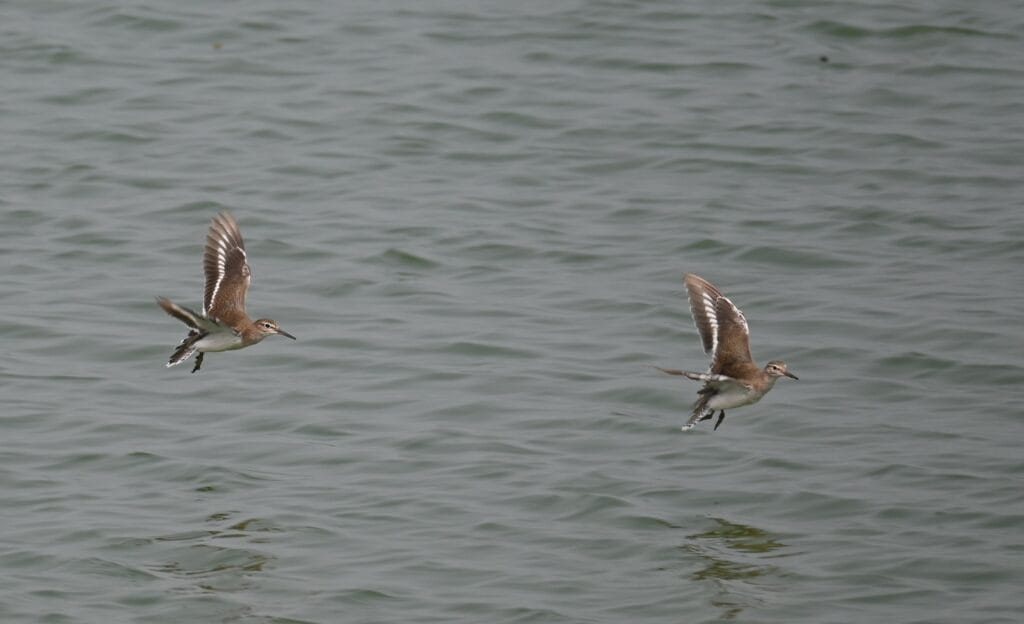
At Bhigwan bird sanctuary (Ujani Dam, Pune district, Maharashtra), you will almost certainly see Common Sandpipers. They are one of those quietly reliable winter visitors that birders sometimes overlook in the excitement of flamingos, raptors, and herons — but once you really watch them, they are endlessly photogenic and behaviourally fascinating. This field guide covers everything: identification, habits, where to find them at Bhigwan, photography tips, and how to plan your birding trip.
| Scientific name | Actitis hypoleucos |
| Family | Scolopacidae (Sandpipers & Snipes) |
| Size | 18–20 cm length · 32–35 cm wingspan |
| Weight | 30–90 g |
| Status at Bhigwan | Winter visitor (October – March) |
| IUCN status | Least Concern |
| Local name (India) | Chaha (Hindi); Nadi Tilav (Marathi) |
| Best location | Ujani Dam shoreline, Kadbanwadi Grasslands edge |
| Ease of sighting | ★★★★☆ (common, reliable) |
What Is the Common Sandpiper? An Introduction to Actitis hypoleucos
The Common Sandpiper (Actitis hypoleucos) is a small Palearctic wader belonging to the sandpiper family Scolopacidae. The genus name Actitis comes from the Ancient Greek word aktites, meaning “coast-dweller.” The species epithet hypoleucos is equally descriptive — from the Greek hupo (beneath) and leukos (white) — a neat summary of its most obvious field mark: a clean white belly.
The Common Sandpiper breeds across most of temperate and subtropical Europe and Asia, and migrates to Africa, southern Asia, and Australasia for the northern winter. In the Indian subcontinent, it is a widespread and extremely common winter visitor, arriving from October onward and departing by April. For Indian birders, it is one of the most reliably encountered shorebirds at virtually every freshwater wetland — including the backwaters of Ujani Dam at Bhigwan.
Field Identification: How to Recognise a Common Sandpiper
Sandpiper identification can seem daunting to beginners, but the Common Sandpiper has a set of signatures that make it one of the more straightforward species once you know what to look for.
Shape and Size
It is a small bicolored sandpiper with a rather long body and short legs. When at rest, the long tail projects well beyond the tips of the wings — a useful structural clue that distinguishes it from similar species. At 18–20 cm, it is similar in bulk to a Common Myna but far more slender.
Plumage
The Common Sandpiper has a brown upperside with a distinctive white underside. Its back and wings show a mottled brown pattern, while the breast carries fine brown streaks. A prominent white spur at the shoulder — where the white of the belly extends up and forward between the folded wing and the breast band — is the single most useful field mark for separating it from the bulkier, rounder-headed Green Sandpiper.
Behaviour in Flight — the Clincher
If you are even slightly uncertain about a perched bird, watch it take off. When disturbed, the Common Sandpiper flies low over water with a distinctive down-curved, flicking wing action. No other common Indian wader moves quite like this — it looks almost mechanical, as though the wings are hinged at a point two-thirds of the way out. Paired with the rapid tee-tee-tee alarm call, it is unmistakable.
The Bob and Teeter
On the ground, the Common Sandpiper is never still. It frequently bobs its tail in a distinctively wagtail-like manner — a constant, compulsive rocking motion that has earned it the affectionate nickname “Bob” among some birders. When feeding, it pauses to bob its head and teeter, scanning the substrate before each lunge. I have spent long minutes at the Ujani Dam edge just watching this behaviour, entirely without binoculars.
Common Sandpiper at Bhigwan: Where and When to See Them
The Bhigwan Context
Bhigwan (sometimes spelled Bhigwan or referred to as Ujani Bird Sanctuary) sits about 100 km southeast of Pune along the backwaters of the Ujani Dam on the Bhima River. In winter, the receding water level exposes vast mudflats, rocky banks, and grassy edges that make it one of Maharashtra’s most productive wetland birding destinations — and a textbook Common Sandpiper habitat.
Best Locations at Bhigwan
Common Sandpipers are most reliably seen along the rocky and muddy margins of the dam backwaters, particularly around the Kadbanwadi Grasslands area where the land transitions from grassland to shoreline. I have also found them regularly on the stone revetments and boat-landing areas near Shirsufal village. Anywhere the shoreline has a mix of exposed rock, wet mud, and shallow water is prime habitat. They are almost always present as singles or loose pairs rather than flocks — the photograph above, with two birds in synchronized flight, is already a memorable encounter.
Season and Timing
At Bhigwan, Common Sandpipers are present as winter visitors from October through March, with peak numbers typically in November and February. They are one of the first waders to arrive and one of the last to leave as water levels rise in April.
Ecology and Behaviour: What the Common Sandpiper Is Actually Doing
Feeding
Common Sandpipers spend their days feeding on the edges of freshwater ponds, lakes, rivers, and streams, using their long bill to search for insects like earwigs, butterflies, spiders, snails, and worms. At Bhigwan, they are typically seen dashing along the waterline, probing wet mud and flipping over small stones in a methodical, purposeful way. The constant tail-bob appears to serve a sensory or camouflage function — the jury is still out scientifically, but it is a distinctive and endearing behaviour regardless.
Migration
Each year the Common Sandpiper flies thousands of miles between its breeding grounds in northern Europe and Asia and its winter home in the southern regions of Africa, India, eastern Asia, and the southern Pacific. The birds at Bhigwan in December have almost certainly bred somewhere in central Asia, the Himalayas, or further north, and have tracked river systems south along the Indian subcontinent’s major flyways. They are part of the Central Asian Flyway, one of the great migration corridors that passes through Maharashtra’s wetlands.
Nesting and Breeding (Away from India)
Common Sandpipers typically nest near water in concealed locations, laying four speckled eggs that both parents incubate. The chicks are precocial, leaving the nest shortly after hatching and remaining with their parents until they are ready to fly. In the wild, they can live up to 8–14 years — impressive longevity for a small shorebird that makes such enormous annual journeys.
Conservation Status
The global population of the Common Sandpiper is estimated at 2.6 to 3.2 million individual birds. The species is widespread and common, and is therefore classified as a species of Least Concern on the IUCN Red List. However, habitat alteration, climate change, and human disturbance to wetland edges all remain real pressures. Responsible birding — keeping noise down, staying on paths, not disturbing roosting birds — makes a difference even for common species.
Photography Guide: Getting That Perfect Common Sandpiper Shot
I shoot all my Bhigwan wildlife with a Nikon Z50 and a 200–500mm telephoto lens. The Common Sandpiper is simultaneously one of the most accessible shorebirds (it tolerates moderate approach distances, especially from a boat) and one of the most technically demanding to photograph well — it is always moving, often in low-contrast shoreline light.
Equipment and Settings
- Shutter speed: Minimum 1/1600s for birds in flight; 1/800s works for bobbing birds on the ground.
- Aperture: f/6.3 to f/8 for sharp depth-of-field on small moving targets.
- ISO: Don’t be afraid of ISO 1600–3200 in early morning. Clean noise beats motion blur.
- Focus mode: Continuous AF (AF-C on Nikon). Enable subject tracking if your body supports it.
- Burst mode: Use high-speed burst and pick the sharpest frame post-shoot.
Composition Tips
- Get low — boat-level or prone on the bank gives far more compelling perspective than shooting down.
- Wait for the bird to face the light, not the shadow. Golden hour at Bhigwan produces extraordinary warm tones on these brown birds.
- The flight shot (as above) is the prize. Position yourself where birds are likely to flush — near the boat ghat where movement disturbs them — and pre-focus on the water surface at the expected flight path.
- The reflection in the water surface adds a professional touch. Ujani’s flat, calm early-morning surface is perfect for this.
How to Plan Your Bhigwan Birding Trip: Complete Practical Guide
Getting to Bhigwan
Bhigwan is approximately 100 km from Pune and 250 km from Mumbai. From Pune, take the Solapur highway (NH65) and turn off at Baramati, following signs toward Bhigwan / Ujani Dam. The drive from Pune is around 2–2.5 hours. From Mumbai, budget 4–5 hours via the Expressway to Pune, then onward.
Best Time to Visit for Common Sandpipers (and All Bhigwan Birding)
- October–November: First arrivals; water levels still relatively high. Good for flamingos and early migrants.
- December–January: Peak season. Maximum species diversity, lower water = more exposed shoreline. Best for Common Sandpiper photography.
- February–March: Pre-departure activity; birds in transitional plumage. Fewer tourists.
Similar Species: Avoiding Confusion at Bhigwan
Several sandpipers and waders at Bhigwan could briefly be confused with the Common Sandpiper, especially in flight. Here is a quick comparison:
| Species | Key difference from Common Sandpiper | Status at Bhigwan |
|---|---|---|
| Green Sandpiper | Bulkier, rounder head, no white shoulder spur, white rump visible in flight | Common winter visitor |
| Wood Sandpiper | Taller, longer neck and legs, spotted upperparts, yellowish legs | Common winter visitor |
| Little Ringed Plover | No wing-bob, different head pattern, yellow eye-ring, runs rather than wades | Common winter visitor |
| Spotted Sandpiper | American sister species; spotted in breeding plumage; very rare vagrant in India | Vagrant, extremely rare |
My Field Notes: A Morning with Common Sandpipers on the Ujani Backwaters
The photograph at the top of this article was taken at around 7:45 AM on a January morning, from Abhishek’s boat approximately 30 metres from the eastern shoreline of the dam backwaters near Kadbanwadi. The water was flat calm — the kind of glass-surface stillness you only get before the breeze picks up at Bhigwan. I had been shooting Painted Storks roosting in the far tree line and had lowered my lens for a moment when the pair of Common Sandpipers broke from the muddy bank directly ahead.
What strikes me most in the image, looking at it now, is the absolute synchrony — the two birds are at almost identical wingbeat phases, as though they had agreed on timing. That pair-bond flight behaviour, low over the backwater surface with both birds angled steeply upward in the frame, is something I had never managed to capture cleanly before. The Nikon Z50’s subject tracking locked onto the nearest bird’s eye almost immediately, which made the difference.
On that same morning, I counted at least seven individual Common Sandpipers working a 200-metre stretch of shoreline — which, for a largely solitary species, was an unusually high density. It speaks to how productive the Ujani mudflats are as a wintering ground for this species.
Frequently Asked Questions: Common Sandpiper at Bhigwan
Is the Common Sandpiper found at Bhigwan year-round?
No. The Common Sandpiper is a winter visitor at Bhigwan, present from approximately October to March. It breeds in Eurasia during the northern summer and migrates to the Indian subcontinent for the winter. A handful of non-breeding individuals may occasionally linger into April, but the species is not resident at Ujani Dam.
How do I tell a Common Sandpiper apart from a Green Sandpiper at Bhigwan?
The two most reliable differences are: (1) the white shoulder spur on the Common Sandpiper — a white notch pushing up between the folded wing and the breast — which is absent on the Green Sandpiper; and (2) flight pattern — the Common Sandpiper’s low, stiff-winged flickering flight over the water is immediately distinctive. The Green Sandpiper flushes more vertically and shows a bright white rump in flight.
What is the best time to visit Bhigwan to see shorebirds including Common Sandpipers?
December and January are generally the best months. Water levels are at their lowest, exposing the maximum area of mudflat and rocky shoreline — the habitats that shorebirds like the Common Sandpiper prefer. Early mornings (arriving at the dam by 6:30–7:00 AM) yield the most activity and the best light for photography.
Do Common Sandpipers bob their tail all the time?
Almost, yes. The continuous bobbing or teetering motion — rocking the rear of the body and tail up and down — is a near-constant behaviour in the Common Sandpiper, and it is one of the most reliable identification features. It slows or stops briefly when the bird is alert to a threat, or during active feeding lunges, but resumes almost immediately.
Can I photograph Common Sandpipers in flight at Bhigwan?
Yes, and the flight shot is highly rewarding. Position yourself on a boat or low on the bank near active shoreline areas. The birds flush predictably when a boat moves slowly along the bank, flying low across the water surface. Use continuous autofocus, a shutter speed of at least 1/1600s, and burst mode. The white wingbar and down-curved wingbeat are clearly visible in flight images and make for striking photographs.