
Bhigwan Bird Sanctuary · Species Field Notes
The Osprey
of Ujani
India’s winter raptor that flies thousands of kilometres — and arrives at Bhigwan to do one thing with absolute, mechanical perfection.
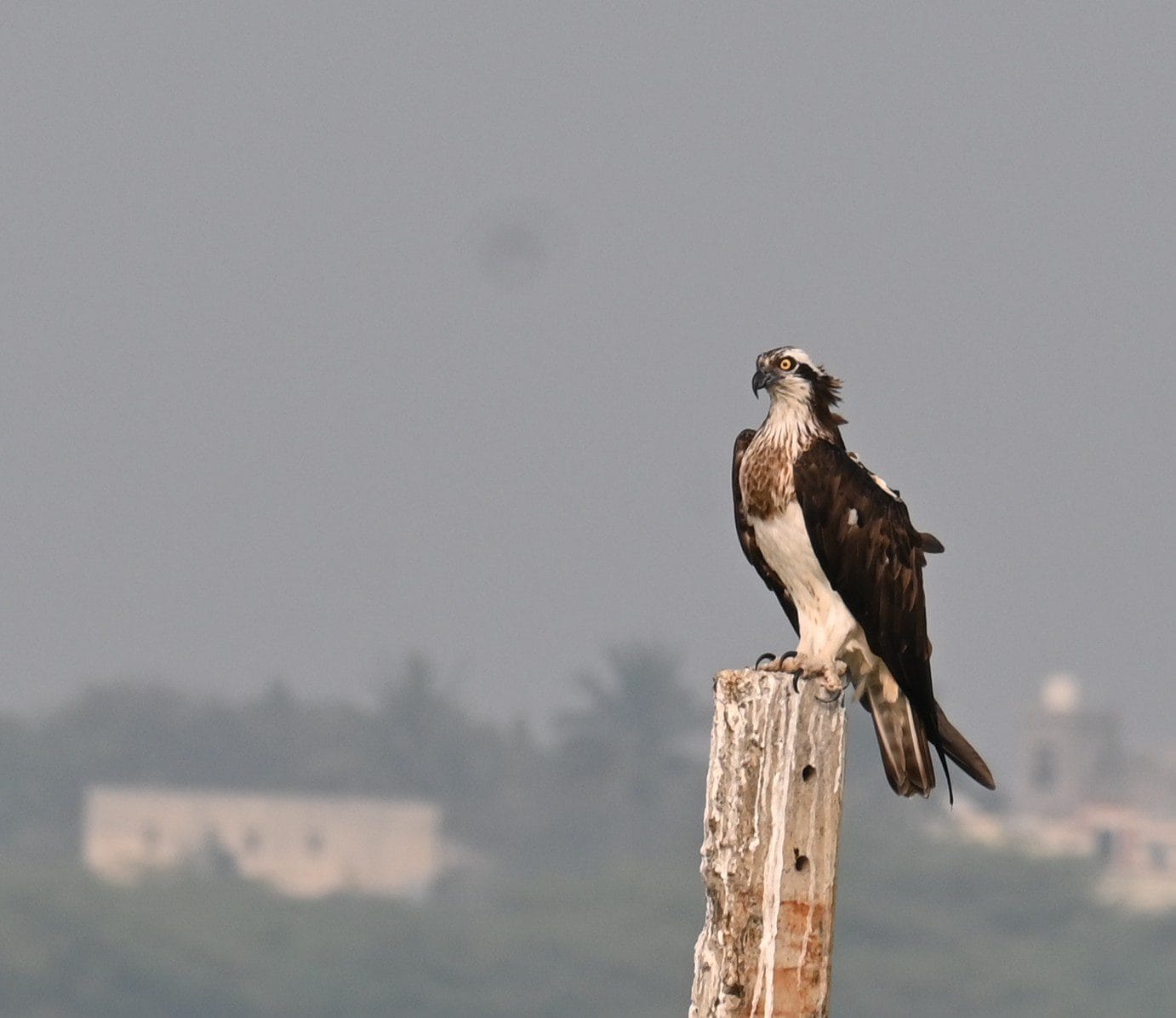
The hunter holds its post. Ujani backwaters, Bhigwan. Nikon Z50.
There is a bird at Bhigwan that most people miss. Unlike the flamingos, it does not gather in the thousands. Unlike the painted stork, it does not glide in slow arcs across the sky. Instead, it sits — alone, on a broken post above open water — and waits with the kind of stillness that belongs only to things that have nothing to prove.
The Osprey. Pandion haliaetus. The fish hawk of Ujani.
Every winter, one of the world’s most precisely engineered predators flies down from its Eurasian breeding grounds and settles along these Maharashtra backwaters. It has been doing this long before there were boat safaris, before there were birders with cameras, before there was a name for this particular stretch of water. The instinct is that old, that reliable.
And when it dives — which it will, if you stay patient, if you stay quiet — you will understand immediately why virtually every field guide, every ornithologist, and every wildlife photographer who has watched one calls it something close to perfect.
The Only Bird in Its Family
The Osprey is so singular that science gave it a family of its own. Pandionidae. One genus. One species. No closest relatives. While eagles, hawks, kites, and harriers all share the family Accipitridae, the Osprey branched off into its own taxonomic room and shut the door.
Notably, that isolation is not coincidence — it reflects how radically different the Osprey is from every other bird of prey. While other raptors eat fish opportunistically, the Osprey made fish its entire identity and then spent millions of years building a body perfectly suited to that single decision.
The subspecies seen at Bhigwan — Pandion haliaetus haliaetus, the Eurasian Osprey — breeds across the Palearctic from Scandinavia to Kamchatka, then migrates south each autumn. As a result, India receives them as winter visitors. The birds here are long-haul travelers that may have crossed Central Asia before settling on this particular arm of the Ujani reservoir. They choose their wintering waters carefully: shallow, open, fish-rich, with clear sightlines and unobstructed perches above the surface.
Bhigwan qualifies on every count.
The Osprey didn’t just adapt to catch fish. It redesigned itself from the feet up — until nothing about its body makes sense for anything else. — Field observation, Ujani backwaters
Six Adaptations That Explain Everything
Every part of the Osprey exists in direct service of one act: hitting water at speed and returning with a fish. Consequently, understanding the anatomy is understanding why the dive looks the way it does.
- Reversible Outer Toe Most raptors carry three toes forward, one back. The Osprey rotates its outer toe to two-and-two — gripping each side of a fish like opposing clamps. Fish are designed to slip. This solves that.
- Spicule Foot Pads Short, sharp spines cover the underside of each toe pad. Where other birds grip, the Osprey locks. A thrashing fish has almost no exit once those feet close.
- Closable Nostrils Physical nasal valves seal on water impact. The Osprey hits the surface feet-first at speed — without this, every dive would flood the airways. Evolution built a seal.
- UV-Range Vision Fish scales fluoresce in ultraviolet light. The Osprey’s eyes detect this spectrum, allowing it to locate fish through the optical distortion of a water surface that confounds every other predator.
- Dense Oily Plumage Water-resistant feathers prevent saturation during the dive. The bird re-emerges and is airborne within seconds. Waterlogged wings are the difference between predator and casualty.
- Mid-Air Fish Rotation Rising from a dive, the Osprey rotates the fish in its grip — head forward, body aligned — to reduce aerodynamic drag in flight. This happens every time. It is not instinct. It is engineering.
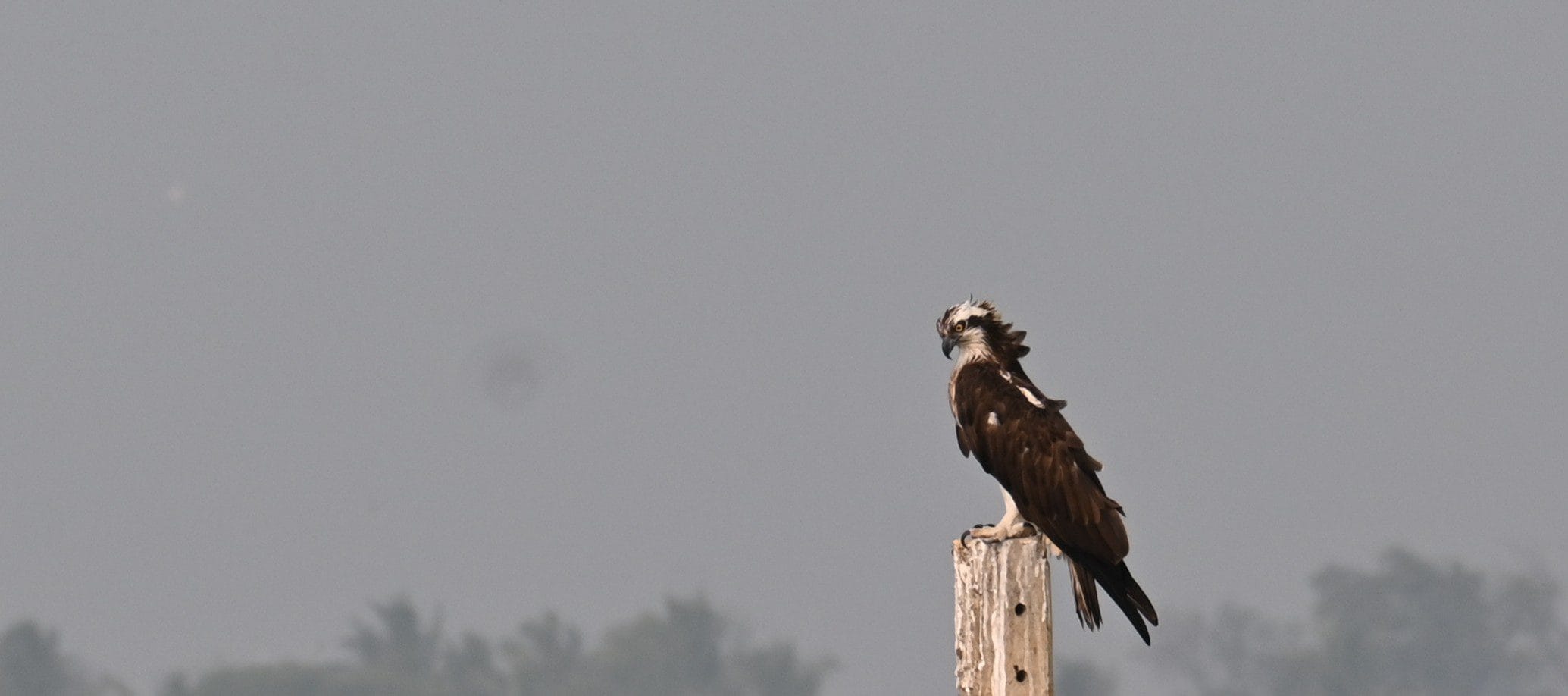
The Dive — What Actually Happens
You will wait for it. That is not a warning — it is, in fact, part of what makes it worth waiting for.
The Osprey hunts with a rhythm that belongs to a different pace of time than the boat, the water, or the morning around you. It perches. Minutes pass in silence. Nothing moves, and the bird ignores everything that isn’t a fish within striking range. You begin to wonder if today is the day it simply doesn’t. And then — almost without announcement — the sequence begins.
The Five Phases — In Real Time
Phase 01 — The Weight Shift
The bird’s posture changes almost imperceptibly — a slight forward lean, weight shifting toward the feet. The head drops a fraction, and immediately the grip on the post tightens. If you are watching the body and not the head, you will miss this. This is the only warning.
Phase 02 — The Hover
The Osprey lifts off and locks itself in position above the water — wings beating in a shallow, measured arc, body angled into the wind, head absolutely still. At this point, it is not searching anymore. It has already found the fish. This is pure calculation, not hesitation.
Phase 03 — The Drop
The wings fold and the bird falls, feet leading, straight into the surface. It hits at speed. The water erupts, and for one second the bird is gone — fully submerged. You are left with a circle of white water and silence.
Phase 04 — The Rise
The Osprey emerges — wet, heavy, wings working hard against the combined weight of water and fish. Even so, the feet are locked and the fish is already being rotated. By the time the bird clears two metres above the surface, the fish sits head-forward, drag minimised, grip absolute.
Phase 05 — The Return
Back to the post. Methodical. No ceremony. The bird begins eating efficiently, without pause — and within minutes is already scanning the water again. The transaction is complete. The next one has already begun.
In total, the entire sequence from first lift-off to landing with the fish runs under four minutes. The dive itself is three seconds. You will spend the rest of the morning replaying it.
Watch the Osprey dive from a guided boat on the Ujani backwaters.
Bhigwan bird sanctuary · Oct – Mar season · Dawn departuresWhen and Where to See It at Bhigwan
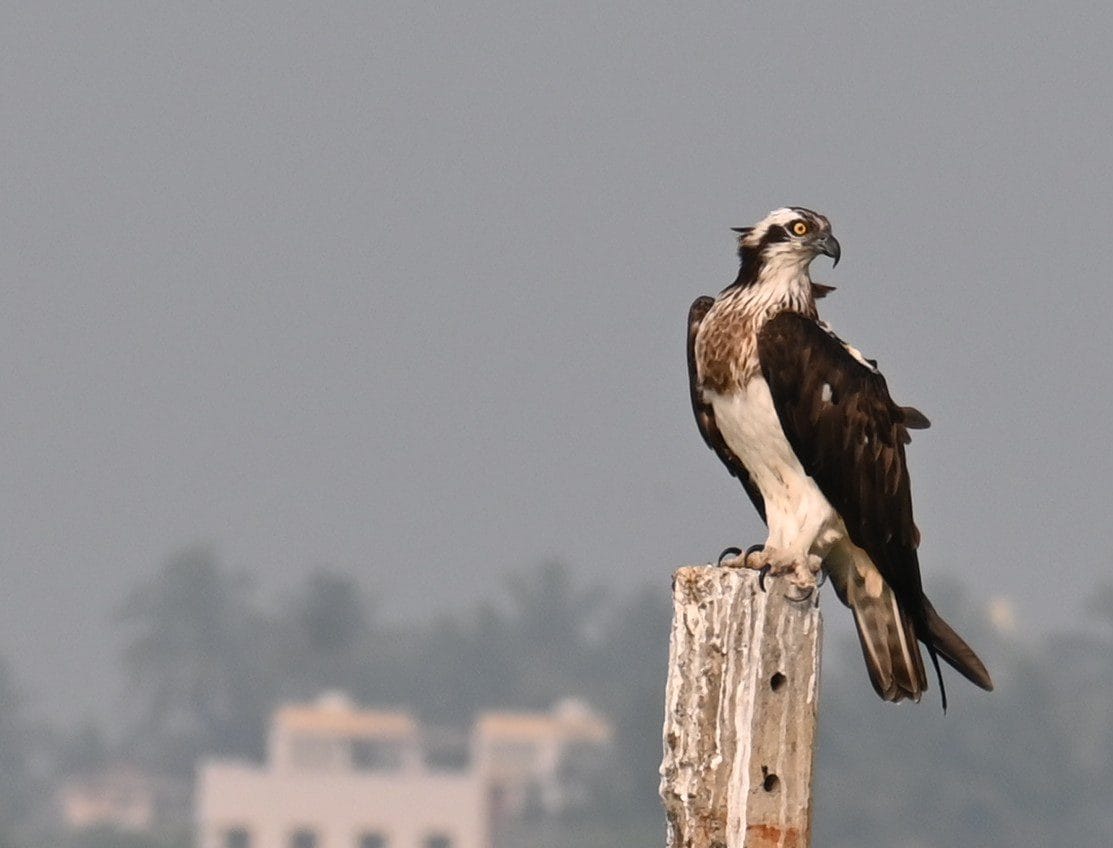
The Osprey at Bhigwan is a perch hunter, which makes it unusual among raptors in one specific way: it is findable. Unlike pursuit predators that cover kilometres of sky, it commits to a hunting territory and works it repeatedly. Once you locate the post or dead tree it has claimed as its base, that bird will return to it throughout the morning.
Specifically, look for isolated structures above open water — broken concrete posts, dead trees, the remnants of old infrastructure standing in the Ujani backwaters. The Osprey selects for height and clear sightlines to the water below. It avoids the dense reed margins where the painted storks and egrets work, and instead prefers open water with clean approach angles for the dive.
From a distance, identification is straightforward: large brown-and-white raptor, sitting alone, not in a group. The dark chocolate upperparts, white underparts, and distinctive dark eye-stripe running back from the bill like a mask across the face separate it from every other large bird at Bhigwan at a glance.
Why Timing Matters More Than Location
First light is mandatory. The Osprey hunts actively in the first two hours after sunrise, when fish move closer to the surface and the light still sits low and direct across the water. By mid-morning, however, heat haze increases over the backwaters, fish retreat to depth, and the bird shifts into a more passive holding pattern. Being on the water at 6 AM is therefore not a recommendation — it is the article’s single non-negotiable.
| Month | Osprey Presence | Conditions |
|---|---|---|
| October | Arriving | Early migrants settling in, sightings building |
| November | Good | Resident birds established, cooler mornings |
| December | Peak | Maximum activity, best light, coldest mornings |
| January | Peak | Most consistent sightings of the season |
| February | Good | Still present, beginning pre-migration restlessness |
| March | Departing | Last sightings as northward migration begins |
| Apr – Sep | Absent | Breeding in Palearctic — bird is north of India |
Getting to Bhigwan
Bhigwan sits approximately 100 kilometres southeast of Pune — a drive of two to two-and-a-half hours depending on route and traffic. The Kumbhargaon dock on the northern edge of the Ujani backwaters is the standard departure point for boat safaris into the wetlands.
In practice, the logistics are not complicated — the timing is everything. Leave Pune no later than 3:30 to 4 AM. Reach the dock before sunrise. This is the difference between a productive morning and an expensive drive to watch birds you could have seen closer to noon. The Osprey hunts at dawn, the flamingo flocks mass at dawn, and the light is only soft and usable in the first two hours. Ultimately, Bhigwan is a trip that rewards the early departure with disproportionate generosity.
For those planning to stay overnight, accommodation options near the sanctuary range from guesthouses in Bhigwan village to Agnipankh — the most commonly used option for photographers planning two consecutive dawn sessions on the water.
Why the Osprey Stays With You
There is a specific quality to watching an animal that has fully committed to one thing. No ambivalence, no alternative strategy. The Osprey hunts fish, and consequently everything it is — its eyes, its feet, its feathers, its behaviour — reflects that commitment without remainder.
Most wildlife sightings are, after all, about rarity or scale: the tiger glimpsed in the grass, the flamingo flock stretching pink across a kilometre of water. The Osprey, however, is neither rare nor vast. Rather, it is a single bird, in a fixed location, doing something quietly extraordinary that it has done every winter morning of its adult life.
The Thing That Actually Lingers
What stays with you is not the drama. Rather, it is the competence — the absolute, unremarkable, mechanical competence of a creature that has solved the problem of how to live so completely that watching it work feels less like witnessing nature and more like watching something that was always going to happen exactly this way.
Sit with it on a cold Bhigwan morning — boat engine cut, water flat, the bird on its post against the early light — and that feeling arrives without announcement.
It doesn’t need one.
Osprey at Bhigwan — Common Questions
Is the Osprey a permanent resident at Bhigwan, or a seasonal visitor?
Strictly a winter visitor. The subspecies present at Bhigwan — Pandion haliaetus haliaetus — breeds across the Palearctic from Scandinavia to Russia and Japan, then migrates south to India for the Northern Hemisphere winter. It typically arrives at Ujani from October onward and departs by late February or March as northward migration begins.
How hard is it to spot an Osprey at Bhigwan?
Easier than most raptors, because the Osprey is a perch hunter rather than a soaring or pursuit predator. It spends long periods stationary on an elevated post or dead tree above open water, making it visible from a significant distance. Once you locate the perch it has claimed for the morning, that bird will typically remain in the same area. Arrive at dawn, move to the open backwater sections rather than the reed-margin areas, and scan any structure rising above the water surface.
What time of day is best for Osprey sightings and photography?
Sunrise to approximately 9 AM without exception. The Osprey hunts most actively in the first two hours after dawn, when fish are nearer the surface and the light is soft and directional. By mid-morning the water temperature rises, fish move deeper, and the bird shifts to a passive mode. Being on the water before 6:30 AM is the single most effective variable in a Bhigwan visit.
Can you witness the Osprey diving from the boat?
Yes, with patience. The bird dives multiple times across a morning session. The dive itself lasts approximately three seconds from fold to emergence — too fast to react to if you are not pre-focused on the water below the perch. Watch the bird’s posture rather than waiting for movement: a slight forward lean and head drop precedes every dive by a few seconds. Keep your camera focused on the surface beneath the perch once the hover begins.
Where else in Maharashtra can you see an Osprey?
The Osprey is a widespread winter visitor across India wherever large, open bodies of shallow water hold adequate fish populations. Large reservoirs and river systems throughout Maharashtra can hold wintering birds. Bhigwan’s Ujani backwaters are among the most reliable sites in the state for consistent sightings due to the combination of shallow, open water, isolated perch structures, and low disturbance across the core zones.
Is the Osprey endangered in India?
No. The Osprey is listed as Least Concern on the IUCN Red List globally, with an estimated world population of approximately 460,000 individuals. In India it is a protected migratory species under the Wildlife Protection Act. Population recovery has been steady since the global ban on DDT, which had caused significant breeding failure in many regions through the 1950s and 1970s.
Photography: Prashant S. Gupta · Nikon Z50 · Ujani Backwaters, Bhigwan, Maharashtra
More wildlife and bird photography at www.travelontales.com