
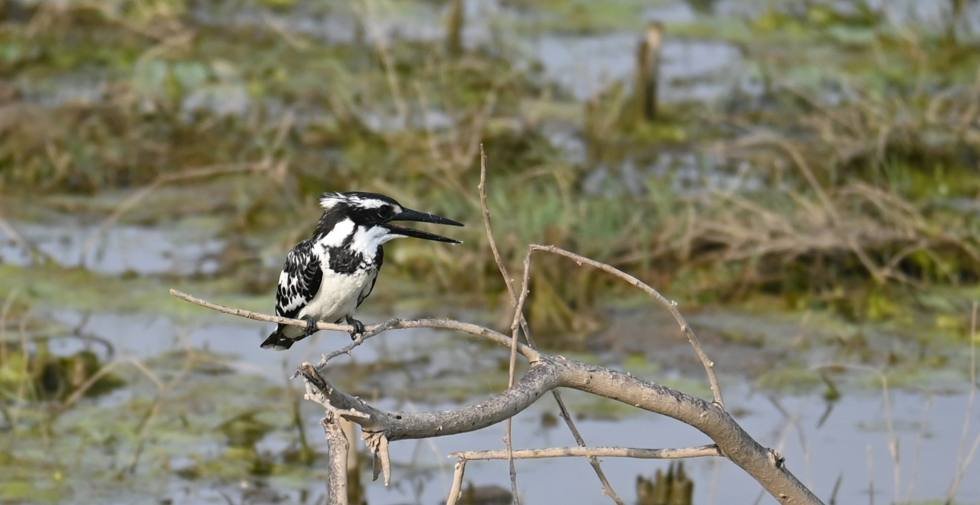
Everyone comes to Jawai watching the hills. The leopards are up there, after all — folded into the granite like shadows that learned to breathe. But turn your back on the rocks for a moment, walk down to where the dam spreads thin and silver across the land, and a different Jawai opens up. It is loud with frogs and dragonflies, and somewhere along a half-drowned branch, dressed in nothing but black and white, sits one of the most extraordinary hunters in all of India.
 Click to enlarge
The Jawai Nobody Photographs
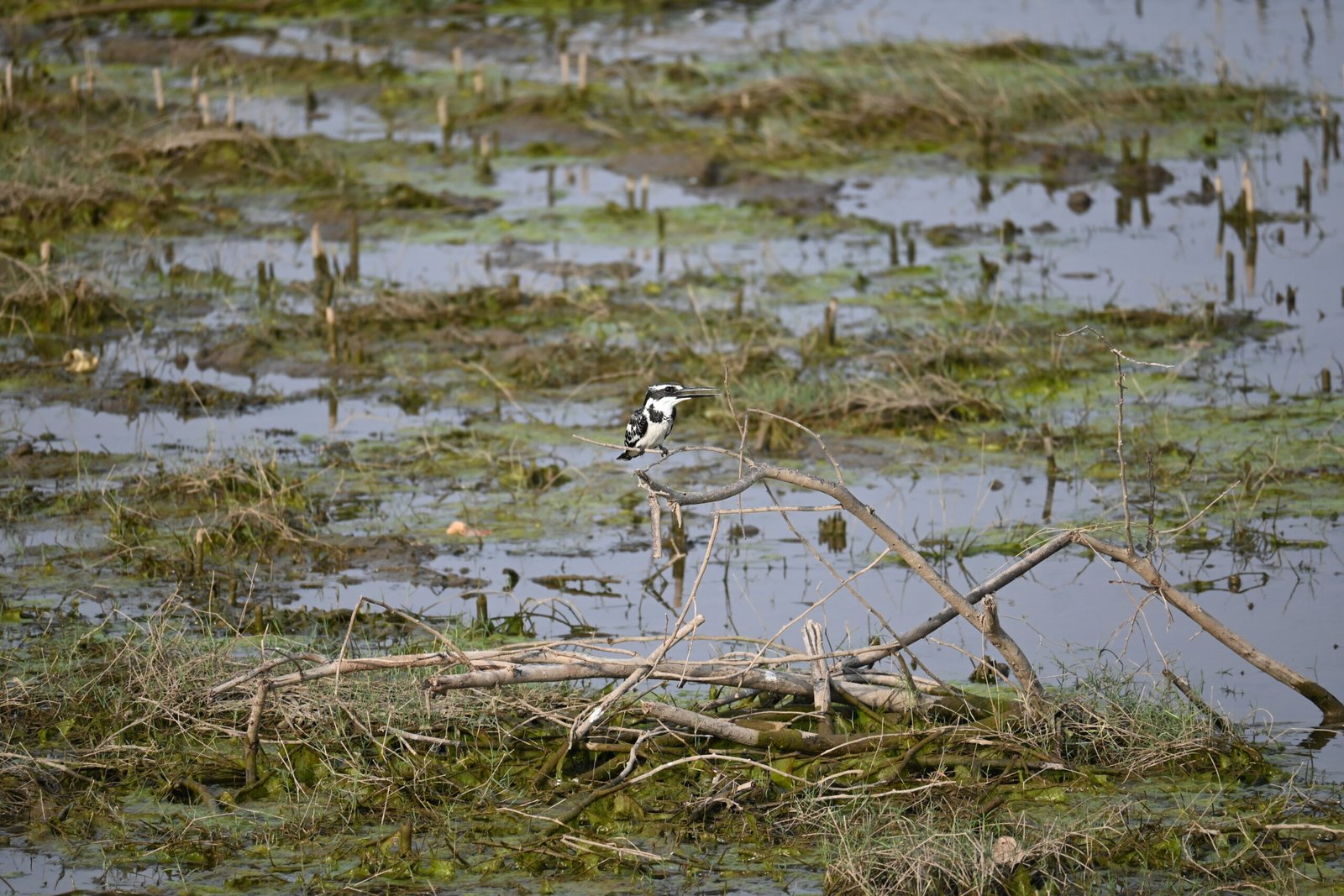
The reservoir behind Jawai Dam is the reason any of this works. In a corner of Rajasthan that spends half the year cracked and thirsty, it holds water when nothing else does — and water, here, is an invitation. Fish move into the shallows. Frogs sing from the reeds. And down the food chain comes everything that eats them: egrets stalking like white question marks, herons standing in their long patience, bee-eaters stitching colour across the air.
Spend an hour at the edge and you stop missing the leopards. (When you do want them, our full Jawai Leopard Safari guide has the drives mapped out.) But of all the birds working this water, one keeps stealing the show.
 Click to enlarge
The Bird That Hangs in the Air
Most kingfishers are creatures of the perch. They wait, they watch, they drop. The Pied Kingfisher does all that too — but it owns a trick almost no other kingfisher on Earth can match. It can stop. Mid-flight, far out over open water where there is nothing at all to sit on, it locks its head dead-still, hammers its wings into a blur, and simply hangs there — a black-and-white smudge pinned to the sky — reading the water below for the flick of a fish.
And then it falls. Wings folded, it drops like a thrown stone, vanishes in a white splash, and lifts off again — sometimes swallowing the catch in mid-air before it has even climbed back to height. There is no wasted motion. It is hunting reduced to its most efficient, most theatrical form, and Jawai’s open water is the perfect stage for it.
Field Notes
- Name Pied Kingfisher (Ceryle rudis)
- Range Across Africa and southern Asia, wherever there is open fresh water
- Diet Mostly small fish; also insects and crustaceans
- Signature move Sustained hovering over open water
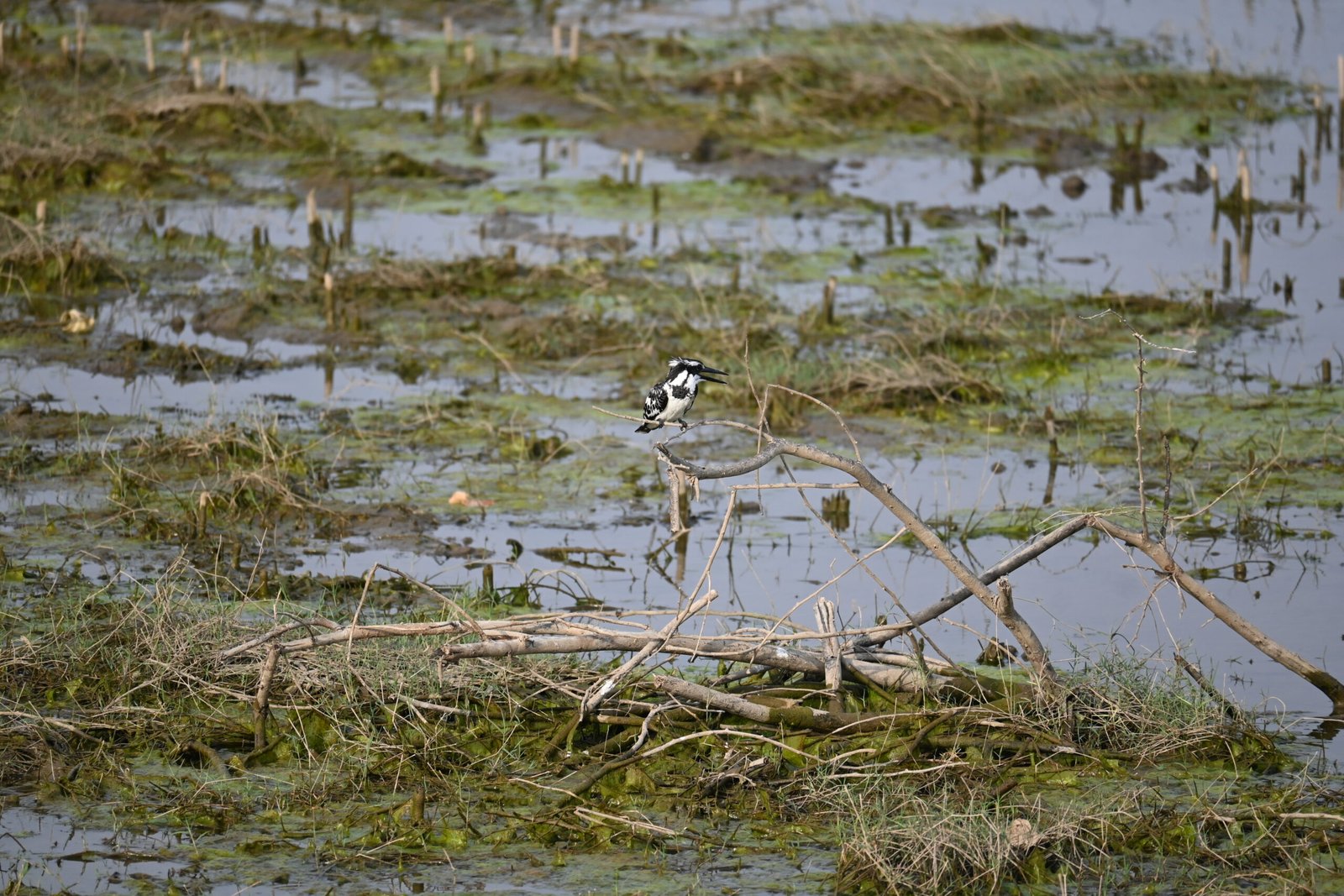
- Male vs female Two breast bands on the male, one (often broken) on the female
 Click to enlarge
A Family Effort
Here is the part that surprises people. That lone bird on the branch may not be working alone at all. Pied Kingfishers are among the very few birds that breed as a team — grown young from an earlier brood, and sometimes unrelated males with nowhere better to be, will line up to carry fish back to the chicks tucked inside a burrow in the riverbank. So the hunter you’re watching might be feeding someone else’s family, biding its time until it has one of its own. These wetlands, it turns out, reward patience in birds and birdwatchers alike.
When to Come, and Why It Matters
Jawai is at its best from October into early April — full reservoir, kind weather, and a winter rush of migrants thickening the crowd at the water. The Pied Kingfisher stays put all year, so you’ll find it whenever you visit, but the edges hum loudest in the cold months. Chase the light: the ninety minutes after dawn and the last golden hour before dusk hand you soft colour and busy birds in equal measure.
And there’s a quieter reason to care. A wetland full of kingfishers is a wetland in good health — they need clean water and steady fish, and where they thrive, so does everything else. Protecting Jawai’s water protects far more than one beautiful bird.
How to Photograph It
Small, quick and easily spooked — the Pied Kingfisher makes you work. A few habits tilt the odds your way:
Speed over everything. If you want the hover or the dive, hold your shutter at 1/2000s or faster — those wingbeats are merciless. Raise ISO before you let the shutter slow.
Learn the perch. Kingfishers return to the same snags again and again. Find an active one, settle low and still, and let the bird come back rather than chasing it around the water.
Guard the whites. That bright breast blows out in a heartbeat against dark water. Dial in a touch of negative exposure compensation and lift the shadows later.
Drop to its level. Shooting from the boat’s waterline puts you on the bird’s plane and melts the background into soft wash — exactly the look in the frames above, all taken handheld on a Nikon Z50 at 250mm.
The Supporting Cast
The Pied Kingfisher rarely has the water to itself. A single Jawai morning can turn up Common and White-throated Kingfishers, egrets in white and herons in grey and purple, bee-eaters slicing the air, River Terns quartering the open stretches, and waders picking along the mud. In winter the raptors join in — Ospreys and harriers cruising the margins.
Frequently Asked Questions
Can you really see Pied Kingfishers at Jawai?
Yes — the wetlands around Jawai Dam are reliable year-round habitat. Look for them on dead branches over the water or hovering above the open stretches during morning and evening drives.
What makes the Pied Kingfisher special?
It is the largest bird able to truly hover in still air, which lets it hunt over open water with no perch nearby. It also breeds cooperatively, with helper birds assisting at the nest — a rare trait among birds.
How do you tell a male from a female?
The male carries two black bands across his white breast; the female has a single band, usually narrower and broken in the middle.
When is the best time to visit Jawai?
October to early April brings comfortable weather, a full reservoir and peak bird activity, with early mornings and late afternoons giving the best light for birds and leopards alike.
Heading to Jawai for the leopards? Don’t pack the camera away at the water’s edge — read our complete Jawai Leopard Safari guide and make every drive count.