
Bhigwan · Accipitridae
Montagu’s Harrier
Circus pygargus
Drive west of Bhigwan bridge on the Kumbhargaon road one hour before sunset in December. Stop the vehicle and scan the sky. If you have chosen the right evening, you will count a hundred harriers — and counting will become difficult.
- Status at Bhigwan
- Winter visitor
- How often seen
- Common
- Size
- 43–47 cm
- Family
- Accipitridae
The roost — what actually happens
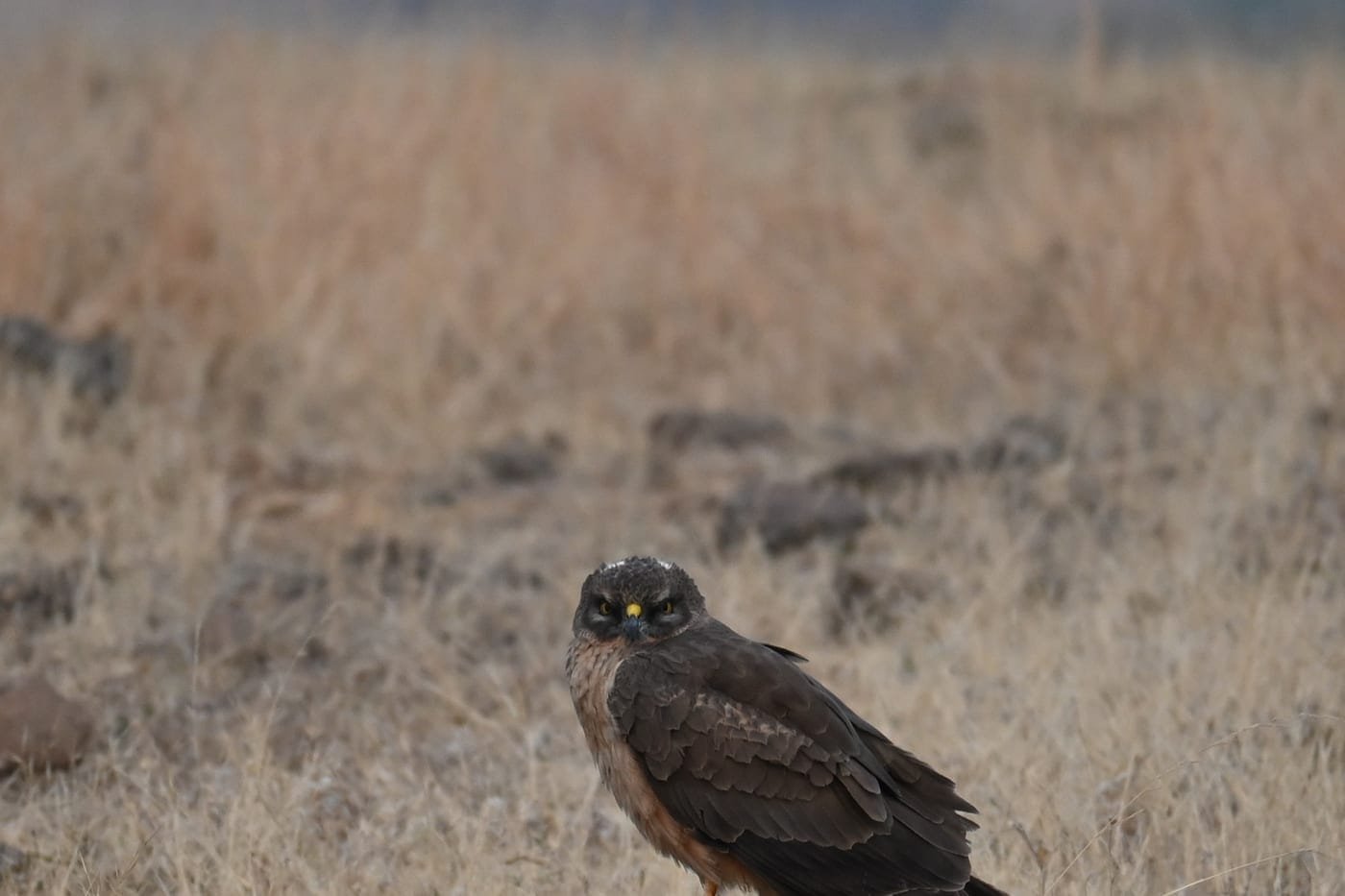
Montagu’s Harriers are solitary hunters during the day. They spend the daylight hours quartering over cropland and fallow fields, each bird covering its own circuit. But at dusk something switches: they gather. Birds converge from different directions — a dot on the horizon becomes a shape, becomes a slim long-winged raptor, becomes 10 more behind it. They spiral slowly down into sugarcane, jowar or tall grass in loose groups, folding their wings at the last moment and vanishing into the vegetation as though they were never there. Then another group arrives and does the same.
In a good winter, roost counts of 100–200 birds have been made near Kumbhargaon village. Most Bhigwan visitors see harriers during the day and think them merely common. The evening roost is a different order of experience entirely, and very few travellers know about it.
Identifying Montagu’s — the tricky parts
The adult male is grey — not unusual — with black wingtips and the two field marks that separate it from the superficially similar Pallid Harrier: a black bar running across the upper secondaries, and rufous streaking on the belly and flanks. Count the visible “fingers” at the wingtip: Montagu’s shows five, Pallid’s four. At reasonable distance and in good light, the secondary bar is the faster mark.
Females and first-year birds are a different matter. Brown, with a pale rump patch and an owl-like facial disc, they overlap with Hen Harrier and Marsh Harrier. Body shape is your best guide: Montagu’s is long-winged and slim-tailed, built like a buoyant glider, and it tilts on slightly kinked wings — a posture that the heavier Marsh Harrier does not share.
Where and when to look
The open farmland west and north of Kumbhargaon holds the best roost sites. Arrive 90 minutes before sunset; the birds are still spread over their hunting ranges but begin drifting towards the roost from about an hour before dark. During the day, scattered birds hunt over the same fields and along the reservoir’s drier margins. The species is present from October to March, with December and January offering the largest numbers.
Hunting behaviour
Montagu’s Harrier hunts in a low, buoyant glide — rarely more than 3–4 metres above the ground — with sudden drops onto prey: small rodents, lizards, large grasshoppers, and occasionally frogs. It works more open ground than the Marsh Harrier, avoiding the dense reedbeds. At the roost site, birds that have been territorial all day become tolerant of each other within a matter of metres.
Best time and spot
Face west on the Kumbhargaon road with the setting sun behind you, 60–90 minutes before dark. Incoming birds approach from the east and are lit by the last warm light. The gap between the bird arriving and dropping into cover is 20–30 seconds — enough for several frames. A 400 mm lens handles the distance comfortably.
Common questions
Can I see Pallid Harrier at Bhigwan as well? +
Yes — Pallid Harrier also winters at Bhigwan and sometimes roosts alongside Montagu’s. Adult male Pallids are noticeably paler, almost silvery-white, with cleaner black wingtips and no secondary bar. Females and immatures of the two species are genuinely difficult and require careful attention to wingtip structure and facial disc pattern.
Why do harriers roost communally when they hunt alone? +
Communal roosting in harriers is thought to serve an information-sharing function — birds that failed to find food may track successful hunters to better foraging areas the next morning. The behaviour is well documented in the literature and the Bhigwan roost is consistent with this. It may also reduce individual predation risk, though harriers face few predators of their own.
What do Montagu’s Harriers eat at Bhigwan? +
At Bhigwan they hunt primarily over open cropland — taking small rodents (particularly field mice), large grasshoppers and other insects, frogs, and occasionally small lizards. They do not hunt waterbirds and rarely enter the reedbeds, preferring the drier agricultural land around the reservoir margin. Prey is usually killed on the ground after a short pursuit from low altitude.
Is Bhigwan one of the best places in India to see Montagu’s Harrier? +
It is certainly one of the most accessible. The Deccan plateau in general — Maharashtra, Karnataka and Andhra Pradesh — holds significant numbers of wintering harriers, and the open farmland around Bhigwan and Ujani reservoir is prime habitat. The roosting aggregation near Kumbhargaon is well known among local birders but barely mentioned in mainstream travel coverage, which keeps the site quiet.
Plan your visit
Birds of Bhigwan — the full guide
Montagu’s Harrier is one of ten species in this series. Find the complete checklist with photographs and locations on the main Birds of Bhigwan page.