
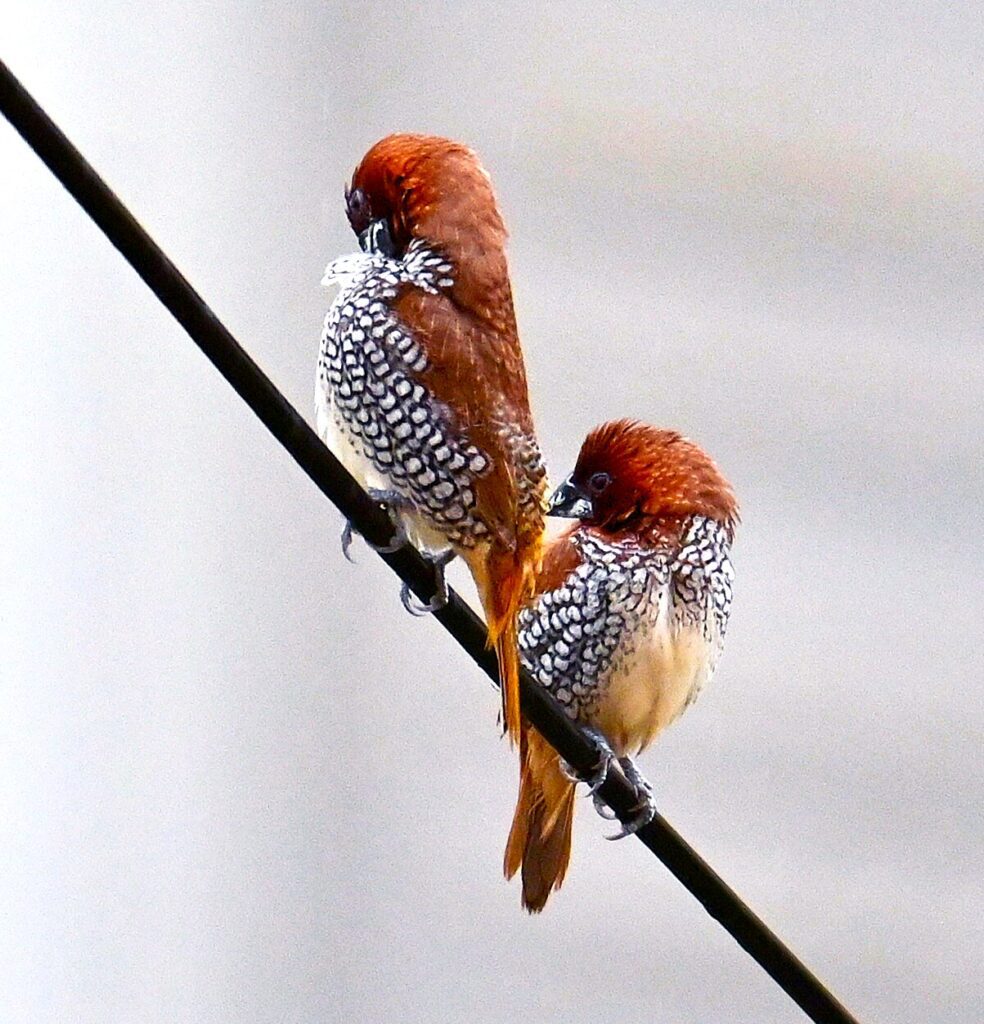
Nature’s Beautifully Patterned Songbird. Nutmeg Manikins

Nutmeg Manikin

The Scaly-breasted Munia (Lonchura punctulata), also known as the Nutmeg Manikin or Spice Finch, is one of the most charming little songbirds you’ll spot in gardens, grasslands, and urban spaces. Recognizable by their reddish-brown heads and unique scale-like markings on their underparts, these birds are a treat for birdwatchers and photographers alike.

Native to Asia, Munias are social birds often seen in flocks. They thrive on grass seeds but occasionally feed on insects during breeding to meet protein needs. What makes them fascinating is their cooperative behavior—they roost, feed, and fly in groups, showing us the importance of community living in the wild.

With their adaptability, Scaly-breasted Munias are now found in different parts of the world. Their gentle chirps and synchronized flock flights make them a joy to observe, proving that even the tiniest creatures have the biggest lessons to teach.

Interesting Facts

  1. Appearance: Named for their unique “scale-like” feather patterns on the body
  2. Social Birds: They move in flocks and are highly social, often seen feeding together on grass seeds.
  3. Diet: Mainly granivores (seed-eaters), but they also eat small insects during breeding season.
  4. Global Spread: Native to tropical Asia, but introduced to many parts of the world including the USA and Australia.
  5. Cultural Significance: In India, they’re often considered symbols of simplicity and togetherness because they always move in pairs or groups.

The nest they never stop building

Munias build a big, untidy, domed ball of grass with a side entrance, usually wedged in a thorny bush or a palm crown. For a bird of 12 cm it is a substantial structure.

The unusual part is that they do not only build it to breed in. Munias construct roosting nests as well, used purely for sleeping, often by several birds together through the year.

So a nest you find in December is not necessarily a breeding attempt. It may just be a dormitory.

Why they huddle

Munias roost pressed tightly together in a row, bodies touching. On a cold night this makes a real difference to a bird with very little mass to hold heat.

You will see the same behaviour on a wire or a bare stem at dusk — a line of small round birds squeezed shoulder to shoulder, constantly shuffling for position. The birds in the middle are warmest, which is why the shuffling never quite stops.

Flock life

Outside breeding, munias live in flocks that can number well into the hundreds where food is good. The flock moves as a unit, drops into seeding grass, feeds, and lifts again together at the smallest alarm.

That synchronised lift is a predator defence. A raptor stooping into a scattering cloud of identical small birds finds it hard to fix on one.

Feeding technique

Munias do not usually feed on the ground if they can help it. They land on the grass stem itself and ride it down under their own weight, then work the seed head directly.

The bill is a seed-cracking tool: short, deep and conical, worked like a pair of pliers. Watch closely and you can see the husk being split and discarded while the kernel is swallowed.

Breeding

They breed largely with the rains, when grass seed is abundant. Both parents build, both incubate and both feed the young.

Pairs are strongly bonded and sit in contact, preening each other — a behaviour called allopreening that is common in munias and part of what makes them appealing to watch.

Photographing behaviour

  • Find the roost. A line of huddled munias at dusk is the best image this species offers.
  • Watch the nest from a distance. Do not approach an active nest; use a long lens.
  • Shoot the stem ride. A munia bending a grass stem under its own weight is characteristic and rarely photographed well.
  • Look for allopreening. Two birds preening each other is a far better picture than a portrait.

Frequently asked questions

Do munias use nests outside the breeding season?

Yes. They build separate roosting nests purely for sleeping, often used communally.

Why do munias sit so close together?

To conserve heat. Huddling matters a great deal for a bird this small.

When do munias breed?

Mainly during and after the rains, when grass seed is plentiful.

Do both parents raise the young?

Yes. Both build, incubate and feed.


Related: How to identify the Scaly-breasted Munia and Munias and the cage-bird trade.

Scroll to Top