
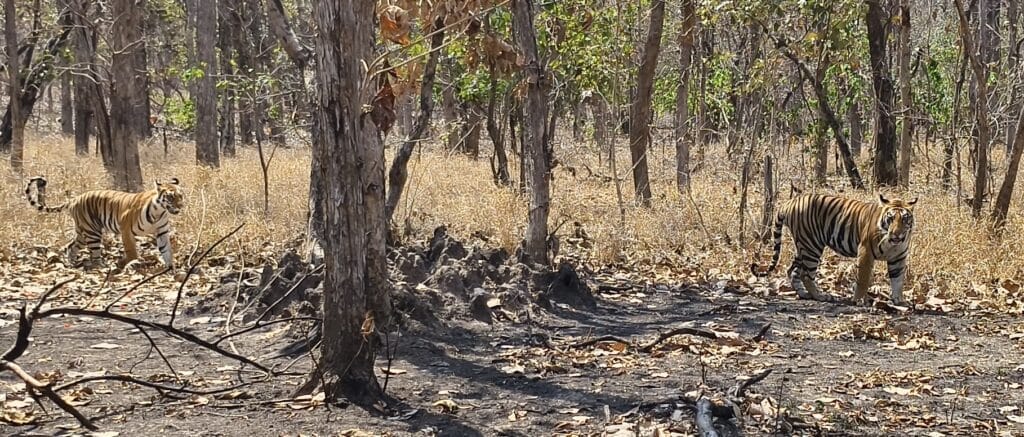
Tiger Sighting in Panna Tiger Reserve, Madhya Pradesh
Panna Tiger Reserve is known for dramatic landscapes, deep gorges, and elusive big cats. But every now and then, the forest rewards visitors with something unforgettable — like a rare moment where two tigers appear together in perfect harmony with the jungle.
Two Tigers
Tigers are solitary by nature, so spotting a pair walking through Panna’s dry deciduous terrain is an encounter safari enthusiasts dream of. Whether it is territorial movement, siblings, or a courtship phase, these moments are incredibly rare.
In this sighting, both tigers emerged from the dense trees, their stripes glowing in the harsh summer light. Their calm, confident body language added to the wild magic of the moment.
Panna’s Dry Forest Adds a Dramatic Canvas
The golden-brown landscape of Panna Tiger Reserve gives tigers near-perfect camouflage. Yet when they choose to reveal themselves, the contrast of the bright coats against the parched forest floor creates a visual masterpiece.
A Reminder of Panna’s Conservation Success
Panna’s tiger comeback story is legendary — from losing its entire population to reintroducing tigers successfully through one of India’s greatest conservation efforts. Every sighting today is proof of how resilient this ecosystem truly is.
Fun Facts About Panna Tigers
- Panna Tiger Reserve once had zero tigers — today it thrives with a growing population.
- Tigers in Panna often move across gorges and riverbeds, making sightings spectacular.
- The Ken River flowing through Panna adds unique biodiversity to the region.
- Panna is home to the famous diamond mines of Central India.
- Summer offers the best visibility for tiger sightings in its dry landscape.
Click Here: Explore More Tiger Safari Stories
The story you need to know first
Panna is the reserve that lost every one of its tigers. By 2009 the official count was zero — poaching had emptied it completely, and it became a national embarrassment.
What happened next is the reason Panna is worth visiting. Tigers were relocated from Bandhavgarh and Kanha, breeding began, and the population recovered to a viable one. It is the most successful tiger reintroduction India has done, and you are looking at the result of it.
What Panna looks like
This is not the sal forest of Kanha or Bandhavgarh. Panna sits on the Vindhyan plateau, and the landscape is dry deciduous forest cut by gorges, with the Ken river running through it and layered rock escarpments above.
It is more open and more dramatic than most central Indian reserves, and the viewpoints over the Ken gorge are worth the drive on their own.
What you can see
- Tiger, the reintroduced population and their descendants.
- Leopard, present and reasonably visible in the rocky terrain.
- Sloth bear, which the escarpments suit well.
- Chital, sambar, nilgai and chinkara — the drier habitat brings chinkara in, which you will not see at Kanha.
- Indian vultures, nesting on the cliffs. Panna is one of the better places left in India for them.
- Gharial and marsh crocodile in the Ken.
Practical details
- Season: open roughly October to June. March to May for sightings, winter for comfort.
- Gates: Madla and Hinauta are the main entries.
- Getting there: Khajuraho is about an hour away and has both an airport and a station. This is the easiest big reserve in Madhya Pradesh to reach.
- Boat rides on the Ken are offered separately and are good for crocodile and birds.
Combining it with Khajuraho
Panna’s proximity to the Khajuraho temples makes it the obvious pairing for anyone who does not want a pure wildlife trip. Two nights at Panna and one day at the temples is a comfortable itinerary, and the contrast between the two is genuinely enjoyable.
Frequently asked questions
Did Panna really lose all its tigers?
Yes. By 2009 the count was zero. Tigers were reintroduced from Bandhavgarh and Kanha and the population has since recovered.
How do I reach Panna Tiger Reserve?
Khajuraho, about an hour away, has the nearest airport and railway station.
When is the best time to visit Panna?
March to May for tiger sightings; November to February for pleasant weather and birds.
What makes Panna different from Kanha or Bandhavgarh?
Drier, rockier terrain with gorges and cliffs, plus the Ken river, chinkara, and nesting vultures.
Related: Spotted Deer in Panna and Bandhavgarh Safari Guide.
