
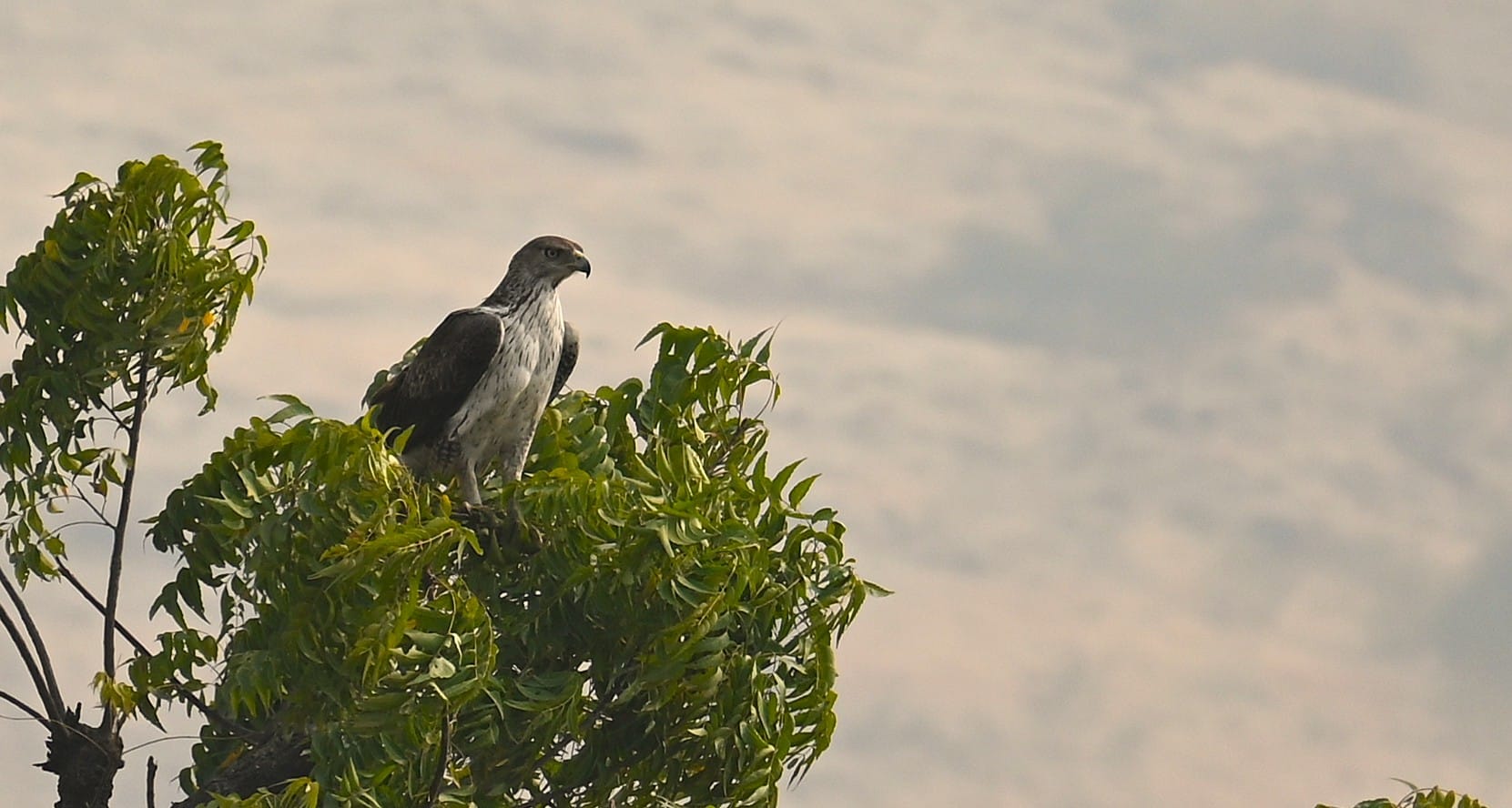
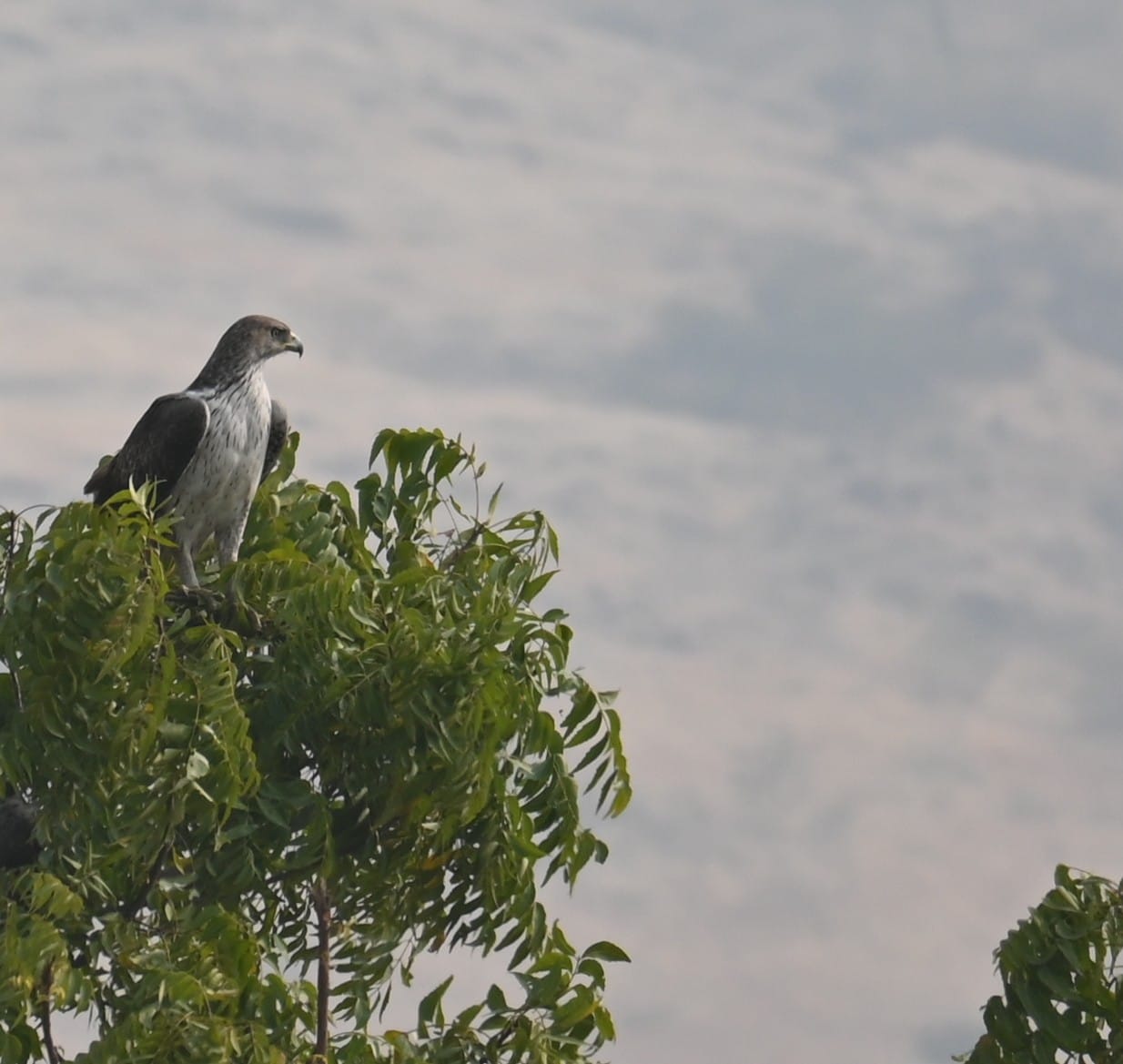
The morning light was still thin over the Ujani backwaters when I spotted it — perched high on a canopy tree above the grassland edge, dark mantle against a grey winter sky, completely indifferent to the world below. It took me a second look and a hard review of the field marks to say it with confidence: a Bonelli’s Eagle, Aquila fasciata. Not the bird I had expected. Not the bird most visitors to Bhigwan ever look for. And easily one of the most underrated raptor sightings you can get in Maharashtra.
Bonelli’s Eagle: The Raptor Most Birders Walk Past
Bhigwan draws most people for its flamingos, its Painted Storks, its winter waders lining the mudflats in pink and white abundance. Raptors are a bonus — and when birders do look up, they’re scanning for Ospreys, Brahminy Kites, or the occasional Marsh Harrier quartering the reeds. A Bonelli’s Eagle is not on most people’s mental checklist for this wetland.
Which is precisely why it’s worth writing about.
Aquila fasciata is a large, powerful booted eagle — classified now in the genus Aquila after formerly sitting in Hieraaetus. The species ranges widely across southern Europe, northern Africa, the Middle East, the Indian subcontinent, and into Southeast Asia and southern China. In India it is largely resident, favouring hilly, rocky terrain and woodland edges — but outside the breeding season it wanders, and the dry scrub and acacia woodland surrounding Bhigwan’s backwaters provides exactly the kind of open, elevated-perch habitat this species uses when hunting.
Field Identification: How to Recognise Bonelli’s Eagle
Bonelli’s Eagle is a medium-to-large eagle — measuring 55 to 74 cm in length, with a wingspan ranging from approximately 143 to 180 cm depending on sex, females being notably larger. In the field, the following marks are diagnostic:
Upperparts: Dark brown across the mantle and wings, with a distinctive pale whitish patch between the shoulders that is visible in good light. This scapular patch is one of the clearest adult field marks.
Underparts: White or cream below, with dark streaking that is heaviest on the breast and upper flanks, thinning toward the belly. The streaking pattern is important — clean, not barred, and concentrated toward the chest.
Head: Relatively small for an eagle of this size, with yellow eyes and a strong, hooked beak. The head has a slightly flattened profile compared to the large-headed snake eagles.
Tail and wings in flight: Broad, rounded wings, long tail with a clear dark subterminal band and a thin white tip. The flight is powerful and direct — agile enough to take birds in the air over extended chases.
Separating Bonelli’s Eagle from Similar Species
At Bhigwan, two species cause the most confusion with Bonelli’s Eagle from a distance: the Grey-headed Fish Eagle and the Short-toed Snake Eagle. I’ve had first-hand experience with this confusion on the same morning — and the separating marks, once learned, are reliable.
From the Grey-headed Fish Eagle (Ichthyophaga ichthyaetus): the Fish Eagle is a waterside specialist, almost always found in dense leafy canopy immediately over the backwater. It has a heavier, more hunched build, and the underparts are clean white without the breast streaking characteristic of Bonelli’s. The eye colour is yellow but smaller and less prominent. Body structure — particularly the heavy, fish-eagle shoulders and short neck — reads differently in the field once you know what you’re looking at.
From the Short-toed Snake Eagle (Circaetus gallicus): the Snake Eagle’s enormous, owl-like head and striking amber-orange eyes are unmistakable at close range. The underparts show heavier spotting. The overall gestalt is bulkier in the head, slimmer in the body.
Bonelli’s sits cleanly between these two — a true large eagle with a conventional raptor profile, distinguished by its dark-above/streaked-white-below pattern and that pale scapular patch.
Behaviour and Diet: A High-Performance Predator
What makes Bonelli’s Eagle notable among Indian raptors is its hunting capability. This species is a specialist predator of medium-sized birds — pigeons, partridges, crows — and mammals including rabbits and rodents. It is fast and agile in flight, capable of sustained chases through cover and surprise strikes on birds at take-off. Larger prey including herons, buzzards, and even foxes are recorded kills.
Outside the breeding season, Bonelli’s Eagle can move considerable distances from its core territory and is known to use wetland edges for opportunistic hunting — which explains its presence at a location like Bhigwan, where the surrounding acacia grassland and dry scrub produce steady populations of pigeons and other prey species.
The bird I observed was entirely stationary on the perch for the duration of my sighting — that upright, alert posture that experienced raptor watchers recognise as active scanning rather than resting. It was watching the grassland below, not the water.
Conservation Status: Least Concern, But Declining
The IUCN currently lists Bonelli’s Eagle as Least Concern — a classification that reflects its wide global range rather than its population health. Across Europe particularly, the species has declined significantly, with electrocution from power lines, habitat destruction, and persecution identified as primary drivers. The Indian subcontinent population is considered more stable, though habitat degradation and prey base decline apply here too. Breeding in India occurs primarily between November and February, with nests built on cliff ledges or large trees.
Bhigwan Bird Sanctuary: Complete Tour Guide for Birders
A Bonelli’s Eagle sighting is one of those unexpected bonuses that makes a well-planned Bhigwan trip unforgettable. But to set yourself up for sightings like this, the groundwork matters. Here is everything you need to know for a serious birding visit to Bhigwan.
Why Bhigwan Is Called the Bharatpur of Maharashtra
Bhigwan sits in the Solapur-Pune district of Maharashtra, approximately 105 km from Pune and 248 km from Mumbai. The Ujani Dam on the Bhima River has created an extensive backwater system that functions as a critical wetland habitat — attracting over 400 recorded bird species across the seasons. The shallow, receding winter waters create ideal mudflat conditions for waders, flamingos, and waterfowl, while the surrounding acacia scrub and dry grassland hold raptors, shrikes, and grassland specialists that most visitors never pause to look for.
The two primary birding zones are the Diksal-Parewadi area and the Kumbhargaon area — each with its own character and species assemblage. Serious birders cover both.
Best Time to Visit Bhigwan for Birding
The peak birding window is November through March, with January and February representing the absolute peak for migratory species and flamingo concentrations. December through March is when water levels are at their lowest, mudflats are most exposed, and species diversity is at its highest. Early morning sessions — 6 AM to 8 AM — and late afternoon light from 5 PM to sunset are the most productive times both for observation and photography.
The summer months (April to June) are hot and most migratory species have departed, though resident species and raptors remain year-round.
How to Reach Bhigwan
By road from Pune (105 km via Solapur-Pune Highway) is the most practical option for most visitors. Mumbai to Bhigwan is approximately 248 km. A train station at Bhigwan (BGVN) is served by some Chennai Mail and Hyderabad Express services from Pune and Mumbai — but note that the birding spots are 10 to 15 km from the main town, so having your own vehicle or arranging local transport is essential. State buses to Solapur also stop at Bhigwan but share the same last-mile problem.
Boat Safari: The Core Bhigwan Experience
The boat safari on the Ujani backwaters is the centrepiece of any Bhigwan visit. Local boatmen are skilled at approaching birds without flushing them — the shallow-draft wooden boats allow you to get genuinely close to waders, herons, cormorants, and flamingo concentrations. A typical boat ride runs two hours and accommodates five to six people, or you can hire a private boat for dedicated photography.
For a fully guided experience including safari logistics, I recommend booking through a verified platform. Check current Bhigwan and Maharashtra wildlife tour availability on Viator — booking in advance is strongly recommended during peak season (January–February) when boats fill quickly.
Key Bird Species to Watch For
Bhigwan’s species list is remarkable in its range. On the water and mudflats, the signature species are Greater and Lesser Flamingo, Painted Stork, Black-headed Ibis, Bar-headed Goose, Common Teal, Northern Shoveler, Grey Heron, and River Tern. Wader diversity is exceptional with Common Sandpiper, Marsh Sandpiper, Black-winged Stilt, and multiple stint species possible in season.
Above the waterline, look along the grassland and scrub fringe for raptors: Osprey hunting over open water, Short-toed Snake Eagle perched on exposed acacia canopy, Montagu’s Harrier quartering low over the grassland, and — if you’re paying attention to every exposed high perch at the tree line — the possibility of a Bonelli’s Eagle doing exactly what I photographed it doing: watching, waiting, completely still.
Photography Tips for Bhigwan
A focal length of 400mm or more gives you working distance on the water birds. For raptors perched on canopy trees, you’ll often be shooting upward into sky — flat, overcast winter light is actually your friend here, giving even exposure without harsh shadow. Shoot in RAW for recovery latitude. Golden hour on the backwater produces spectacular silhouette and reflection opportunities, and the late-afternoon light on flamingo flocks has a quality that is hard to replicate anywhere else in Maharashtra.
The boat is moving and the boatman will try to hold position — use burst mode and keep shutter speed above 1/1000s for any bird in flight.
Where to Stay Near Bhigwan
Homestay options in and around Bhigwan are available from approximately ₹900 per night. For those looking for more comfort, Baramati (21 km) has better hotel options and is a reasonable base. Pune (105 km) is the full-service option for travellers who prefer city accommodation and a day trip, though an overnight stay is strongly recommended if you want both morning and evening sessions.
Final Thoughts
Bhigwan will keep surprising you if you let it. Most visitors come for flamingos and leave satisfied. The birders who slow down — who scan every exposed canopy perch, every distant silhouette against a grey winter sky — come away with a completely different list. The Bonelli’s Eagle I photographed that morning was not a tick on a pre-planned target list. It was the result of looking carefully at a perch that most boats probably passed without a second glance.
That’s what makes Bhigwan worth coming back to, season after season.
If you’re planning a trip to Bhigwan, explore available tour options and book your boat safari in advance — especially during peak season. Browse Bhigwan and Maharashtra wildlife tours on Viator →
For my complete destination overview including maps, seasonal guides, and species lists, visit the Bhigwan Bird Sanctuary Guide.
All photographs TravelOnTales. Reproduction without written permission is prohibited. Licensing enquiries: contact via TravelOnTales.
Research references: Wikipedia — Bonelli’s Eagle (Aquila fasciata); Birda species guide; oiseaux-birds.com; State of India’s Birds (SoIB); eBird species account — Bonelli’s Eagle on eBird.