
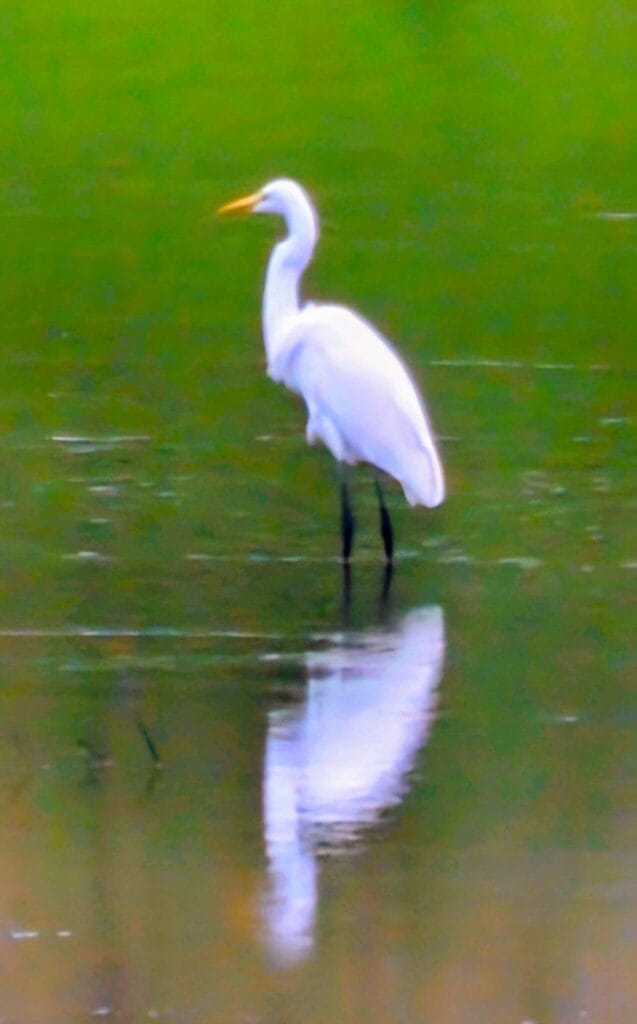
A Calm Egret in Tadoba While Everyone Waited for the Tiger
During our safari in Tadoba, all tourists were waiting near one spot because a tiger was resting behind the bushes. Cameras were pointed, excitement was high, and everyone hoped the tiger would finally stand up.
While everyone was waiting for the tiger to wake up, we looked towards the lake and noticed a beautiful white bird standing alone in the shallow water. That was the moment we spotted the Great Egret in Tadoba, quiet and calm, almost as if it didn’t care about the noise around.
It was not making any noise. It was just standing still in the shallow water, looking down, maybe waiting for a fish to swim close. Compared to the noise and rush of tiger sighting, this bird felt like a completely different world — calm, slow, and peaceful.
We clicked the photo quietly, even though the jeep was moving. It felt like a small, simple moment inside a big, dramatic safari.
About the Great Egret
The Great Egret is one of the most elegant water birds in India.
Tall, pure white, with a long yellow beak and thin black legs — it looks like a bird from a painting.
When it stands still, it looks like a statue.
When it flies, it opens beautiful wide white wings.
What the Egret Eats
Great Egrets are expert hunters.
Their food mostly comes from water.
Simple food list:
- small fish
- frogs
- insects
- small snakes
- tadpoles
- freshwater crabs
- small lizards
The egret stands quietly in one place and waits.
The moment something moves, it strikes fast with its long sharp beak.
They are patient hunters… very patient.
Interesting Things About the Great Egret
1. Experts in stillness
They can stand in one place for a long time without moving a feather.
2. Beautiful flight
When they fly, the wings look huge and pure white — very graceful.
3. Live near lakes and wetlands
Wherever there is calm water, there is a chance to see an egret.
4. They eat fast
When they catch a fish, they swallow it within seconds.
5. Reflection moments
Egrets often stand where their reflection is seen clearly
This gives a very peaceful vibe.
Why This Sighting Felt Special
Everyone around us was focused only on the tiger.
But nature is not only about big animals.
Sometimes a quiet white bird standing calmly in the lake makes the scene complete.
The Great Egret was doing its own thing — slow steps, small movements, watching the water closely. It did not care about jeeps, tourists, or cameras.
For that moment, it was just the bird… the water… and the silence.
Want to See More Bird Stories?
If you enjoy watching birds as much as we do, you can explore many more moments from different forests, lakes, and safaris here:
https://travelontales.com/category/birds
The egret problem
India has four common white egrets and they are the single most reliably misidentified group of birds in the country. Size is useless on its own, because you rarely have anything to compare against. What works is the bill, the gape, and the neck.
Sorting them out
- Great Egret: largest, with a very long neck held in a pronounced kink. Bill yellow in non-breeding, black in breeding. Crucially, the dark gape line extends behind the eye.
- Intermediate Egret: shorter neck, more compact, and the gape stops below the eye. This is the comparison that settles most arguments.
- Little Egret: black bill year-round, black legs with yellow feet, and two long head plumes when breeding.
- Cattle Egret: stocky, short thick bill, and buff on head and breast when breeding. Usually away from water, with livestock.
Breeding condition
In breeding plumage the Great Egret grows long lacy plumes across the back — the aigrettes — and the bare skin between bill and eye turns a startling blue-green. The bill goes from yellow to black.
Those plumes are the reason the species was nearly wiped out. The millinery trade of the late nineteenth century paid more per ounce for aigrettes than for gold, and the resulting slaughter is what prompted the founding of the first bird protection societies. Egret plumes are, quite directly, the origin of organised bird conservation.
At a Tadoba lake
Great Egrets at Tadoba work the lake edges alone, spaced well apart, and they defend a fishing patch. The hunting method is worth watching in full — a very slow advance, a freeze that can last a minute or more, then a strike too fast to follow.
They also steal. An egret will follow a cormorant or a heron and take what gets flushed, and at a busy lake edge in summer there is a constant low-level squabbling between species over position.
Photographing white birds
The standard mistake is letting the camera average the scene and blowing out the plumage. Underexpose deliberately, watch the highlight warning on the wings, and shoot early or late when the light is warm enough to hold detail. A pure white bird in midday sun on water is close to unphotographable.
Frequently asked questions
How do I tell a Great Egret from an Intermediate Egret?
Look at the gape line. On a Great Egret it extends behind the eye; on an Intermediate it stops below it. The Great also has a much longer, kinked neck.
Why is the Great Egret’s bill sometimes black?
It turns black in breeding condition and is yellow the rest of the year.
What are aigrettes?
The long lacy breeding plumes. Demand for them in the hat trade almost destroyed the species and led to the first bird protection movements.
Where do you see them at Tadoba?
Along the lake and waterbody margins, usually solitary and well spaced.
Related: Birds of Tadoba.
