
Montagu’s Harrier at Bhigwan: India’s Most Elegant Winter Raptor
It arrived from somewhere north of the Urals. It crossed mountain ranges and desert margins and arrived here — in the tawny Deccan grasslands of Kadbanwadi — to spend the winter on a basalt rock. And when the jeep stopped, it simply looked at us with those burning yellow eyes and went back to surveying its territory.
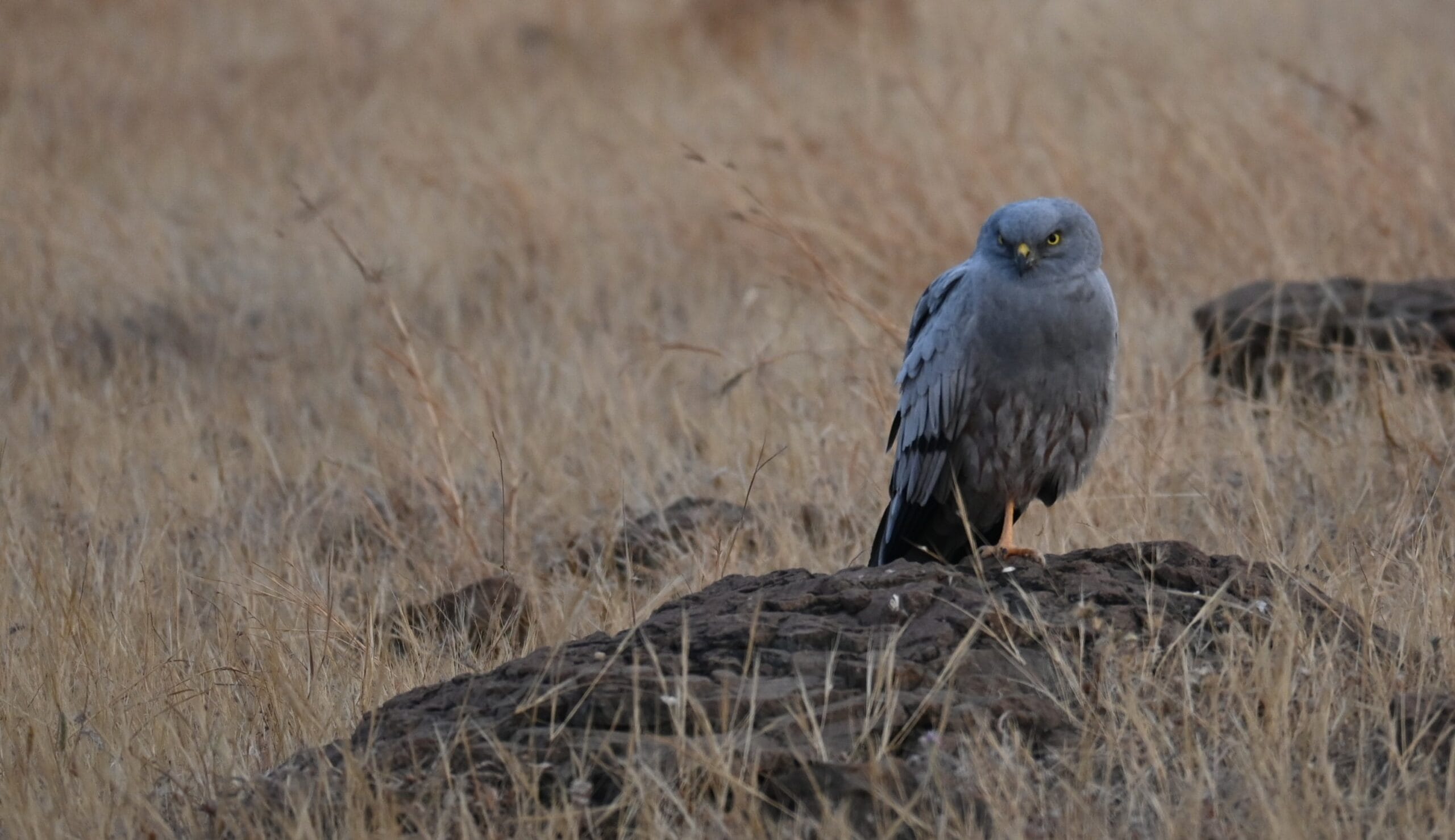
Male Montagu’s Harrier (Circus pygargus) in his element — a low basalt rock, open Deccan grassland, winter light. Kadbanwadi, Bhigwan. © Prashant S. Gupta / TravelOnTales
Most people who visit Bhigwan for the first time come for the waterbirds.
They come for the flamingos that turn the backwaters pink. Painted storks, bar-headed geese, and Ospreys perched over the dam are all on the checklist. And Bhigwan delivers — reliably and generously. However, sometime in the mid-morning, a good naturalist will suggest a different track. As a result, the landscape changes completely. The water disappears behind you. Before long, the golden tawny grassland of Kadbanwadi opens up — dry, windswept, Deccan-flat. Suddenly, you are in entirely different birding territory.
That is where the harriers are.
This male Montagu’s Harrier was perched on a basalt outcrop about twenty metres from the track. We found him during a winter safari organized through Wildagram Wildlife Expeditions. He stayed for nearly fifteen minutes. He rotated slowly on the rock, scanning the grass in every direction with that bright yellow eye. We subsequently shot him from four angles before he finally decided the grassland to the west required his attention.
Species Profile — Montagu’s Harrier
- Common Name
- Montagu’s Harrier
- Scientific Name
- Circus pygargus
- Named After
- George Montagu, British naturalist (1751–1815)
- Family
- Accipitridae (hawks, eagles and harriers)
- Size
- 40–50 cm length; wingspan 100–120 cm; male 220–300 g
- Male Plumage
- Slate blue-grey overall; black bar across secondaries; black wingtips; fine rufous streaking on underparts; yellow eye and cere
- Female Plumage
- Brown with white rump (classic “ringtail”); streaked underparts; yellow eye
- IUCN Status
- Least Concern (declining in Europe due to agricultural pressure)
- In India
- Winter visitor, October–March; dry open grasslands, plains, agricultural edges
- At Bhigwan
- Regular winter visitor; Kadbanwadi grasslands and Shirsufal near Baramati
- Migration range
- Breeds Eurasia (Portugal to Kazakhstan); winters Indian subcontinent and sub-Saharan Africa — up to 5,000 km each way
The Photograph — Four Angles, One Bird
What made this encounter unusual was time. Most raptor sightings in the Indian grasslands are kinetic — a bird in low quartering flight, working a line of grass, gone in thirty seconds. A perched harrier that stays is a gift, and this individual gave us four complete compositions across fifteen minutes.
The first frame — the close portrait — shows the bird’s defining features most clearly: the yellow eye, the clean slate-blue of the head and mantle, and the dark mottling on the folded wing coverts where the secondary bar begins. This is the diagnostic shot. The wider frames that follow show the bird in its context — small and alone on a basalt rock in a vast tawny grassland, which is exactly what this species looks like at Bhigwan in January.
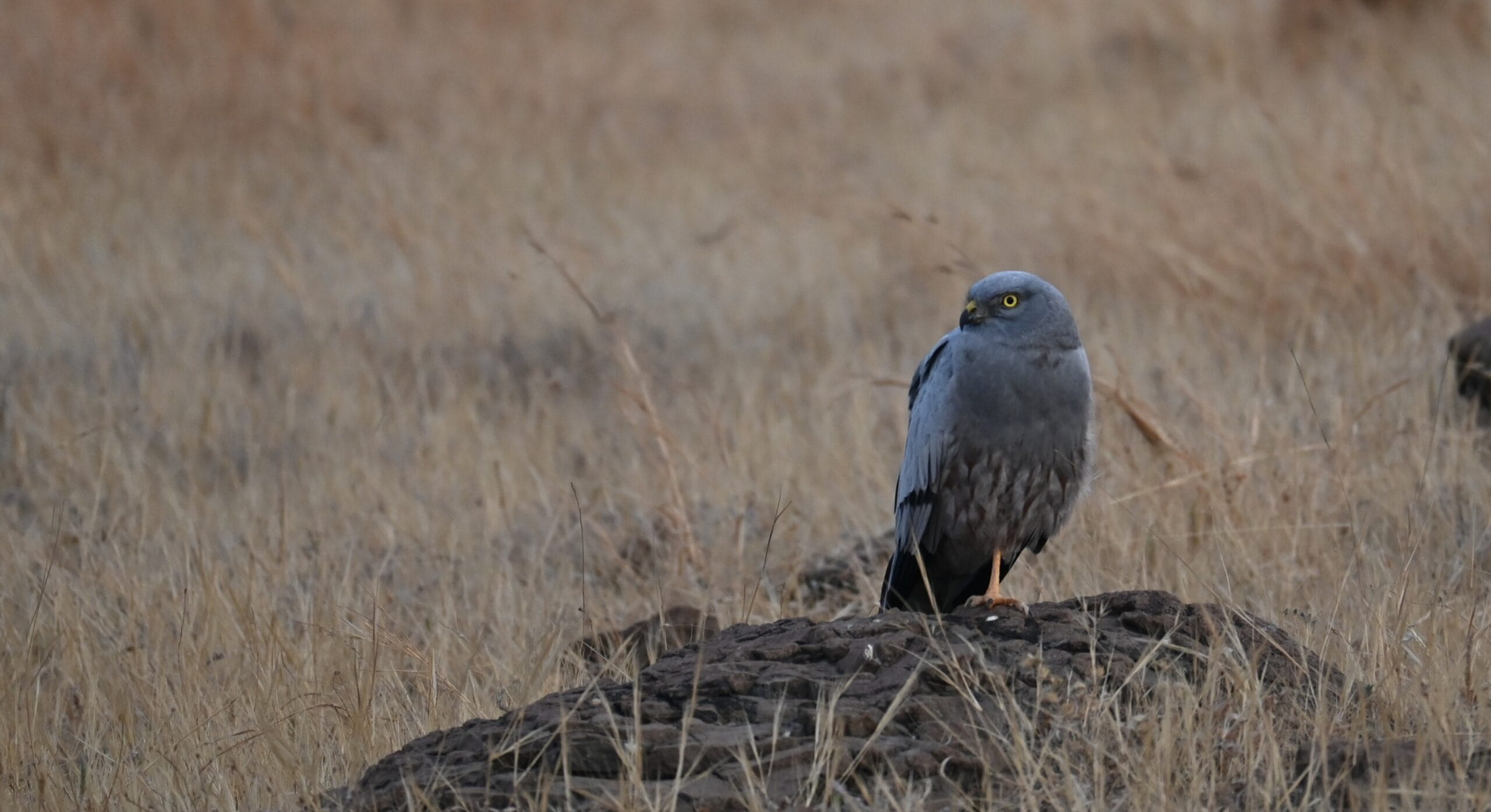
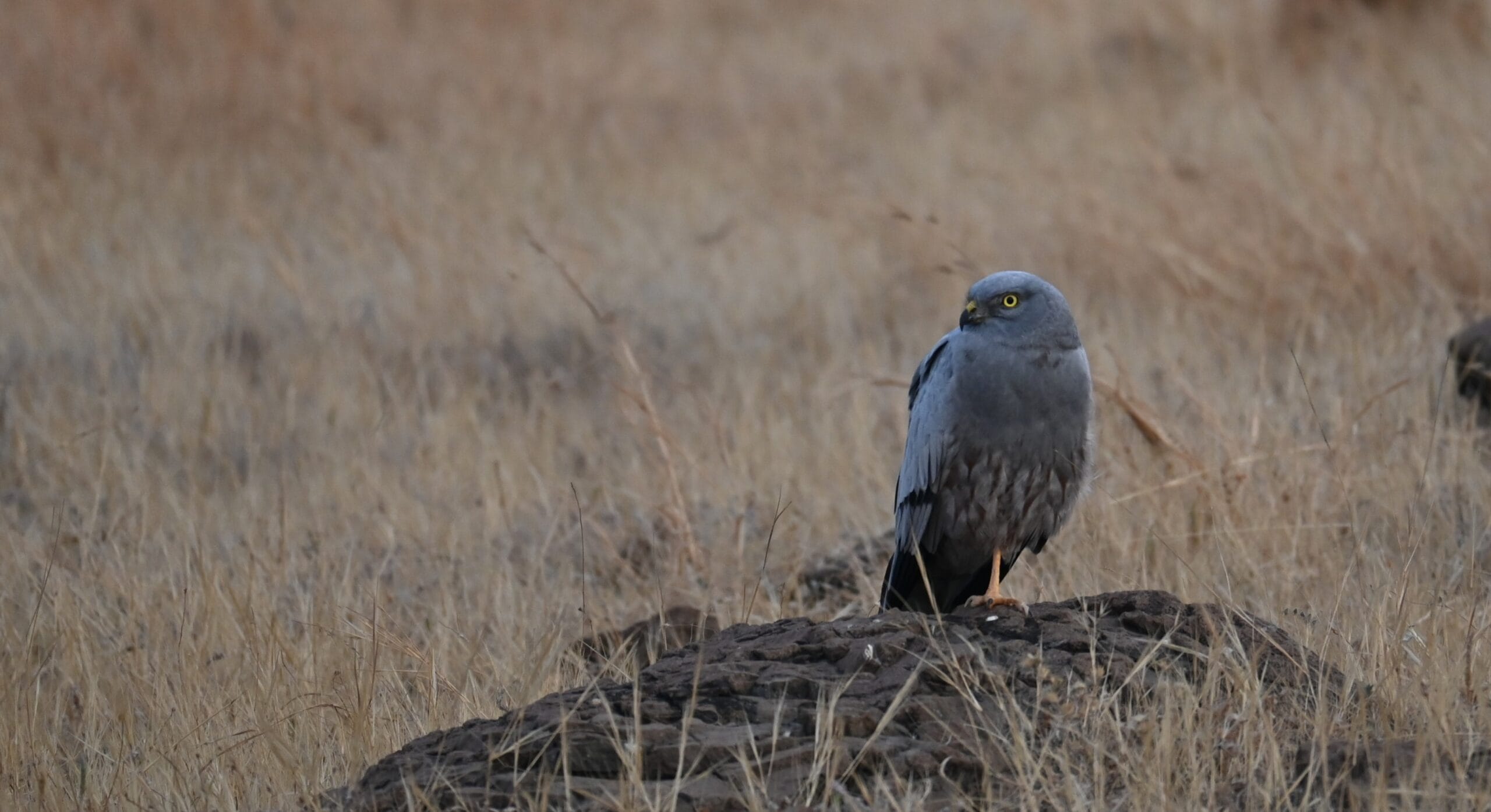
The habitat context photographs are important for a different reason. They show what you are actually looking at when you scan the Kadbanwadi grasslands: an open, almost featureless landscape of dry grass and scattered basalt where the elevated perch points — rocks, termite mounds, the occasional fence post — are where every raptor in the area concentrates. If you know to scan those points systematically with binoculars, the harriers find you.
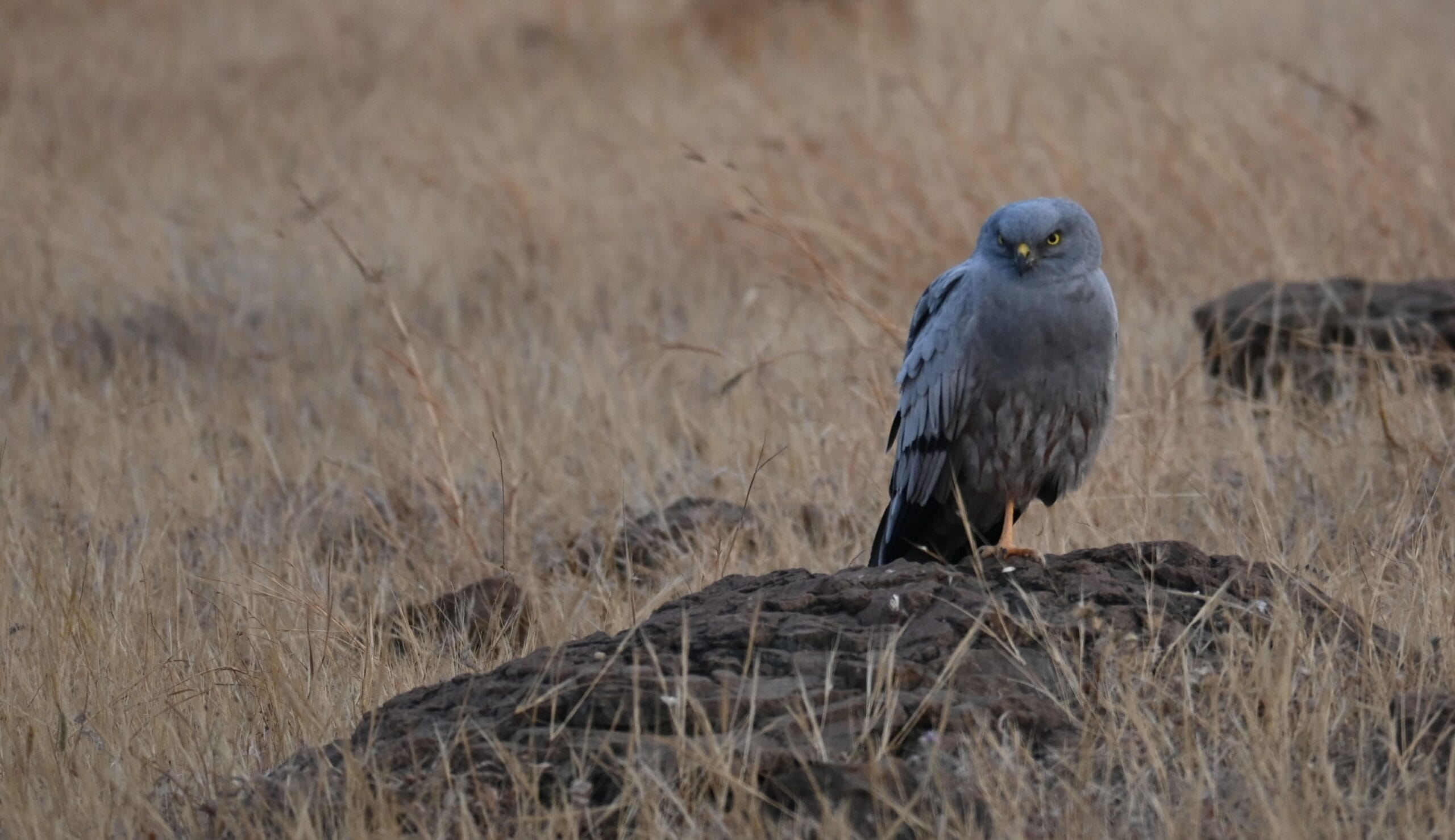
The grassland harrier is a bird that rewards stillness. You don’t chase it. You park the jeep, cut the engine, and wait to see what the rocks have to say. — Field notes, Kadbanwadi grasslands, Bhigwan · January
Why the Male Montagu’s Stops You Cold
Among winter raptors on the Indian subcontinent, the male Montagu’s Harrier holds a special place. It is not the largest — the Steppe Eagle and Greater Spotted Eagle are both bigger. Similarly, it is not the most dramatic — the Osprey diving or the Peregrine stooping outranks it for pure spectacle. Nevertheless, no winter raptor in India is more visually refined.
A Bird Built From Blue and Gold
That slate-blue plumage is the defining quality. Unlike the Pallid Harrier’s pale white-grey, this is a deeper, more saturated tone. As a result, it glows almost luminous against dried Deccan grass in low winter light. Furthermore, the yellow eye, the precise folded wing, and the alert upright posture all combine to make this a genuinely beautiful subject. In short, patient watching rewards you far more than a rushed encounter.
This individual was clearly a territorial male. The same compass points were scanned in the same order each time. His response to our presence never changed: register, assess, decide we are not worth moving for, resume scanning. This outcrop had been his base for weeks. Moreover, the relaxed posture showed he had seen safari jeeps many times before. In March, however, he would leave — heading north to breed in Eurasia. The following October, another male — possibly this same bird — would return and claim a rock on this same Kadbanwadi slope.
Identifying Montagu’s vs Pallid Harrier — The Essential Guide
Both Montagu’s and Pallid Harriers winter in Bhigwan’s grasslands, and the pair is one of the most discussed ID challenges in Indian field birding. For adult males in good light — as in these photographs — the separation is actually straightforward. The problems arise with females, juveniles, and birds in flight at distance.
Here is the complete comparison for the adult male, which is what we have across all four frames:
| Feature | Montagu’s Harrier ♂ | Pallid Harrier ♂ |
|---|---|---|
| Overall plumage tone | Darker blue-grey; saturated, not pale | Very pale — almost white-grey; ghost-like |
| Secondary bar KEY MARK | Prominent black bar across upperwing secondaries — visible perched and in flight | Absent — upperwing is clean grey with no bar |
| Wingtip pattern | Black primary tips extending back + secondary bar | Narrow black wedge at wingtips ONLY |
| Underparts | Fine rufous/chestnut streaking on belly and flanks | Clean white below — no streaking at all |
| Head tone | Same medium grey as back | Slightly paler, almost white-grey face |
| Build | Very slender, long narrow wings, long tail | Slightly bulkier; still slim but less attenuated |
| Flight style | Buoyant, almost tern-like — elastic wingbeats | More direct, slightly faster wingbeats |
| Foraging behaviour | Low quartering with sudden drops; follows vegetation edges | Similar but often faster, more direct approach |
The Secondary Bar — Your Single Best Field Mark
If you take one ID tool into the Kadbanwadi grasslands, make it this: look for the secondary bar. It is a dark band crossing the upper wing along the secondary feathers. In these photographs, it is visible on the folded wing. Moreover, it becomes dramatically clear in flight. Therefore, if you can see that bar, you have a Montagu’s. If, on the other hand, the upperwing is clean grey with only a narrow dark edge at the wingtips, you have a Pallid.
Female and Juvenile: The Hard Identification
Female and juvenile Montagu’s and Pallid Harriers are known as “ringtails.” Both are brown above and streaked below, with a barred tail and a white rump patch. As a result, they are among the hardest ID problems in Indian birding. However, the most reliable distinction is the pale collar on the Pallid — a crescent of whitish feathering behind the dark cheek. By contrast, female Montagu’s lacks this collar entirely. The head pattern is more uniform and darker behind the eye. In poor light at distance, therefore, experienced birders often leave these birds unresolved as “Monpal.” When in doubt, photograph first and review later.
See Montagu’s Harrier on a Full-Day Bhigwan Bird Safari from Pune
The Kadbanwadi grassland zone is not automatically on the itinerary for self-drive visitors — most first-time Bhigwan trips stick to the Ujani backwaters and miss the raptor grasslands entirely. A guided full-day safari from Pune covers both sessions: morning backwater boat safari for flamingos, painted storks, and waders; mid-morning grassland drive for harriers, eagles, and kestrels. It’s the difference between a flamingo trip and a complete Bhigwan experience.
This Viator-listed safari includes:
- Return transport from Pune
- Expert naturalist guide
- Boat safari on Ujani backwaters
- Grassland jeep session
- Species checklist
- Full-day itinerary (6 AM–7 PM)
The Migration Story: From Eurasia to Kadbanwadi
There is something genuinely affecting about the geography of this bird’s presence at Bhigwan.
A Journey of 5,000 Kilometres
Montagu’s Harrier breeds across a vast arc of Eurasia. Its range runs from Portugal and the UK in the west through France, Spain, Russia, Belarus, Poland and Kazakhstan to the steppes of Central Asia. Importantly, the birds wintering in India are primarily from the eastern part of this range. Departure from breeding grounds happens in August and September. After crossing mountain ranges and arid zones, the birds reach the Thar Desert margins and consequently arrive in peninsular India by October and November.
What Bhigwan Means to This Bird
The bird on that Kadbanwadi rock may therefore have flown 4,000 to 5,000 kilometres to be there. It will spend four months hunting these grasslands. Its diet includes small rodents, lizards, large grasshoppers, and the occasional small bird. By March, however, the journey north begins again. In other words, Bhigwan is simply a winter address — a seasonal territory this bird knows, perhaps returns to each year, and perhaps competes for with other males.
When you understand that, the fifteen minutes on the rock takes on a different quality. You are not simply watching a bird. Rather, you are watching the endpoint of a continental journey.
The Kadbanwadi Grasslands: Bhigwan’s Hidden Raptor Zone
Most Bhigwan trip reports focus almost exclusively on the Ujani backwaters — and for good reason. The waterbird density there is extraordinary. Consequently, the boat safari is one of Maharashtra’s finest wildlife experiences. However, the dry grassland zone around Kadbanwadi and Shirsufal near Baramati is a completely different habitat. It has a different species list. Moreover, it remains underreported in most online coverage of Bhigwan.
In winter, the Kadbanwadi grasslands host a remarkable raptor diversity. In addition to Montagu’s and Pallid Harriers, the zone regularly produces Greater Spotted Eagle, Indian Spotted Eagle, Steppe Eagle, Tawny Eagle, Booted Eagle, and Bonelli’s Eagle. Furthermore, Common Kestrel, Red-necked Falcon, White-eyed Buzzard, and Short-toed Snake Eagle are all regularly seen. As a result, for the raptor photographer, this is the most productive zone in all of Maharashtra between November and February.
Reading the Basalt Rock Scatter
The key to the grassland zone is the basalt rock scatter. The Deccan plateau’s dark basalt outcrops are low and flat-topped. Therefore, they are exactly the right height for a perched harrier or kestrel to survey the grass around it. Scan every exposed rock systematically on your approach. What looks like a dark stone from a hundred metres sometimes has wings. Meanwhile, termite mounds serve the same function — particularly for smaller raptors like the Common Kestrel. In short, anything elevated above the grass line is worth a second look.
Photography Notes: Shooting a Perched Harrier
Field Photography Settings — Male Montagu’s Harrier, Perched
- Approach: Stop the jeep and kill the engine at least 30 metres out — perched harriers are more sensitive to engine vibration than visual approach at this range
- Aperture: f/6.3–f/8 — you need the full bird sharp, not just the head; at f/4 the wing-tips can go soft on a slightly turned bird
- Metering: Spot meter directly on the bird’s chest; the golden dry grass background fools evaluative metering into underexposing the bird by 1–1.5 stops
- Shutter: 1/640s is sufficient for a fully stationary bird; go to 1/1000s when the head is moving — harrier head movements are sudden and fast
- ISO: Auto ISO with ceiling at 6400; early morning Kadbanwadi light is low and you need the latitude
- AF Mode: Single point AF on the eye for portraits; Animal Detection AF (Nikon Z50) works well in open grassland for tracking any sudden movement to flush position
- When it flushes: Switch to Continuous AF immediately and track — the flush gives you the secondary bar and wing pattern most clearly; these are the ID-critical frames
- White balance: Shoot RAW; the warm golden-hour light on blue-grey plumage requires manual colour correction in post to render accurately
- Focal length: 300mm is sufficient at 20 metres; the real challenge is not focal length but stability — use a bean bag on the jeep door rather than handheld at long focal lengths
Planning Your Bhigwan Grassland Safari
Self-Drive vs Guided: What to Know
The grassland zone at Kadbanwadi requires a vehicle — there is no practical way to cover it on foot, and the birding distances involved make a jeep essential. If you are coming from Pune on a self-drive trip, therefore, factor at least two hours for the grassland session in addition to backwater time. The productive window for perched raptors is 7 AM to 10:30 AM before the heat causes birds to seek shade.
For first-time visitors, however, a guided full-day safari is the more efficient option — the naturalist knows which rocks are currently being used as regular perches, which routes have been productive that week, and crucially, will be able to identify birds at distance before you’ve even raised your binoculars. In fact, the difference between a good day and a great day at Kadbanwadi is almost entirely a function of local knowledge.
Where to Stay and When to Leave
In addition to the grassland drive, Bhigwan village has several guesthouses, including Agnipankh, which caters specifically to birding visitors and can arrange both boat and grassland sessions locally. For those coming as a day trip from Pune, departure by 5:30 AM is recommended so that you are in the grassland zone at first light.
Frequently Asked Questions
Is Montagu’s Harrier found at Bhigwan?
Yes. Montagu’s Harrier (Circus pygargus) is a regular and reliable winter visitor to Bhigwan’s dry grasslands, particularly at Kadbanwadi and the Shirsufal area near Baramati. November through February is peak season.
How do I identify Montagu’s Harrier vs Pallid Harrier?
For adult males: Montagu’s is darker blue-grey with a prominent black bar across the secondary wing feathers and fine rufous streaks on the underparts. Pallid is much paler — almost white-grey — with narrow black wingtips only, clean white underparts and no secondary bar. The secondary bar is the single most reliable field mark for adult male Montagu’s.
When is the best time to see Montagu’s Harrier at Bhigwan?
November through February. Early morning grassland sessions at Kadbanwadi (7–10:30 AM) offer the best chances of perched birds before midday heat pushes them into shade and low flight.
Where exactly in Bhigwan should I look for harriers?
The Kadbanwadi grasslands and the Shirsufal area near Baramati are the primary zones — these are distinct from the Ujani backwater area and require a separate grassland drive. Scan basalt rock outcrops systematically; perched harriers use these as territorial survey points.
What camera settings work for photographing a perched harrier?
Aperture priority at f/6.3–f/8; spot meter on the bird’s chest (the golden grass background will cause underexposure if you use evaluative metering); 1/640s minimum; Auto ISO. Shoot RAW for white balance flexibility with blue-grey plumage in warm morning light.
Can I see Montagu’s Harrier on a day trip from Pune?
Yes. Bhigwan is about 100 km from Pune. The Full-Day Bhigwan Bird Safari from Pune (Viator) covers both the backwater boat session and the Kadbanwadi grassland drive — the complete Bhigwan experience in one day.