
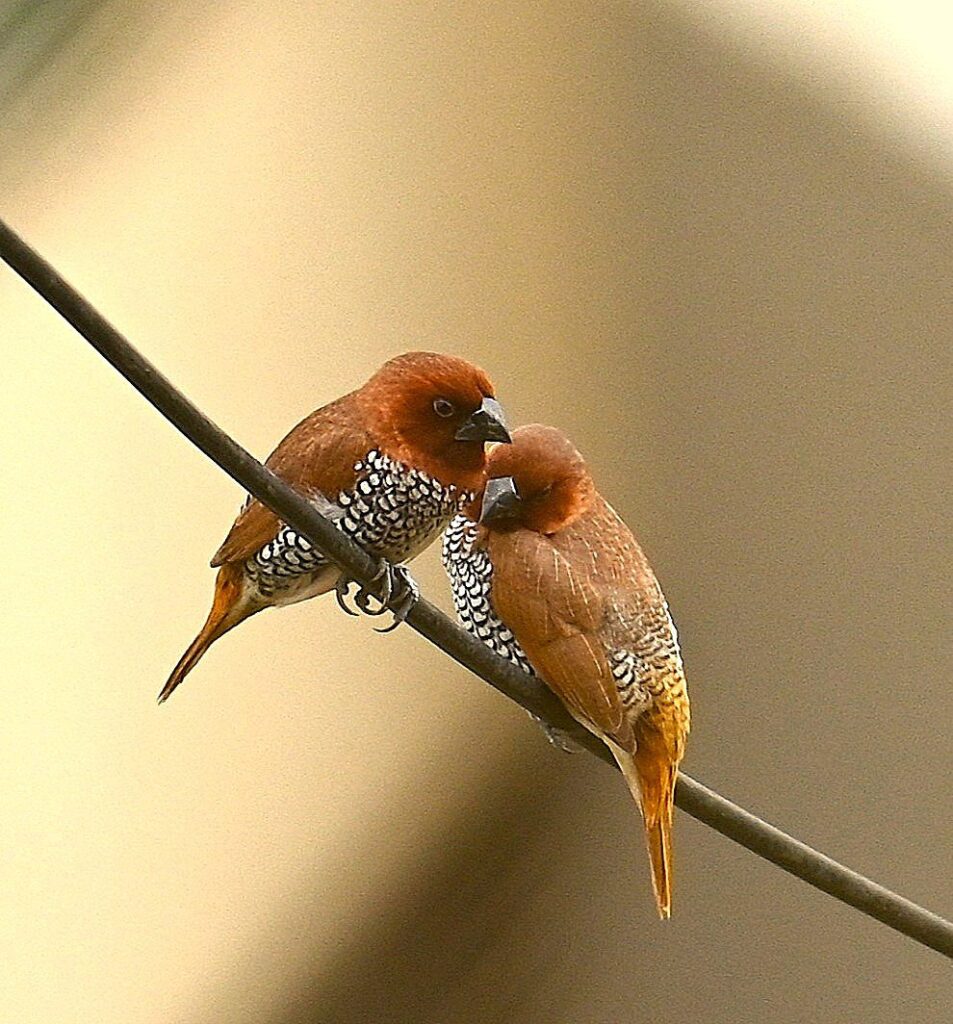
Nutmeg Mannikins

About the Species:

  • These little beauties in your photo are Scaly-breasted Munias (Lonchura punctulata), also known as Nutmeg Mannikins or Spice Finches.
  • Appearance: They get their name from the beautiful white-and-dark scale-like pattern on their underparts. Their head and upper body are usually chestnut brown.
  • Habitat: Commonly found in India, Southeast Asia, and introduced in other parts of the world, they thrive in grasslands, farmlands, gardens, and even urban areas.
  • Diet: They are primarily seed eaters, especially fond of grass seeds, but occasionally snack on insects.
  • Social Nature: Munias are highly gregarious—you’ll often see them in flocks of 10–100, chirping away in perfect coordination.

Fun Facts for Articles:

  1. Architect Birds: Scaly-breasted Munias are skilled nest-builders. Their nests are oval and woven from grass blades, almost like a little basket hung in the trees.
  2. Team Players: Unlike many birds, they are non-territorial and peacefully share food sources in large flocks.
  3. Farmers’ Frenemies: Farmers love them for eating weed seeds but hate them for raiding paddy fields—it’s a love-hate relationship.
  4. Bird Yoga Masters: They can hang upside down acrobatically while feeding on grass seeds, looking like tiny trapeze artists.
  5. Symbol of Simplicity: In many Asian cultures, munias are seen as a symbol of simplicity and community living because they thrive best in groups.
  6. Travel Buffs: Though small (about 11–12 cm long), they have been introduced worldwide—including the U.S., Puerto Rico, and Australia—proving that wanderlust runs even in tiny feathers.

One bird, many names

This species collects names. Nutmeg Mannikin, Scaly-breasted Munia, Spotted Munia, Spice Finch — all the same bird, Lonchura punctulata.

“Spice finch” and “nutmeg mannikin” come from the cage-bird trade, where it was sold under those names. “Scaly-breasted munia” is the one most Indian field guides now use, and it is the most descriptive.

The scaling is the field mark

An adult has a warm chocolate-brown head and throat, and underparts covered in fine dark crescents over white. The effect really does look like scales or fish-net.

  • Adult: brown hood, heavily scaled white underparts, stubby grey conical bill.
  • Juvenile: plain buff-brown all over with no scaling at all. This catches out almost everyone.
  • Size: about 11 to 12 cm. Small, round and short-tailed.

A flock will usually contain both, so if you see plain buff birds mixed with scaled ones, you are looking at adults and this year’s young together, not two species.

Telling it from the other munias

  • Scaly-breasted Munia: brown hood, scaled underparts.
  • Indian Silverbill: paler and sandier, with a distinctly silver-blue bill and a pointed dark tail.
  • Tricoloured Munia: clean black head, white belly, chestnut back. No scaling.
  • Red Avadavat: breeding male unmistakable — red with white spots.

Where to look

Grassland, standing crops, reedbeds, scrub and garden edges. They follow seeding grass, so where the grass has gone to seed, there will be munias.

They are almost always in flocks, and they announce themselves with a thin, high ki-tee call in flight.

Photographing them

  • Find the seed heads. Munias cling sideways to grass stems to feed. That is the picture, not a bird on a branch.
  • Shoot the flock. Several birds on one swaying stem tells the story better than one.
  • Get close to their level. They feed low, often below knee height.
  • Watch for the juveniles. A plain bird beside a scaled one makes an informative frame.

Frequently asked questions

Is the Nutmeg Mannikin the same as the Scaly-breasted Munia?

Yes. Same species, Lonchura punctulata. The names come from different traditions — cage-bird trade versus field guides.

Why do some have no scales?

Those are juveniles. Young birds are plain buff-brown and develop the scaled pattern as they mature.

How big is it?

Around 11 to 12 cm. Small, round and short-tailed.

What does it eat?

Mainly grass seed, plus some small insects when feeding young.


Related: Munia nesting and flock behaviour and Munias and the cage-bird trade.

Scroll to Top