
Pied Bush Chat:
Same Bird, Completely Different Look
One is dressed in pure black. The other, however, disappears into dry grass. Meet the male and female of India’s most common open-country bird — and why nature made them look nothing alike.
“Two birds. Same species. One black as monsoon clouds, the other the colour of dry earth. If you didn’t know better, you’d file them in completely different notebooks.”
A Morning at Bhigwan That Changed My Field Notes
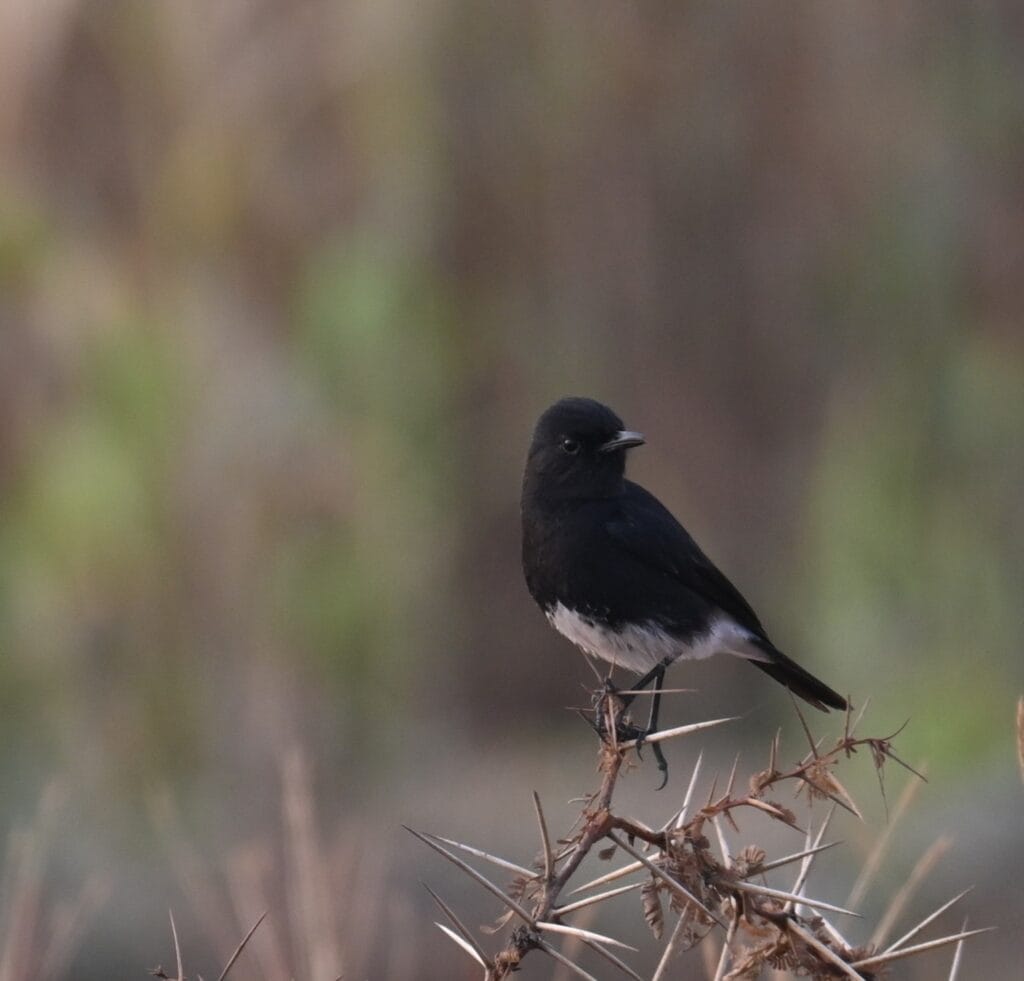
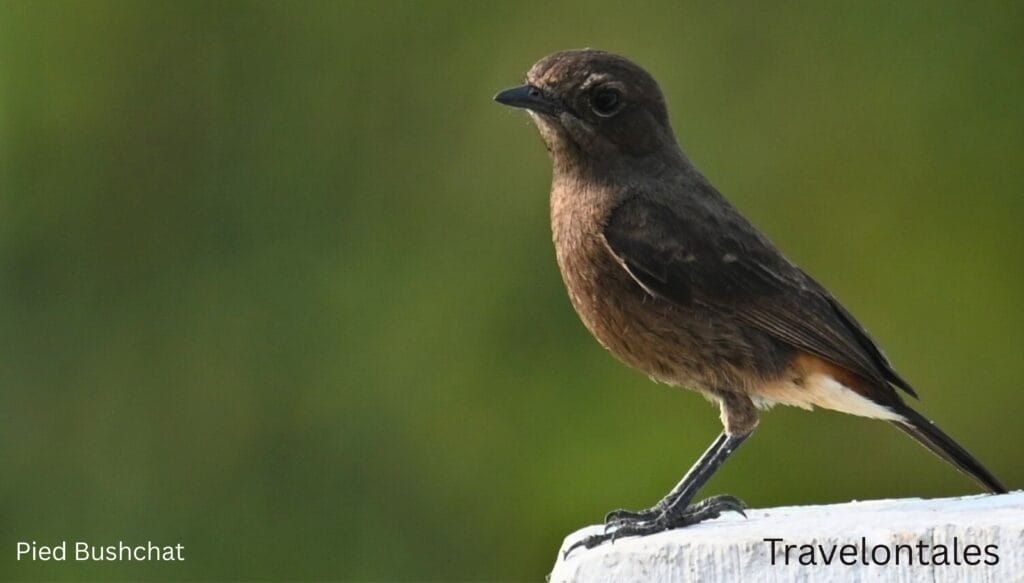
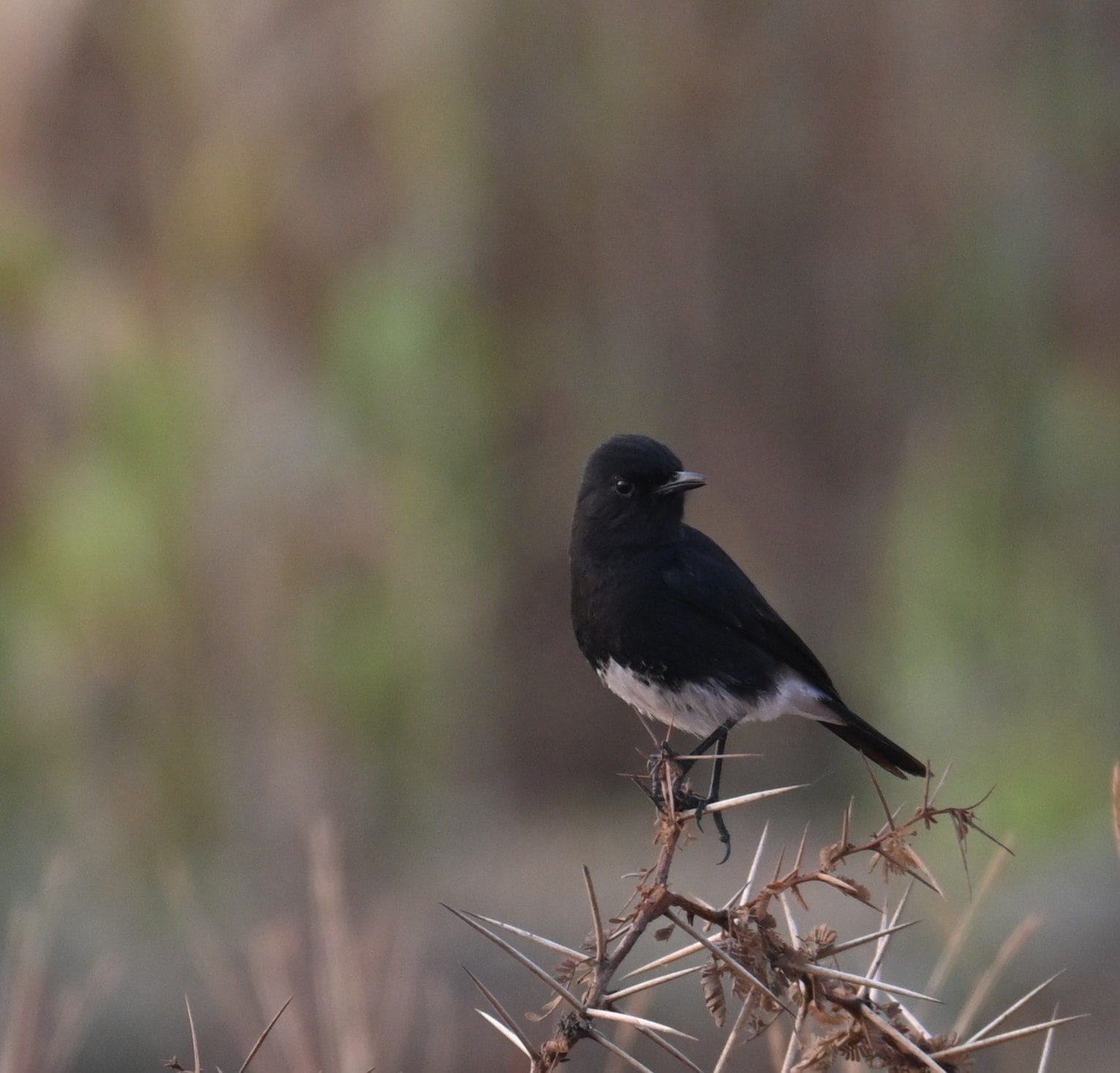
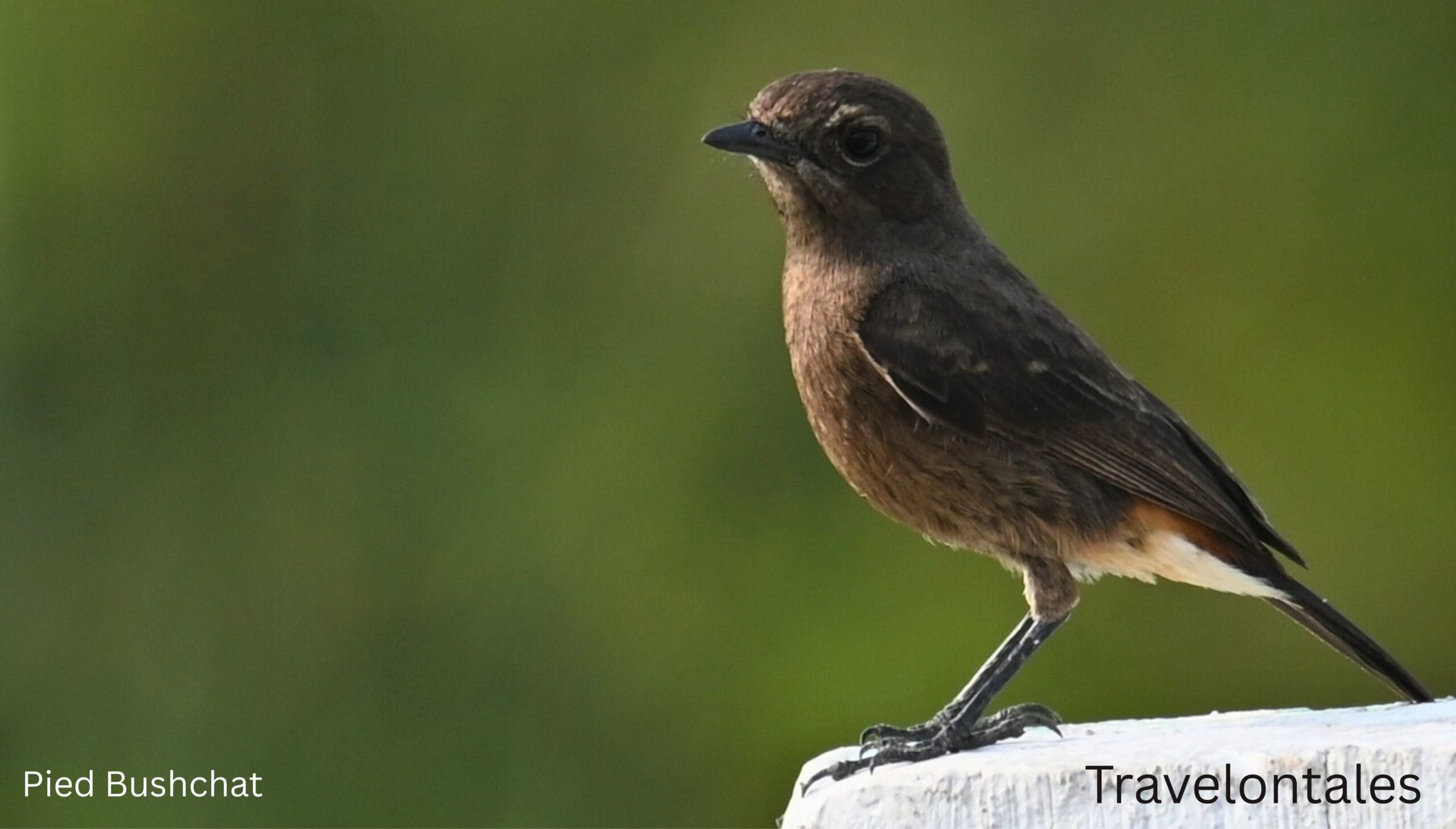
It happened exactly like this at Bhigwan: first, I photographed a small brown bird perched on a white boundary wall — unremarkable at first glance — and made a note to ID it later. Then, barely an hour later, a glossy jet-black bird with a sharp white flank patch landed on a thorny scrub just twenty metres away. Two birds, two photographs, and two completely different field impressions.
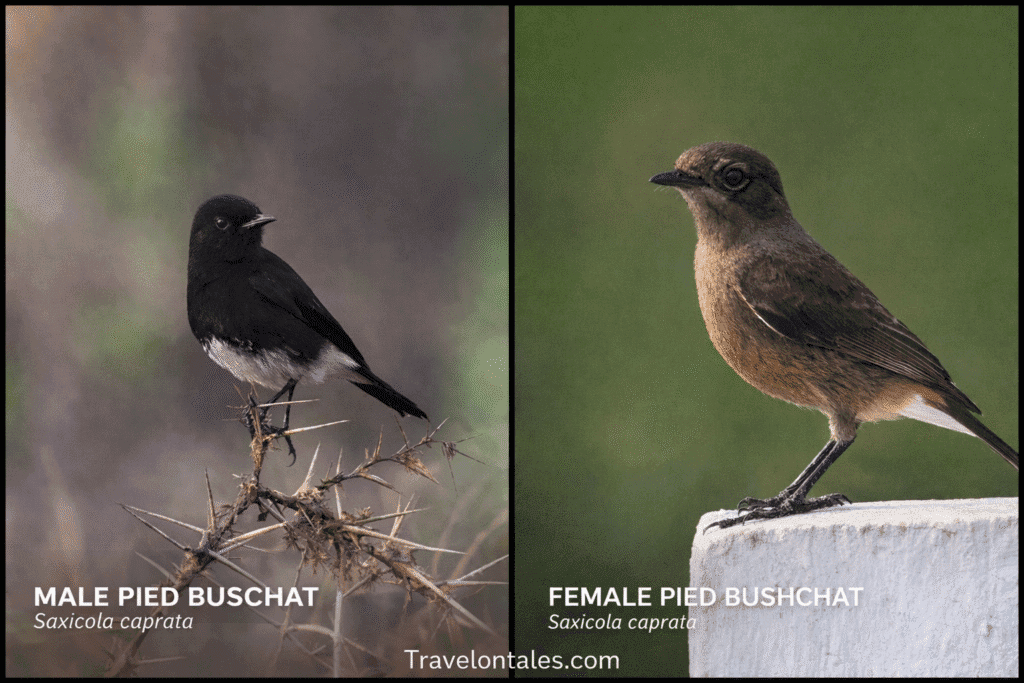
As it turned out, they were the same species — the Pied Bush Chat (Saxicola caprata). One female. One male. Moreover, the contrast between them is one of the most dramatic examples of sexual dimorphism you will encounter in Indian birdwatching.
What This Article Covers
This field guide documents both sexes with original photographs, explains why they look nothing alike, and furthermore gives you everything you need to identify the Pied Bush Chat — in either form — whenever you encounter it across India’s open scrublands, wetland edges, or agricultural margins. In addition, we cover habitat, behaviour, photography tips, and the best locations in Maharashtra to find this species.
Side by Side · Original Field Photographs
The Same Bird — Two Faces
Both photographed at Bhigwan Wetlands, Maharashtra · © TravelOnTales / Prashant S. Gupta
| Feature | ♂ Male | ♀ Female |
|---|---|---|
| Overall colour | Glossy jet black | Warm brown above |
| Underparts | White flank & vent patch | Buffy-rufous, pale buff belly |
| Wings | Black with white wing patch | Plain brownish, no white |
| Rump | White (visible in flight) | Rufous-orange tinge |
| Head | Entirely black, rounded | Brown with pale eyebrow hint |
| Eye | Dark, more visible against brown | |
| Confusion species | Indian Robin (♂), Black Redstart | Female stonechats, female robins |
| Purpose of plumage | Territory + mate attraction | Camouflage while nesting |
| Field impression | Unmistakable, bold | Often overlooked, subdued |
Field Guide How to Identify Both Sexes in the Field
The male Pied Bush Chat is one of the easiest birds in India to identify at a glance. The female, however, requires a little more attention — but once you have the search image, you will consequently start noticing her everywhere you previously missed her. Below, therefore, are the key marks for both sexes.
Entirely glossy black except for a clean white patch on the lower flanks and vent, and a white wing patch visible in flight. Notably, there are no brown tones anywhere on the male. The black head is rounded and the bill is short and fine. In addition, the upright posture with a slightly cocked tail is a very reliable field cue.
Warm brown above, buffy-rufous below, with a pale buff lower belly and vent. Importantly, she has no white wing patches and a dark brown tail. She often looks plain and unmarked at first glance — therefore, look for the flycatcher posture and perch-hunt behaviour to confirm ID.
Confusion Species: What Looks Similar?
The Indian Robin male is also black with a rufous vent — however, it shows chestnut-red under the tail and lacks the Pied Bush Chat’s white flank patch. Similarly, the Black Redstart has a rusty-red tail, diagnostic in any light. By contrast, the Pied Bush Chat’s white flank flash remains unique among these species.
Female Siberian Stonechat and female Brown Rock Chat look similar. However, there are key differences: the Pied Bush Chat female has a pale buff belly and vent, plain wings, and the same upright perching posture as the male. Above all, watch for the hunting behaviour — drop to ground, return to perch.
Where to Find Them Habitat & Distribution in India
The Pied Bush Chat is one of the most widespread resident birds on the Indian subcontinent, present from sea level up to about 3,000 metres in the Himalayas. Notably, it has a strong preference for open, semi-arid landscapes — and a distinct aversion to dense forest interior.
At Bhigwan, for instance, the birds thrive on the mosaic of open scrub, agricultural margins, and grassy wetland fringes around the Ujjani reservoir. In particular, the dry thorny scrub patches near Diksal village are especially productive. Both male and female are consequently encountered here year-round, often within metres of each other during the breeding season.
Reliable Locations Across Maharashtra & India
Beyond Bhigwan, therefore, look for this species at the grassland margins of Tadoba and Pench, the agricultural fringes of Pune and Nashik districts, the dry scrub of Rajasthan and Gujarat, and Tal Chhapar grasslands in Rajasthan. In addition, almost any open area across Central India will hold this species. Meanwhile, in the Himalayas, the species undertakes short altitudinal migration — birds descend to foothills and plains through winter.
Best Spot in Maharashtra: Bhigwan Wetlands
The open scrubby margins along the Ujjani reservoir shoreline — particularly near Diksal village — are exceptional for both male and female Pied Bush Chat year-round. Early morning visits between October and April give the best light and the most active birds. The breeding season (February–June) makes males especially visible and vocal.
In the Field Behaviour: The Perch-Hunt-Return Loop
Watch either sex for five minutes and a clear pattern locks in. First, the bird picks the highest available perch — a thorn tip, a fence wire, the corner of a wall — and then surveys the ground intently. It drops, snatches an insect from the soil or low vegetation, and immediately returns to the same or adjacent perch. This is the flycatcher’s contract with open country: height for visibility, stillness for patience, and sudden speed for the strike.
Furthermore, the Pied Bush Chat is primarily insectivorous, taking beetles, ants, grasshoppers, moths, and flies. During the breeding season, males consequently become highly territorial, singing persistently and chasing rivals with aggressive determination.
Nesting & Breeding Season
When it comes to nesting, the nest is typically built in a cavity — a hole in a wall, a crevice in an embankment, or occasionally low scrub — and lined with grass and animal hair. The female then incubates two to five eggs over approximately 12–13 days. As a result, the breeding season from February to June is therefore the best time to observe active territorial behaviour, particularly in the males.
Song & Calls
The male’s song is a pleasant, varied warbling — somewhat scratchy, yet with a cheerful quality. It has been described as sounding like “we are tea for two” with the ‘tea’ note rising higher. He consequently sings from prominent perches throughout the breeding season, using song both to proclaim territory to rival males and to court females. In addition, the alarm call is a sharp, dry double note — a hard weet-chak — which, once learned, is one of the most reliable signals that you are near open-country scrub with this species present.
Behind the Lens Photography Tips for Both Sexes
The male Pied Bush Chat is deceptively tricky despite being easy to find. Specifically, the all-black head and breast demand careful exposure management. The female, on the other hand, is a subtler challenge — first finding her at all, and then separating her from similarly coloured birds in confusing light.
- Meter for the black plumage, not the background — aim to retain detail on the breast and head even if the background slightly overexposes.
- Furthermore, shoot RAW and recover the white flank patch in post — the dynamic range challenge is real: pure black and pure white in the same small frame.
- In particular, early morning light at a low angle is ideal — it gives the black plumage a subtle sheen rather than a flat void.
- Moreover, the thorny perch context (as in DSC_5392) is worth waiting for — it tells the habitat story far better than a wire or wall.
- Finally, wait for the bird to return to its favourite perch — patience therefore yields better compositions than chasing.
Photographing the Female: Finding the Hidden Bird
- First, look for the upright posture — even when the plumage blends in, the shape gives her away.
- Also, the boundary wall or fence perch (as in the Bhigwan female photograph) gives a clean background — use it when available.
- In addition, the pale buff belly and vent are the key ID marks in photographs — ensure the underside is visible in your composition.
- Furthermore, she will often be found close to the male’s territory — if you’ve photographed the male, therefore scan nearby low perches for the female.
- Finally, overcast light works especially well for the female — the flat, even tone of a cloudy morning brings out the warm brown tones without harsh shadows.
Status Conservation & Long-term Outlook
The Pied Bush Chat is currently listed as Least Concern on the IUCN Red List, with stable populations across its wide range from the Middle East through the Indian subcontinent to Southeast Asia. Moreover, it is one of the beneficiaries of agricultural expansion — fallow fields, field margins, and scrubby cultivation edges provide abundant foraging habitat that did not exist before human land use.
A Growing Threat: Pesticide Use
However, intensification of agriculture — particularly heavy pesticide use that depletes insect populations — poses a longer-term concern. Since this species feeds almost entirely on insects, a landscape with fewer insects therefore means fewer Pied Bush Chats. As a result, recording and documenting this species across locations contributes meaningfully to our understanding of open-country bird populations in India’s rapidly changing agricultural landscape.
Why Field Photography Matters
Every field photograph with accurate date, location, and sex information is consequently a data point. This is precisely why original photography like the two images in this article — both sexes, same site, documented date — has value beyond aesthetics. In short, it is field science, conducted without a laboratory.
Common Questions Frequently Asked
Identification & Species Questions
Why do male and female Pied Bush Chat look so completely different?
This is sexual dimorphism — one of the most pronounced examples among small Indian birds. Specifically, the male’s bold black-and-white plumage helps him attract mates and defend territory from rival males. Meanwhile, the female’s brown, earth-toned camouflage protects her while she incubates eggs in low ground nests or wall cavities. As a result, nature gave each sex exactly the colouring it needs to fulfil its role in reproduction and survival.
I saw a small black bird with a white belly in India — is it a Pied Bush Chat?
Almost certainly yes, if you were in open scrubland, agricultural margins, or near wetland edges. Specifically, the male Pied Bush Chat (Saxicola caprata) is entirely glossy black with a clean white patch on the lower flanks and vent. The only common confusion species is the male Indian Robin, which has chestnut-red under the tail — a very different colour. Therefore, if there was no red or orange anywhere, your bird was very likely a Pied Bush Chat.
How do I identify a female Pied Bush Chat?
The female is warm brown above with a buffy-rufous underside and pale buff lower belly. She has no white wing patches and is consequently often mistaken for a female Indian Robin or a female stonechat. However, the most reliable field marks are the pale buff vent area, the plain (unstreaked) underparts, and the classic flycatcher behaviour — perching upright on an exposed spot and dropping to the ground for insects. Furthermore, if you find the male, the female is almost always nearby.
Location & Birdwatching Questions
Where can I see Pied Bush Chat at Bhigwan, Maharashtra?
The open scrubby margins around the Ujjani reservoir — particularly near Diksal village — are ideal. Both male and female are resident year-round. However, the breeding season from February to June is the most rewarding time, as males are consequently vocal and highly active from prominent perches. In particular, early morning visits between 6:30 and 9:30 AM give the best light and the most active birds.
Names, Range & Distribution
Is the Pied Bush Chat the same as the Pied Stonechat?
Yes — Pied Stonechat is an alternate name used in some older field guides and in the UAE. However, the current accepted IOC name is Pied Bush Chat. Importantly, the scientific name Saxicola caprata remains constant across all naming conventions. In India, therefore, both Pied Bush Chat and Pied Bushchat are in common use.
Are Pied Bush Chats found only in Maharashtra?
Not at all — the Pied Bush Chat is in fact one of the most widespread resident birds across the Indian subcontinent. Specifically, it is found in every Indian state with open scrubland and agricultural habitat. Moreover, it ranges from Sri Lanka north through India and Pakistan into Central Asia and Southeast Asia. As a result, you will encounter it at virtually any open-country birding location in India.