
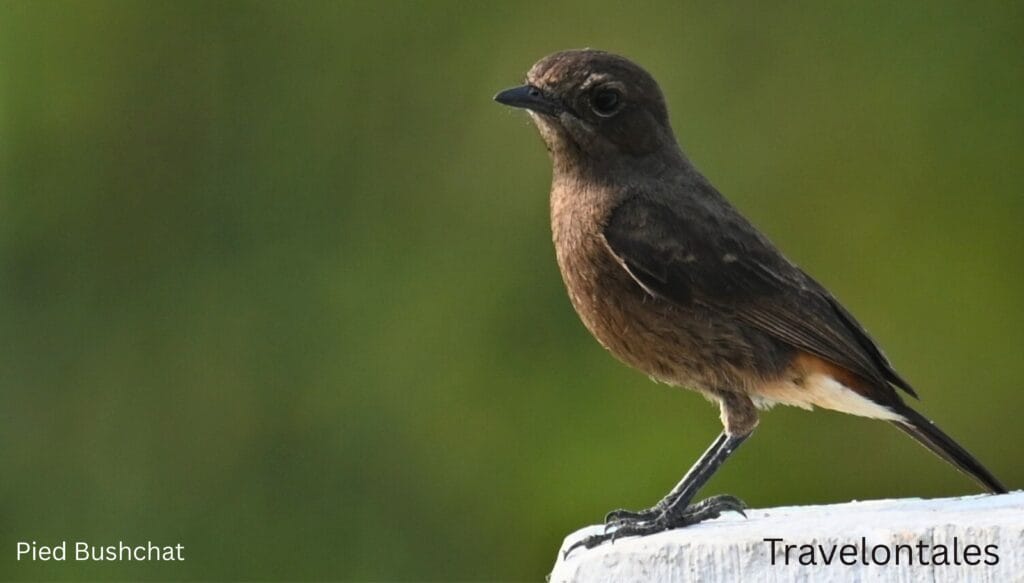
Pied Bushchat (Saxicola caprata) – The Silent Sentinel of Bhigwan Grasslands
Perched quietly yet alert, the Pied Bushchat (Saxicola caprata) is one of the most fascinating small birds found in the open grasslands of Bhigwan, Maharashtra. Though often overlooked due to its size, this bird carries a unique charm that captivates bird watchers and wildlife photographers alike.
📍 Habitat and Distribution
The Pied Bushchat thrives in open landscapes such as grasslands, scrublands, and agricultural fields. Bhigwan, known for its rich bird diversity, provides the perfect ecosystem for this species. Its adaptability allows it to be commonly spotted across the Indian subcontinent.
🪶 Appearance and Identification
This small passerine bird is known for its upright posture and sharp features. Males are typically black with white patches, while females, like the one captured here, display a more subtle brown tone with delicate patterns. Their alert stance and quick movements make them easy to identify once noticed.
🎯 Behavior and Feeding
The Pied Bushchat is an insectivore, often seen perched on low branches or rocks, scanning its surroundings for prey. It quickly darts down to catch insects, showcasing agility and precision. This “perch-and-pounce” behavior makes it an exciting subject for photographers.
📸 Why Photographers Love It
Despite its small size, the Pied Bushchat offers incredible photographic opportunities. Its habit of perching in open spaces provides clean backgrounds, making it ideal for sharp, minimalistic compositions. The natural lighting of Bhigwan further enhances its subtle tones and textures.
🌿 Fun Facts
- The Pied Bushchat often returns to the same perch repeatedly.
- It is known for its territorial behavior despite its small size.
- Its call is soft but distinctive, especially during early mornings.
- Females have more muted colors, helping them blend into surroundings for protection.
📷 Final Thoughts
The Pied Bushchat may not be as flashy as flamingos or eagles, but it represents the beauty of simplicity in nature. Observing this bird in Bhigwan reminds us that even the smallest creatures play a significant role in the ecosystem—and offer immense joy to those who take the time to notice.
Explore more wildlife stories and photography at TravelOnTales
The bird on the topmost twig
Pied Bushchats have a habit that makes them easy to find: they perch high and exposed. Fence posts, wires, the very top of a bush, a dry stem standing above the grass.
They are hunting from it. The bird watches the ground, drops onto an insect, and returns to the same perch — often the identical twig, dozens of times in a morning.
This is why a bushchat is one of the easiest small birds to photograph well. Find the perch, and the bird comes back to you.
Why the male is so black
A male Pied Bushchat in breeding condition is jet black with a white rump and a white wing patch, sitting on the highest thing available in open country.
That combination is deliberate advertisement. He is holding a territory in habitat with no cover, and the most efficient way to tell rivals and females that the ground is taken is to be conspicuous and stay conspicuous.
The cost is obvious — a small black bird on a bare stem is visible to every raptor around. The fact that males do it anyway is a measure of how much territory matters.
Where they fit at Bhigwan
Not on the water. Bushchats belong to the dry open ground — the grassland and scrub around Kadbanwadi, field edges, fallow land and the margins between cultivation and waste ground.
They share that habitat with larks, prinias, francolins, harriers and sandgrouse. If you are doing the grassland half of Bhigwan rather than the boat, this is one of the birds you will see repeatedly.
Seasonal change
Outside the breeding season the male becomes duller and browner, with pale fringes over the black. He is still recognisable, but nothing like the clean pied bird of spring.
The white rump and wing patch remain visible year-round and are the most reliable features when plumage is worn or transitional.
Photographing them
- Use the perch habit. Watch which stem the bird returns to, frame it, and wait.
- Expose for the black. A black bird against bright sky or pale grass is a difficult exposure. Meter for the bird or you will get a silhouette.
- Shoot the drop. The launch off the perch after prey is a better image than a perched bird.
- Get a low angle so the bird is against sky or distant background rather than cluttered ground.
Frequently asked questions
Why do Pied Bushchats perch on the highest twig?
It is a hunting perch and a territorial advertisement. They watch for insects from it and return to it after each catch.
Where at Bhigwan should I look?
The dry grassland and scrub, particularly around Kadbanwadi, rather than the backwaters.
Does the male change through the year?
Yes. He is dull and browner outside breeding, becoming clean black and white in breeding condition.
What do they eat?
Insects, taken mostly by dropping onto them from a perch.
Related: Pied Bush Chat: male vs female, Chestnut-bellied Sandgrouse at Kadbanwadi and Birds of Bhigwan.