
Pied Bushchat
India’s Bold Little Sentinel
“Perched like a small piece of night against the pale dry grass — the male Pied Bushchat is one of India’s most unmistakable birds. Black as charcoal, with that flash of white on the flank, it surveys its patch from the tip of every thorny shrub it can find.”
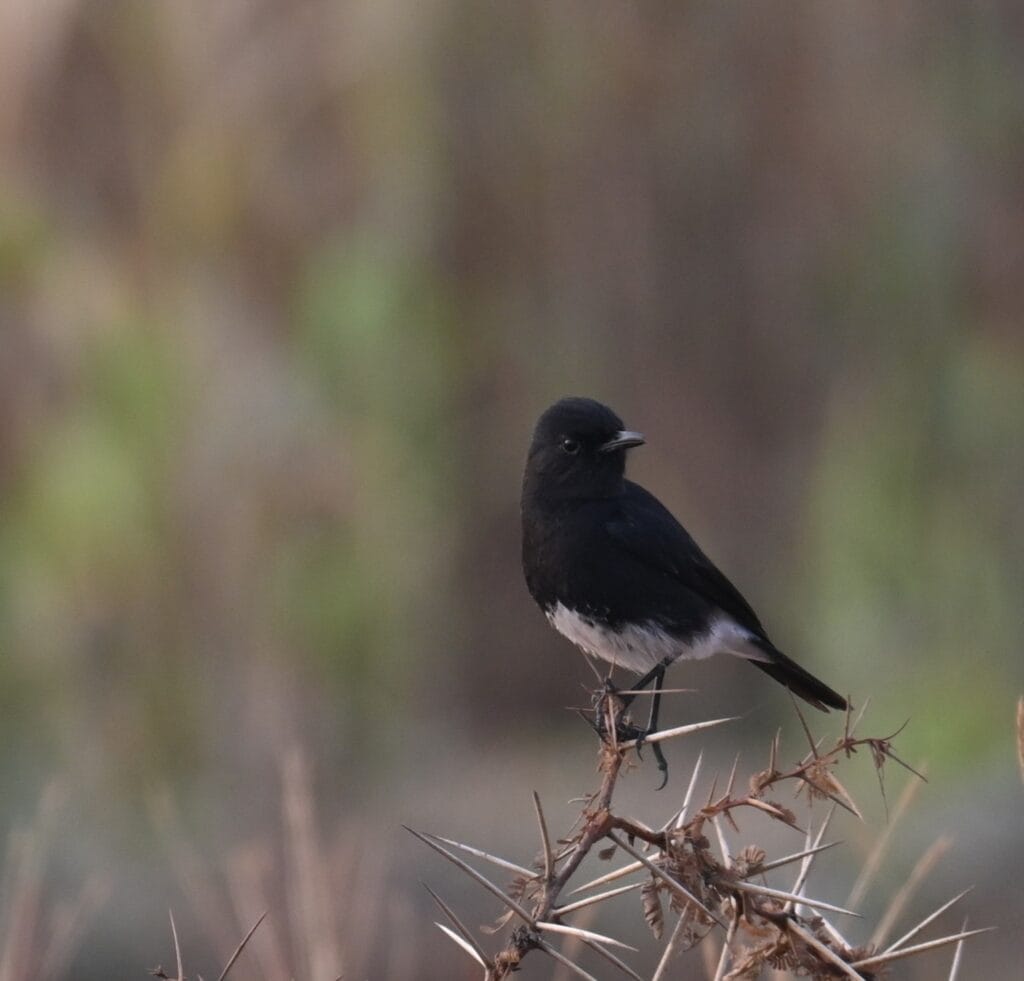
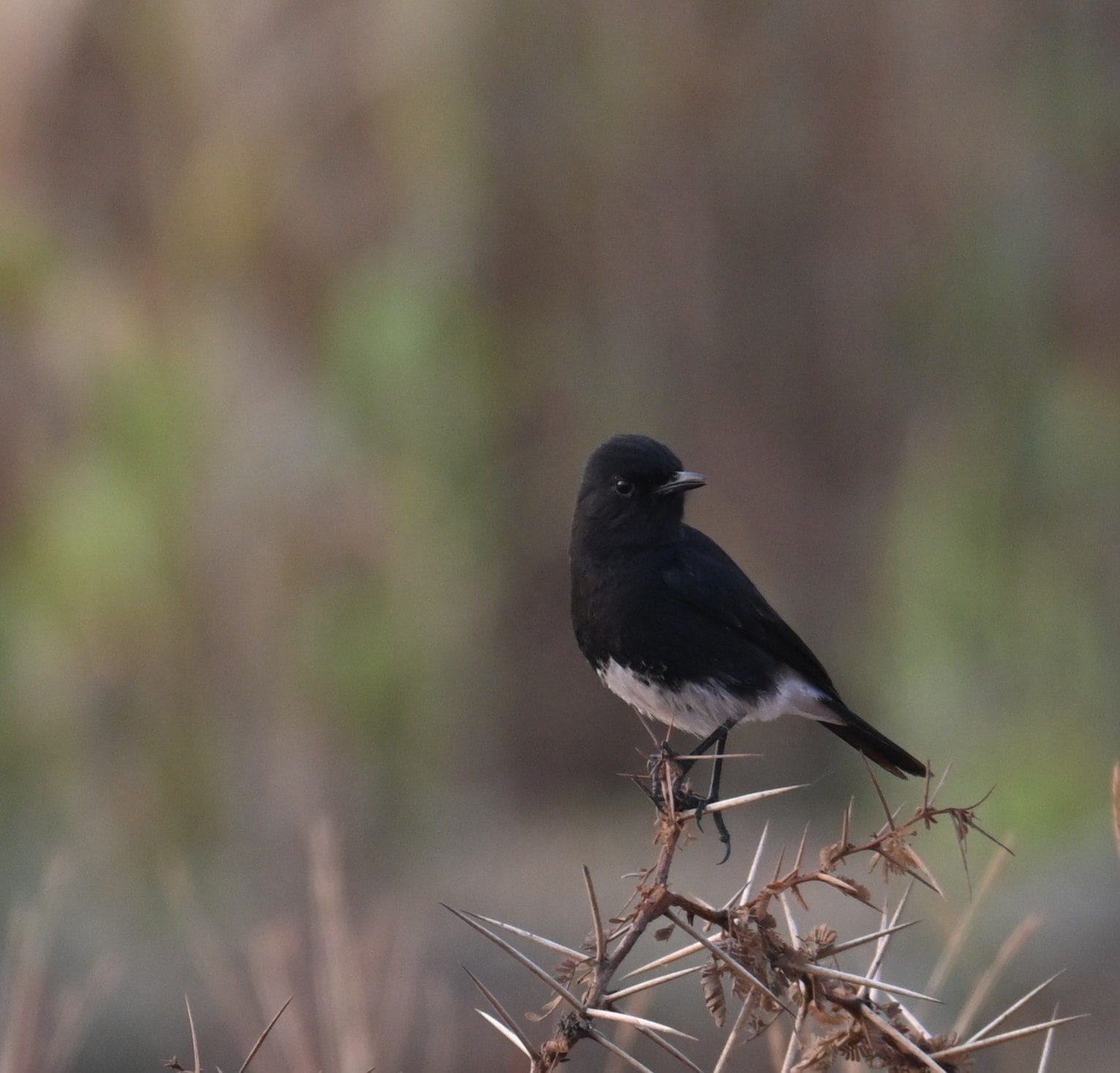
On a quiet morning at the wetland edges near Bhigwan, Maharashtra, I spotted this male Pied Bushchat (Saxicola caprata) doing exactly what they do best — holding court at the top of a dried thorny bush, scanning for insects below. This small passerine is one of those birds that looks almost too bold, too perfectly contrasted to be real against the dusty browns and pale greens of open scrubland.
If you spend time birding in peninsular India, especially around wetlands, agricultural edges, or open grasslands, the Pied Bushchat will be one of your most frequent companions. And yet, it deserves far more attention than casual birders give it.
Quick Identification Reference
| Common Name | Pied Bushchat |
| Scientific Name | Saxicola caprata |
| Family | Muscicapidae (Old World flycatchers) |
| Order | Passeriformes |
| Size | 13–14 cm (sparrow-sized) |
| IUCN Status | Least Concern |
| Photographed At | Bhigwan, Maharashtra, India |
| Date | April 2026 |
| Camera | Nikon Z50 |
Identification: Reading the Bird
The Pied Bushchat is one of those species where the male makes identification almost effortless. The contrast is stark and striking — but knowing what exactly to look for helps confirm the ID instantly, especially when distinguishing from similar bushchats.
Entirely glossy black except for a clean white patch on lower flanks and rump, and a white wing patch visible in flight. The vent area is also white. No brown tones — pure black.
Much more subdued — brown above, buffy-rufous below with a slightly paler throat. Easily overlooked unless you know to look. Often seen close to the male’s perch territory.
Short, fine bill typical of flycatchers. Upright, alert posture. Tail often cocked slightly upward when excited. Legs long relative to body — good for perching on thin thorny branches.
Could be confused with White-capped Water Redstart in poor light, but that species has a rusty-red tail. The Pied’s white flanks and wing patch are diagnostic.
“It’s a bird that does not hide. The Pied Bushchat chooses the most exposed perch available — the tip of a thorn, the top wire of a fence — and watches everything. In that sense, it mirrors something almost philosophical about how to inhabit a landscape.”— Field Notes, Bhigwan 2026 · TravelOnTales
Habitat & Distribution in India
The Pied Bushchat is one of the most widespread resident birds across the Indian subcontinent. It shows a strong preference for open, semi-arid landscapes — places with low shrubby vegetation, scrubby grassland, agricultural margins, fallow fields, and wetland edges. It actively avoids dense forest interior.
Where to Find Them
In Maharashtra, Bhigwan is an excellent location because the wetland fringes create exactly the right mosaic — open grassy areas, scrub patches, and clear sightlines. Other reliable locations across India include the dry zones of Rajasthan, the grasslands of Tal Chhapar, the agricultural fields around most Central Indian reserves, and almost any open area from sea level up to about 3,000 metres in the Himalayas.
The species is present year-round across most of peninsular India. In the Himalayas it undertakes short altitudinal movements, descending to foothills and plains in winter.
Behaviour: The Sentinel Strategy
Watch any male Pied Bushchat for five minutes and a pattern becomes clear: it picks a high, exposed perch, scans the ground intently, drops to snatch an insect, and immediately returns to the same or an adjacent perch. This classic ‘perch-hunt-return’ behaviour is shared by most flycatchers and chats, but the Pied Bushchat executes it with particular consistency.
The bird is primarily insectivorous, feeding on beetles, ants, grasshoppers, flies, and other invertebrates. During the breeding season (roughly February to June across much of India), the male becomes highly territorial — singing persistently from prominent perches and chasing rivals vigorously.
Song & Calls
The Pied Bushchat has a pleasant, varied warbling song — less melodic than some chats, but with a cheerful, scratchy quality. It also produces sharp ‘weet-chak’ alarm calls when disturbed. If you hear a dry, emphatic double note from a conspicuous perch near scrubby ground, check for this species.
Photography Tips: Getting the Shot
The male Pied Bushchat is one of the more cooperative subjects in Indian bird photography — it holds its perch, returns predictably, and its stark plumage means even moderate light conditions can yield clean images. That said, the all-black head and breast present a real exposure challenge.
📷 Field Photography Notes
- Meter for the black plumage, not the background — expose to retain feather detail on the breast and head.
- Shoot in RAW and recover the white flank patch in post — avoid blowing out the white areas.
- Early morning light from a low angle gives the best texture on the black plumage and separates the bird from background.
- Wait for the bird to return to its favourite perch after each hunting sortie — patience pays off more than chasing.
- Thorny perches make for the most natural, contextually rich compositions — do not disturb the bird to get a ‘cleaner’ background.
- At Bhigwan, the open scrub along the lake edges near Diksal village is particularly productive for this species.
Conservation Status
The Pied Bushchat is currently listed as Least Concern on the IUCN Red List, and its populations across South and Southeast Asia appear stable. It is well-adapted to human-modified landscapes and is one of the beneficiaries of agricultural expansion — cultivated fields and their margins provide abundant foraging habitat.
However, intensification of agriculture — particularly increased pesticide use, which reduces insect prey — poses a longer-term concern for this and many other insectivorous birds in India. Observing and recording this species across locations contributes to our understanding of open-country bird distribution in a changing landscape.
Frequently Asked Questions
Is the Pied Bushchat found only in Maharashtra?
No — the Pied Bushchat (Saxicola caprata) is widespread across the Indian subcontinent, from Sri Lanka north through India and Pakistan into Central Asia and Southeast Asia. In India it is a common resident across most states, absent only from dense forest interiors and high alpine zones above 3,500 m.
How do I tell the Pied Bushchat from a female?
The male is entirely black with distinctive white flanks and wing patches. The female is a warm brown bird with a buffy-orange underside and lacks the male’s white markings. The two look so different that beginners sometimes mistake them for separate species.
What is the best time to see Pied Bushchat at Bhigwan?
The Pied Bushchat is a year-round resident at Bhigwan. However, the breeding season (February to June) is the most rewarding time — males are highly active, vocal, and territorial, making them easy to observe and photograph. Early morning visits along the lake edges and scrubby margins yield the best encounters.
Is the Pied Bushchat a migratory bird?
In peninsular India it is primarily a resident, non-migratory bird. Himalayan populations undertake short altitudinal migrations, moving to lower elevations during winter. The birds you encounter across Maharashtra’s plains are resident year-round.