
River Tern at Bhigwan
Wings thrown back in a perfect V. Orange bill just breaking the surface. A small silver fish already turning in its grip, water still erupting below. The Indian River Tern’s surface strike lasts less than half a second — and getting it sharp is one of the most satisfying challenges in Indian bird photography.
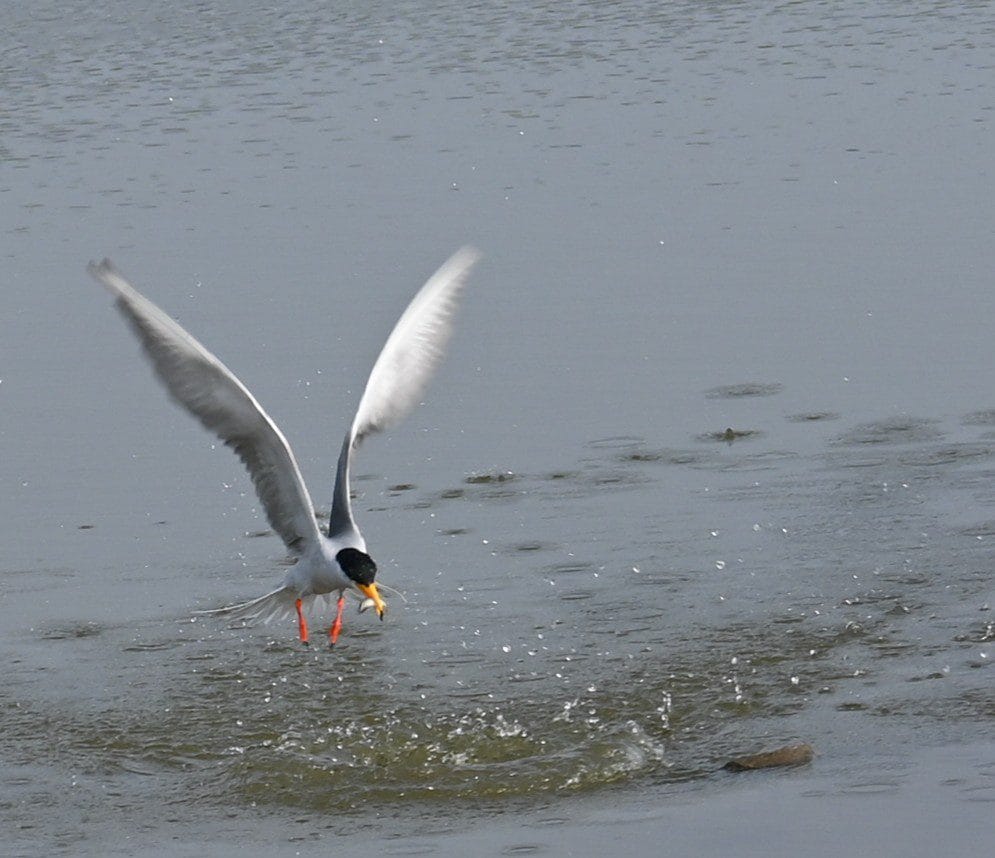
Indian River Tern (Sterna aurantia) at the moment of contact — surface strike, Ujani backwaters, Bhigwan. Wings at full extension, fish already secured. Nikon Z50. © Prashant S. Gupta / TravelOnTales
Most of those strikes were missed frames — too slow to focus, wrong angle, bad light. Consequently, when this one finally came together, it felt like a genuine reward. The wings at full extension, the bill angled down with the catch already visible, the water still disturbed beneath the trailing legs — this is what the River Tern looks like at the precise moment it stops being a bird in flight and becomes a fishing machine.
Species Profile — Indian River Tern
- Common Name
- Indian River Tern
- Scientific Name
- Sterna aurantia
- Family
- Laridae (gulls, terns, skimmers)
- Size
- 38–43 cm; wingspan 75–85 cm
- Key Field Marks
- Black cap, deep orange-yellow bill, orange-red legs, pale grey back, white underparts, deeply forked tail
- Hunting Technique
- Low surface strike — not a vertical plunge-dive
- IUCN Status
- Near Threatened (declining)
- At Bhigwan
- Resident; year-round on Ujani backwaters; peak activity Nov–Feb
- Best Spot
- Open channels near Kadbanwadi mudflats; shallow margins of Ujani reservoir
Reading the Strike: What the Photograph Shows
Bird action photography often rewards the person who knows what is about to happen more than the person with the fastest reflexes. Therefore, understanding the River Tern’s fishing sequence is as important as any camera setting. Look at this frame carefully and each phase of the strike becomes readable.
Breaking Down the Image
What This Frame Is Telling You
- Wing position
- Full V extension — maximum braking, body has halted forward movement
- Bill angle
- Angled down and forward — contact already made, not anticipatory
- Fish
- Visible and gripped — this is a successful strike, not an attempt
- Legs
- Trailing and extended — confirms the body is rising, not descending
- Water surface
- Active disturbance behind the bill — strike occurred fractions earlier
- Wing blur
- Even at 1/2000s, the wingtips show motion — confirms the speed involved
The slight blur on the upper wingtips is worth noting. Even at 1/2000s, the outer primaries during a full braking stroke move fast enough to record motion. In other words, this is not a technical failure — it is an honest record of the physics involved. To freeze the tips completely, moreover, you would need 1/4000s or faster, which in the grey morning light over the backwaters would require either very high ISO or a very wide aperture.
The choice here — to accept the wing blur and expose for the bird’s face and the catch — was the right one. Sharp eyes, sharp bill, sharp fish. That is the hierarchy of a good tern strike frame.
You are not shooting the strike. You are shooting the half-second after the decision was already made — by the bird, not by you. — Field notes, Ujani backwaters, Bhigwan
The River Tern’s Technique: Why It Hunts This Way
The Indian River Tern does not plunge-dive like a Kingfisher or a Little Tern. Instead, it uses a low, fast approach that keeps it parallel to the water surface until the final moment. This technique is adapted to shallow water — specifically the kind of shallow, retreating backwater margins that form at Bhigwan during the winter months as the Ujani reservoir drops.
Why Bhigwan Creates Perfect Conditions
As water levels fall after the monsoon, fish become concentrated in predictable channels between exposed mudflats. The River Tern knows this. It works these channels in systematic passes, repeating the same route in the same direction, striking at the same depth. Consequently, once you have identified an active bird, you can position the boat to intercept its flight path and wait. Furthermore, the bird’s habitual nature means it will likely return to the same channel multiple times within a single session — giving the patient photographer many opportunities at the same angle and light.
This is precisely what happened here. The bird made at least a dozen passes over the same channel during a forty-minute period. Each pass was at roughly the same height and speed. As a result, the challenge was not tracking the bird — it was timing the shutter to the strike rather than to the flight.
Camera Settings: Freezing the Surface Strike
Nikon Z50 Settings — River Tern Surface Strike
- Shutter Speed: 1/2000s minimum; 1/3200s preferred — even this may not freeze outer wingtips at full braking stroke
- Mode: Shutter Priority (S) — let the camera manage aperture; the priority is always stopping motion
- ISO: Auto ISO with ceiling at 6400; grey backwater light at 7 AM needs the latitude
- Metering: Spot meter on the bird’s body — the bright reflective water surface will underexpose by 1.5–2 stops on evaluative/matrix metering
- AF Mode: Animal Detection AF, Continuous (AF-C) — lock onto the bird in flight and hold through the strike
- Drive Mode: High-speed continuous burst — you are looking for one frame in fifteen to twenty
- Focal Length: 300mm at 30 metres gives good frame fill; zoom out slightly to allow for tracking error
- Framing: Leave space below the bird — the strike disturbs the water and the splash is part of the image
- Key mistake to avoid: Do not chimping between passes — reset immediately and track the returning bird
The Tracking Problem
The River Tern’s approach is fast and low. However, the strike itself involves a sudden deceleration that the autofocus system has to compensate for rapidly. On the Nikon Z50, Animal Detection AF handles this well in open-water conditions because there is minimal background clutter. Nevertheless, if the bird passes in front of mangroves or a reeded bank, the AF tends to hunt — so position the boat to keep open water behind the bird wherever possible.
Get on the Water at Bhigwan — Full-Day Bird Safari from Pune
Shore-based viewing gives you distant, flat images of River Terns. Boat access — and specifically slow, quiet positioning on the active feeding channels — is what produces photographs like this one. This full-day guided safari from Pune covers the Ujani backwater boat session with a naturalist who knows where the terns are feeding each morning.
- Return transport from Pune
- Expert naturalist guide
- Boat safari on Ujani backwaters
- Species checklist included
- Full-day itinerary (6 AM–7 PM)
- Grassland session also covered
When and Where to Find River Terns at Bhigwan
Best Season
The River Tern is a year-round resident on the Ujani backwaters, but November through February is peak season for action photography. During this period, water levels are at their lowest, exposing the shallow feeding channels where fish become easy prey. Moreover, the winter light is lower and more directional than summer, which improves the quality of photographs significantly.
Within the day, the most productive window is 6:30 AM to 10:00 AM. Activity drops sharply after 10 AM as light becomes harsher and tern feeding slows. Therefore, the first boat safari of the morning is by far the most valuable session for photographers.
Best Spots on the Water
The open channels near Kadbanwadi mudflats and the shallow margins of the main Ujani reservoir channel are the most reliable River Tern locations. Ask your boat guide specifically to position near the exposed feeding banks rather than heading directly to flamingo point — most guided groups default to the flamingo viewing area, which is worth seeing but is not where the tern action happens.
The River Tern Beyond the Photograph
One thing worth noting is that this bird is under pressure. The Indian River Tern is listed as Near Threatened on the IUCN Red List, with a declining population driven by riverbank disturbance, sand mining, and the degradation of the gravel bars it needs for nesting. Bhigwan’s protected status provides some buffer, but the species is not secure across its range.
In addition to its conservation status, the River Tern is also simply hard to watch without being moved by its skill. The economy of the strike — that total commitment to a half-second window, no hesitation, no second thoughts — is a reminder that wild animals do what they do with a precision that has nothing to do with effort and everything to do with being exactly built for the task. Furthermore, every clean photograph of one is a small document of what remains in India’s wetlands. That gives the image a weight beyond the technical achievement of freezing the wings.
Frequently Asked Questions
What is the Indian River Tern?
The Indian River Tern (Sterna aurantia) is a medium-sized tern found across the Indian subcontinent. It is identified by its deep orange-yellow bill, black cap, pale grey back, and orange-red legs. Unlike smaller terns, it uses a low surface-strike rather than a vertical plunge-dive.
Where is the best place in India to photograph River Terns?
Bhigwan’s Ujani backwaters in Maharashtra is one of the top locations. The shallow, receding winter water levels create predictable feeding channels where terns hunt repeatedly — giving photographers multiple strike opportunities from a single boat position.
What camera settings should I use for a tern fishing strike?
Shutter priority at 1/2000s minimum, ideally 1/3200s. Continuous AF with animal tracking. High-speed burst mode. Spot meter on the bird — not the water surface. Shoot RAW for exposure recovery in flat backwater light.
When is the best time to photograph River Terns at Bhigwan?
November through February. Activity peaks between 6:30 AM and 10:00 AM during the first morning boat session. Water levels are lowest in this period, concentrating fish in the shallow feeding channels the terns prefer.
How do I book a birding boat safari at Bhigwan from Pune?
The Full-Day Bhigwan Bird Safari from Pune (Viator) covers transport, boat access on the Ujani backwaters, and a naturalist guide — everything needed for a productive morning with the River Terns.