
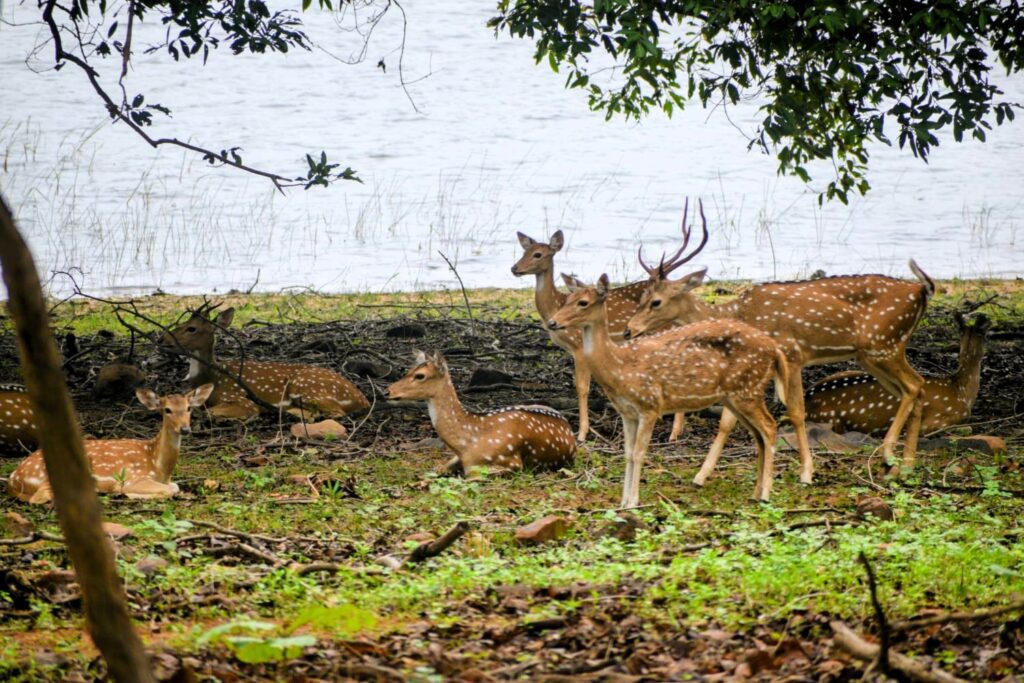
Spotted Deer in Tadoba – The Graceful Chital by the Lake
Introduction
The Spotted Deer (Axis axis), also called Chital, is one of the most graceful and commonly sighted animals in Indian forests. In Tadoba, they form large herds and are often seen grazing near water bodies, alert yet calm, always ready to warn others of approaching predators.
Description of the Photo
This picture shows a peaceful herd of Chital deer resting under the shade near Tadoba’s lake. Some are sitting on the cool ground, while others stand alert with ears raised. The males with antlers add majesty to the group, while the backdrop of water and trees creates a serene and natural setting. It beautifully captures their herd behavior and the calm side of Tadoba’s wildlife.
Appearance
- Golden-brown coat with white spots scattered across the body.
- White underbelly, throat, and inside of legs.
- Males carry impressive three-pronged antlers that can grow up to 1 meter long.
- Elegant build, with large expressive eyes and ears.
Habitat & Behavior
- Found in grasslands, forests, and near water bodies across India.
- Live in large herds, sometimes over 50 individuals.
- Always alert — when alarmed, they give out a loud warning call, alerting the jungle to danger.
- A key prey species for big cats like tigers and leopards in Tadoba.
Fun Facts
- The name “Chital” comes from the Sanskrit word chitrala, meaning “spotted.”
- They are one of the most vocal deer, often barking loudly to warn about predators.
- Unlike some deer, they keep their spots throughout life, not just as fawns.
- They share a special bond with langur monkeys — langurs drop fruits from trees, and deer eat them, while langurs benefit from the deer’s sharp alarm calls.
Why You’ll Love Seeing Them in Tadoba
While tigers may be the star attraction, the Chital deer bring life and beauty to Tadoba’s forests. Their spotted coats, graceful movements, and strong herd bonds are a reminder of the balance of the wild. They are also a symbol of harmony in nature living in cooperation with monkeys, birds, and other species, each helping the other survive. Without them, the forest would lose not just a prey base for predators but also a sense of calm continuity that binds the ecosystem together.
The deer everyone stops photographing by day two
Chital are so abundant at Tadoba that visitors stop looking at them within a day. That is a mistake, because they are the animal that tells you what the forest is doing.
Reading the herd
- All heads up, one direction: something has been noticed. Look where they look, not where your guide points.
- Heads up, ears rotating, no call: uncertainty. This often precedes an alarm by ten or twenty seconds.
- Repeated barking alarm: a predator has been seen. Chital call more readily than sambar, so this is less reliable, but a sustained chorus is worth acting on.
- Stamping a forefoot: testing, trying to provoke movement from whatever it suspects.
- Grazing resumed, tails flicking: stood down. Move on.
Chital and langur
The most productive thing to watch at Tadoba is a chital herd feeding under a langur troop. The langurs see from height, the chital hear at ground level, and they respond to each other’s alarms.
Langurs also drop fruit and leaves that chital eat, so the association is not accidental. When both species alarm together and agree on a direction, that is as good a signal as a safari gives you.
The rut
Chital do not have a tight breeding season in central India, so you can find hard-antlered stags rutting at almost any time of year. In the rut, stags roar — a strange, un-deerlike bellow — thrash vegetation, and hold small groups of does.
Antlers are shed and regrown on an individual cycle, which is why you will see velvet, hard antler and bare pedicels in the same herd on the same morning.
Photographing them
The problem with chital is that they photograph as clutter. Solutions: shoot into backlight so the spots and ear fur glow, isolate a single animal against shade, or wait for interaction rather than portraits. A stag roaring with his head thrown back is a better image than ten sharp standing deer.
Frequently asked questions
Are spotted deer common at Tadoba?
Very. They are the most abundant large herbivore in the reserve and the main tiger prey alongside sambar.
What does a chital alarm call mean?
A predator has been seen or strongly suspected. Chital call more freely than sambar, so a sustained chorus is more meaningful than a single bark.
Do chital keep their spots as adults?
Yes, for life, unlike many deer that lose juvenile spotting.
When do chital breed?
There is no tight season in central India. Rutting stags can be found through most of the year.
Related: Sambar Deer and Tadoba Safari Guide.
