
A Tiger’s Gaze: Stunning Tadoba Forest
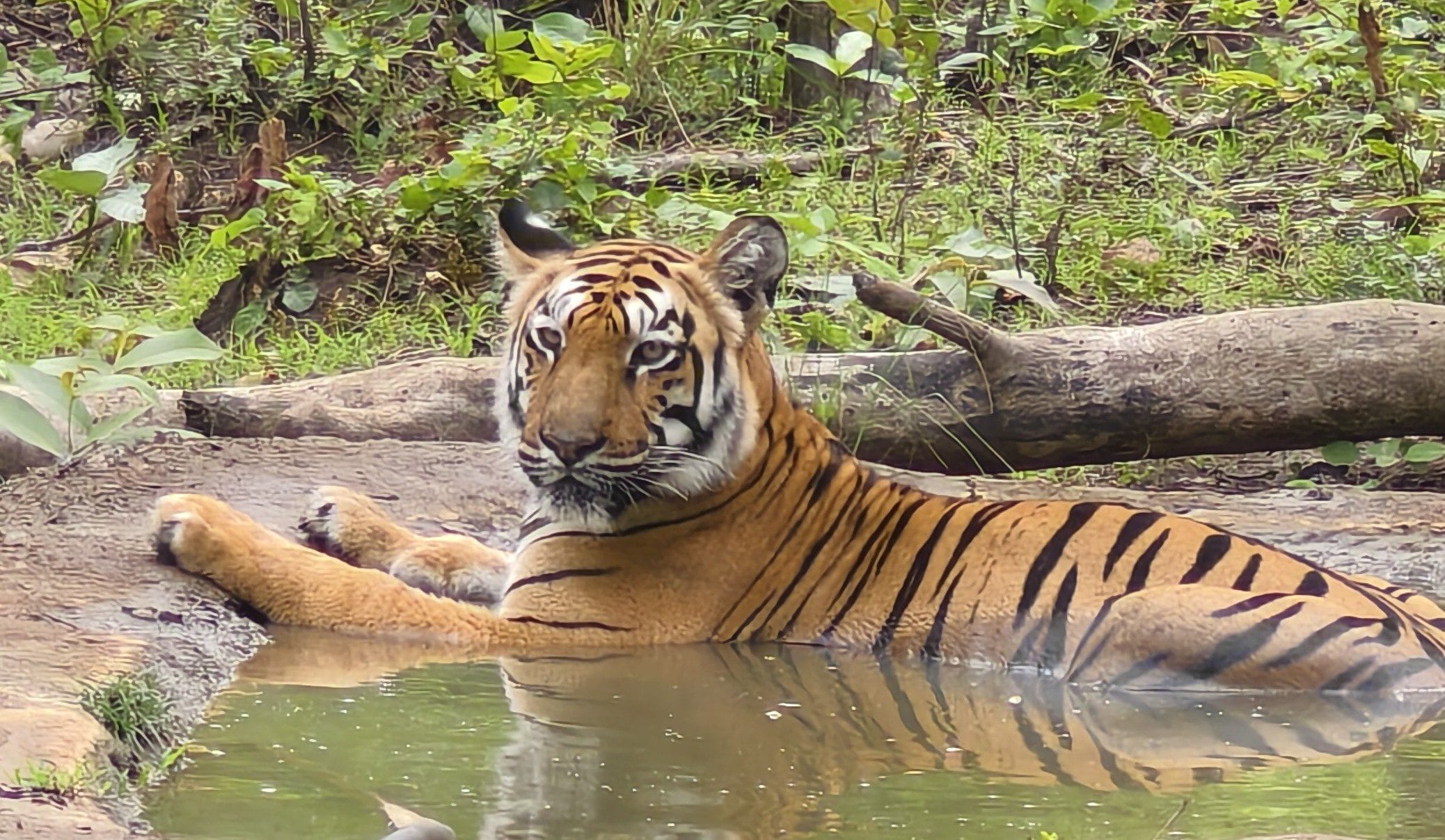
He was already in the forest pool when we found him. Forelegs stretched forward, chin lifted, completely unbothered. Then he turned his head and looked directly at us — and the jeep went very quiet.
There is a specific kind of silence that falls over a safari jeep when a tiger looks at you.
Not the silence of fear — nobody moves fast enough for fear. It’s something older than that. A silence that comes from being seen by something that has been apex of this forest for ten million years and knows it. The naturalist stops narrating. The driver cuts the engine. Four cameras that were firing continuously go still. And for a few seconds, nobody breathes at the same time.
That’s what happened here.
We had come around a bend in the track when the guide spotted the forest pool through the teak. A shape in the water — orange and black, half-submerged, enormous. By the time we positioned the jeep, he had already registered us. His head was turned. His eyes — that particular amber-gold of a Bengal Tiger’s iris in forest light — were already on us.
He stayed like that for what felt like a very long time.
What a Forest Pool Sighting Actually Tells You
Most tiger sightings are a flash — a striped flank disappearing between teak trunks, a pugmark fresh in the dust, alarm calls from langurs in the canopy overhead. You register the movement before you register the animal. The jungle gives and takes in the same second.
A forest pool sighting is different. When a tiger is wallowing — genuinely relaxed, body temperature dropping, not hunting, not moving — it gives you something the forest almost never gives: time. Time to look. Time to read the animal.
And when you have time, you notice things the flash sighting doesn’t allow. The weight of those forelegs — each one as thick as a human torso — resting on the muddy bank. The way the stripe pattern on the face is not symmetrical, like a fingerprint, unique to this individual. The small deliberate movements of the ears, tracking a sound somewhere behind him even while his eyes stay fixed on the jeep. A tiger in a forest pool is a tiger thinking. And watching something that powerful think, from thirty feet away, is an experience that doesn’t translate to words very efficiently.
The eyes hold you longer than you expect. You think you’ll look away first. You won’t. — Field notes, Tadoba
The Photograph — What Makes It Hard
This is not the easiest subject to photograph well, despite appearances. The challenge is not the tiger — he is completely still, cooperative, beautifully lit by dappled canopy light. The challenge is the exposure triangle between three very different tonal zones in the same frame: the bright reflective pool surface, the deep shadow of the forest behind, and the tiger’s coat itself, which sits in high-contrast orange and black between the two.
Meter off the face. Not the water, not the background — the face. The pool surface will blow out slightly. The forest will block down. But the face — those eyes, those whiskers, that extraordinary stripe pattern above the brow — that’s the photograph. Everything else is context.
Shooting Settings: Tiger in a Forest Pool
- Aperture priority f/5.6–f/8 — you want face AND water reflection both in focus
- Spot meter on the tiger’s face; ignore the bright pool surface
- 1/500s is enough for a stationary tiger; bump to 1/1000s if ears or head are moving
- Auto ISO — forest light shifts fast; let the camera handle it
- Shoot RAW — you’ll want to pull shadow detail from the forest background in post
- Resist the urge to zoom to maximum — some negative space gives the image room to breathe
- When the tiger looks at the jeep, stop chimping and keep shooting
The Behaviour: Why Tigers Use Forest Pools This Way
Bengal Tigers are strong swimmers — unlike most large cats, they actively seek water and are entirely comfortable submerged to the shoulder. During Tadoba’s peak summer months, when the forest floor radiates heat past 40°C by mid-morning, a shaded forest pool is not a luxury. It’s thermoregulation. A tiger can spend two to four hours wallowing during the hottest part of the day, barely moving, body temperature dropping in the cool mud-water.
The posture in this photograph is specific: forelegs stretched forward onto the bank, chest and hindquarters in the pool. This is not a defensive posture or a pre-hunt crouch. This is a tiger doing the equivalent of lying on a cool tile floor on a hot afternoon. He is, in the most literal sense, comfortable. Which is why the eye contact is so unnerving — there is no threat in it, no tension. Just assessment. You are a large noisy thing that has entered his field of vision and he is deciding, calmly, that you are not interesting enough to move for.
Reading the Direct Eye Contact
New visitors to tiger country often interpret a direct tiger gaze as aggression or threat display. It almost never is — not from a resting, habituated Tadoba tiger in a forest pool. What you’re seeing is territorial awareness: this animal knows every jeep track, every forest pool, every territorial boundary in this range. He is cataloguing you the same way he catalogues a sambar at the forest edge. With interest, without alarm, and with complete confidence in his own position in this ecosystem.
Want to be in that jeep? Book a Tadoba Tiger Safari
Getting a forest pool sighting like this is partly luck — but mostly knowing which zone, which pool, and which time of day to be there. That’s what a good naturalist gives you. This Tadoba safari is guided by experts who know the reserve’s tiger territories, forest pool locations, and seasonal patterns.
Book a Tadoba Safari →The Moment After the Photograph
He looked at us, he turned his head back to the forest. One ear tracked left. His tail moved once beneath the pool’s surface, a slow muscular sweep that sent a small ripple across the still water. And that was that. We had been assessed, filed under “not relevant,” and dismissed.
The naturalist exhaled slowly. The driver started the engine. Someone in the back seat said something very quiet in Marathi.
We sat there for another twenty minutes, none of us quite willing to be the one who said it was time to go.
Frequently Asked Questions
Which zone in Tadoba has the best forest pool tiger sightings?
The Tadoba core zone — particularly around Tadoba Lake, Pandarpauni, and Jamni — has the most reliably photographed forest pools. Tigers use these heavily in April through June when temperatures exceed 40°C.
What time of day do tigers wallow in forest pools at Tadoba?
Mid-morning to early afternoon (10 AM–2 PM) is prime time, especially in summer. Tigers often enter a pool after a morning patrol and can stay for two to four hours. An afternoon safari (3–6 PM) sometimes catches them still in the water.
Is a tiger in a forest pool dangerous to safari visitors?
No. A tiger wallowing is in a relaxed, non-hunting state. Tadoba’s tigers are highly habituated to safari vehicles. Direct eye contact from the pool is curiosity and territorial awareness, not aggression.
What camera settings should I use for a tiger in a forest pool?
Aperture priority at f/5.6–f/8, spot meter on the tiger’s face, 1/500s minimum. Shoot RAW — dappled forest light over open water creates tricky mixed exposures that need post-processing flexibility.
How do I book a Tadoba tiger safari?
Through the Maharashtra Forest Department portal or registered operators. For a guided experience with naturalists who know the forest pool locations and tiger territories, the Tadoba Safari on Viator is a reliable option.