
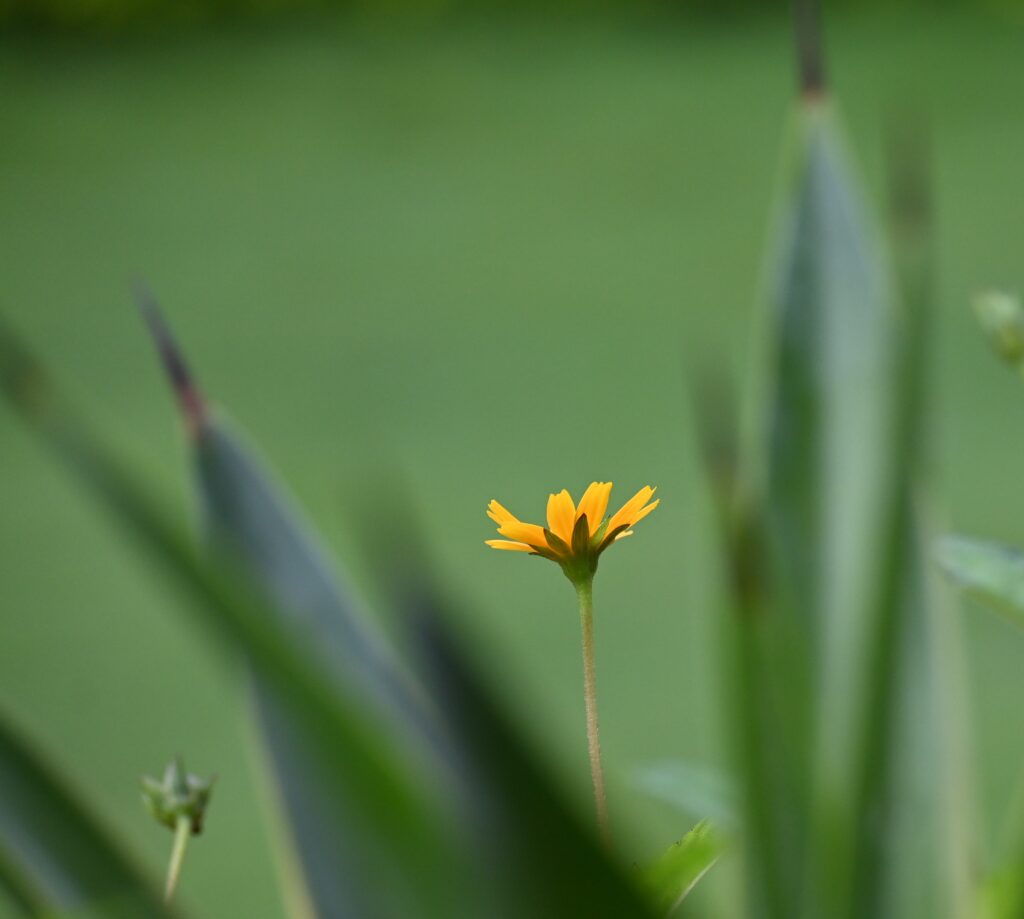
Yellow Daisy Flower: The Sunshine Bloom of Nature
The Yellow Daisy (Wedelia trilobata) is one of nature’s most cheerful gifts, often brightening up gardens, roadsides, and wild fields with its golden charm. Belonging to the Asteraceae family, this hardy flower is loved for its simple beauty and adaptability.
Habitat & Range
Yellow Daisies grow in tropical and subtropical regions, thriving in both wild landscapes and home gardens. They spread quickly, covering open spaces with carpets of green leaves and yellow blooms. In India, they are often spotted in parks, lawns, and forest clearings.
Appearance
The flower typically has 8–13 bright yellow petals radiating around a golden center. Its slender stem and small size give it a delicate yet bold look against the greenery.
Uses & Significance
- Often grown as a ground cover plant due to its fast spread.
- Attracts pollinators like bees and butterflies, making it ecologically important.
- In folk medicine, parts of the plant are used for treating skin problems and wounds (though scientific validation is limited).
Fun Facts About Yellow Daisies
- The word Daisy comes from “day’s eye” because the flower opens at sunrise and closes at sunset.
- Daisies symbolize innocence, purity, and new beginnings in flower language.
- A single Yellow Daisy plant can produce dozens of blooms in one season.
- They are drought-resistant, making them perfect for low-maintenance gardens.
It is not one flower
A daisy looks like a single bloom with petals around a centre. It is not. It is a dense head of many small flowers packed together, and the “petals” are individual flowers in their own right.
- Ray florets: the outer “petals”. Each is a complete flower with a single strap-shaped extension, mostly there to advertise.
- Disc florets: the tightly packed centre. Each is a tiny tubular flower producing nectar and pollen, and each can set a seed.
A daisy head can hold well over a hundred florets. What looks like one flower is closer to a crowd.
Why that arrangement works so well
It solves a problem for small insects. A single large flower with deep nectar suits a bee or a bird. A flat plate of hundreds of shallow florets suits everything else — small flies, tiny beetles, ants, short-tongued bees and butterflies can all feed without specialised equipment.
An insect landing on a daisy can walk across the disc and feed repeatedly without flying again. That efficiency is why composites are one of the largest plant families on earth.
What you will find on one
Sitting at a patch of yellow daisies for ten minutes in decent weather is one of the easiest pieces of natural history available to anyone.
- Butterflies nectaring with the proboscis extended into the disc florets.
- Hoverflies, which mimic bees and hang motionless in the air before landing.
- Crab spiders, which sit motionless in the disc, colour-matched, waiting to ambush the visitors.
- Small beetles, often several sharing one head.
The crab spider is worth looking for specifically. Once you have found one you will start seeing them constantly.
Photographing flowers and their visitors
- Shoot early. Insects are slower before the day warms, and the light is better.
- Get level with the flower head, not above it. Shooting down flattens everything.
- Use a wide aperture to separate one head from a busy patch, but not so wide that the insect is half out of focus.
- Watch for the spider before you photograph a butterfly. A crab spider mid-ambush is a far better image.
- Avoid wind. Even a light breeze makes macro work at these distances close to impossible.
Frequently asked questions
Is a daisy one flower?
No. It is a composite head made of many small flowers — ray florets around the edge and disc florets in the centre.
What are the petals of a daisy?
Each “petal” is an individual ray floret, a complete flower with one strap-like extension.
Why do so many insects visit daisies?
The flat head of shallow florets is accessible to small insects that cannot reach into deep tubular flowers.
What is the spider sitting in the flower?
Most likely a crab spider, which ambushes visiting insects and is often colour-matched to the bloom.
Related: Hibiscus and sunbirds and Plain Tiger Butterfly.
