
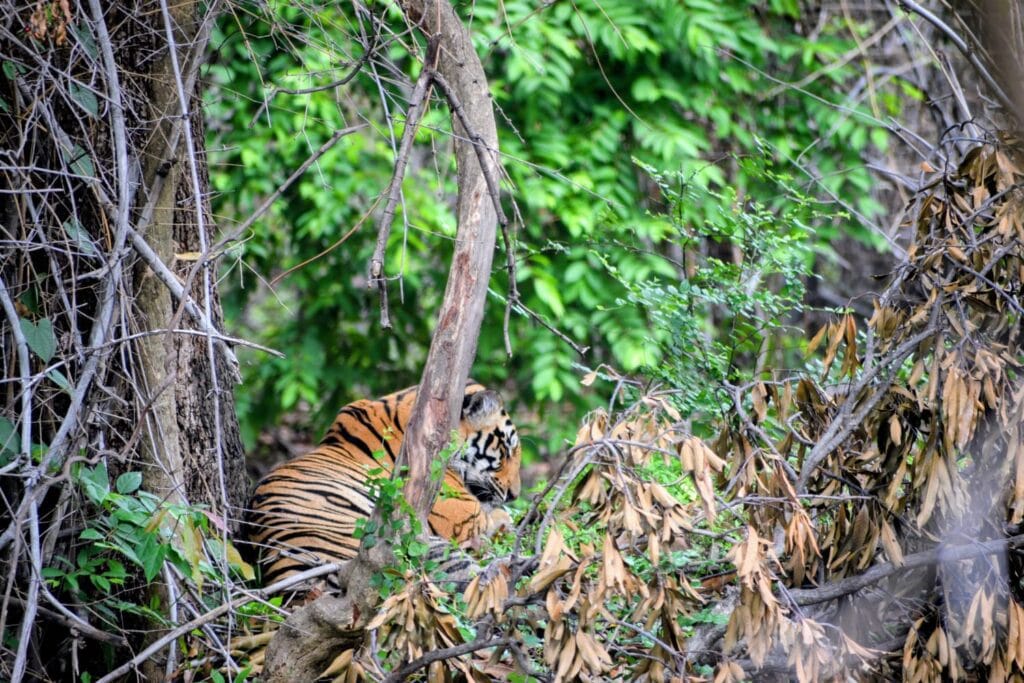
Tiger at Tadoba National Park

We went for a safari in Tadoba hoping to see some wildlife. The morning was quiet, and we were just enjoying the trees, the cool air, and the forest sound. After some time, we noticed many other suddenly speeding in the same direction. Even our driver said, “Let’s go there, maybe something is happening.”

When we reached that area, there were so many safari jeeps already stopped. All tourists were waiting quietly and looking towards the bushes. We also stopped our jeep and tried to see what everybody was watching.

And then we saw him — a tiger resting behind the trees. He was lying down in the shade, looking very calm. His face was partly hidden, but we could clearly see the orange and black stripes. The tiger was not scared or disturbed. He was just relaxing like the jungle king he is.

Everyone around us was excited. Some tourists were whispering, some were trying to get a better view. Even though many jeeps were there, the place felt peaceful because nobody wanted to make noise and disturb the tiger.


How the Tiger Was Resting

The tiger looked like he had just finished drinking water from the lake nearby. Tigers often rest after hydrating, and this one seemed very comfortable. He didn’t stand up or look at us much. He just stayed still, enjoying his quiet time.

Sometimes his ears moved… sometimes he lifted his head… and every small movement made everyone’s heart beat faster. Seeing a tiger in the wild is a big thing, especially when he is so close.


Why We Could Not Stay Longer

We wanted to watch him for a long time, but Tadoba has strict timings. Safari vehicles must exit the gate at a fixed hour. Our driver reminded us that we needed to leave soon. So slowly, we turned back and started moving towards the exit.

Even while leaving, all of us kept looking back through the trees hoping to catch one more glimpse. The tiger stayed in the same resting pose, enjoying his peaceful moment in the forest.

To read more of our jungle trips, you can check out many more safari experiences here:
https://travelontales.com/category/safaris/

We keep adding new sightings, photos, and travel memories, so feel free to explore and enjoy more wild adventures.

How a sighting usually happens

Almost nobody finds a tiger by seeing a tiger. You find one by noticing everything that stops being normal.

The sequence on this drive was routine, and it is worth setting down because it repeats.

The sequence

  • Langur alarm from a tree, a single sharp cough, then silence.
  • Chital freeze, all facing the same line of bamboo.
  • Sambar “dhonk” from further in — the one that made the guide switch off the engine.
  • Peafowl call and run, the least reliable signal, and usually the last to arrive.
  • Then nothing, for eleven minutes. This is the part nobody mentions. The waiting is most of it.
  • Then a shape on the track, walking, unhurried, straight down the middle.

What waiting properly means

The instinct when the alarms start is to drive towards them. That is usually wrong. Alarm calls tell you a predator is moving, and a moving animal will cross a track somewhere. Sitting at a likely crossing with the engine off beats chasing calls around the forest.

The other half of it is silence. A jeep full of people whispering is loud, and a tiger deciding whether to step onto a track hears all of it.

When it is actually in front of you

  • Stay seated. Standing up changes the shape of the vehicle, and that is what animals read.
  • No flash. Ever.
  • Let it choose the distance. If it is walking towards you, hold still. Reversing slowly is fine; advancing is not.
  • Watch it, then photograph it. People spend the whole sighting behind a viewfinder and remember nothing.

Why Tadoba is good for this

Tadoba’s tiger density is among the highest in India, and its tigers are used to vehicles without being fed or baited. That combination produces sightings that are relaxed rather than fleeting.

It also means crowds. A good sighting at Moharli can pull ten jeeps in four minutes. The buffer zones give you the same tigers with a fraction of the audience.

Frequently asked questions

How do guides find tigers?

By tracking alarm calls, pugmarks and animal behaviour, then waiting at likely crossing points rather than chasing.

What is the best signal that a tiger is near?

A repeated sambar alarm from a fixed direction. Sambar do not call lightly.

How many safaris do I need for a tiger sighting at Tadoba?

The odds are good, but plan four drives across two days rather than gambling on one.

Core or buffer?

Both hold tigers. The buffer is cheaper, easier to book and much less crowded.


Related: Planning a Tadoba Safari and Buffer vs Core Zone.

Scroll to Top