
By Prashant S. Gupta | Bandhavgarh National Park, Madhya Pradesh | Published: April 20, 2025 | Updated: May 2026 | Field Notes
There is a moment on every Bandhavgarh safari that catches you completely unprepared — and it is not always the tiger. I was sitting in a gypsy moving slowly through the Tala Zone in the April heat when the jeep stopped without explanation. The naturalist simply pointed left. And there, twenty metres from the track, standing absolutely still in the sal undergrowth, was a bull Indian Gaur.
Not a glimpse. Not a retreating tail. A full, unhurried, unblinking presence — close enough that I could see the ridged forehead, the pale curved horns, the white legs against the dark forest floor.
I have photographed this animal before. But the Bandhavgarh gaur feels different. Bolder. Less inclined to vanish. And once you know the history — that this population did not exist here twenty years ago, that it was deliberately brought back from extinction at this park — the sighting becomes something more than wildlife photography. It becomes a conservation story you can actually see.
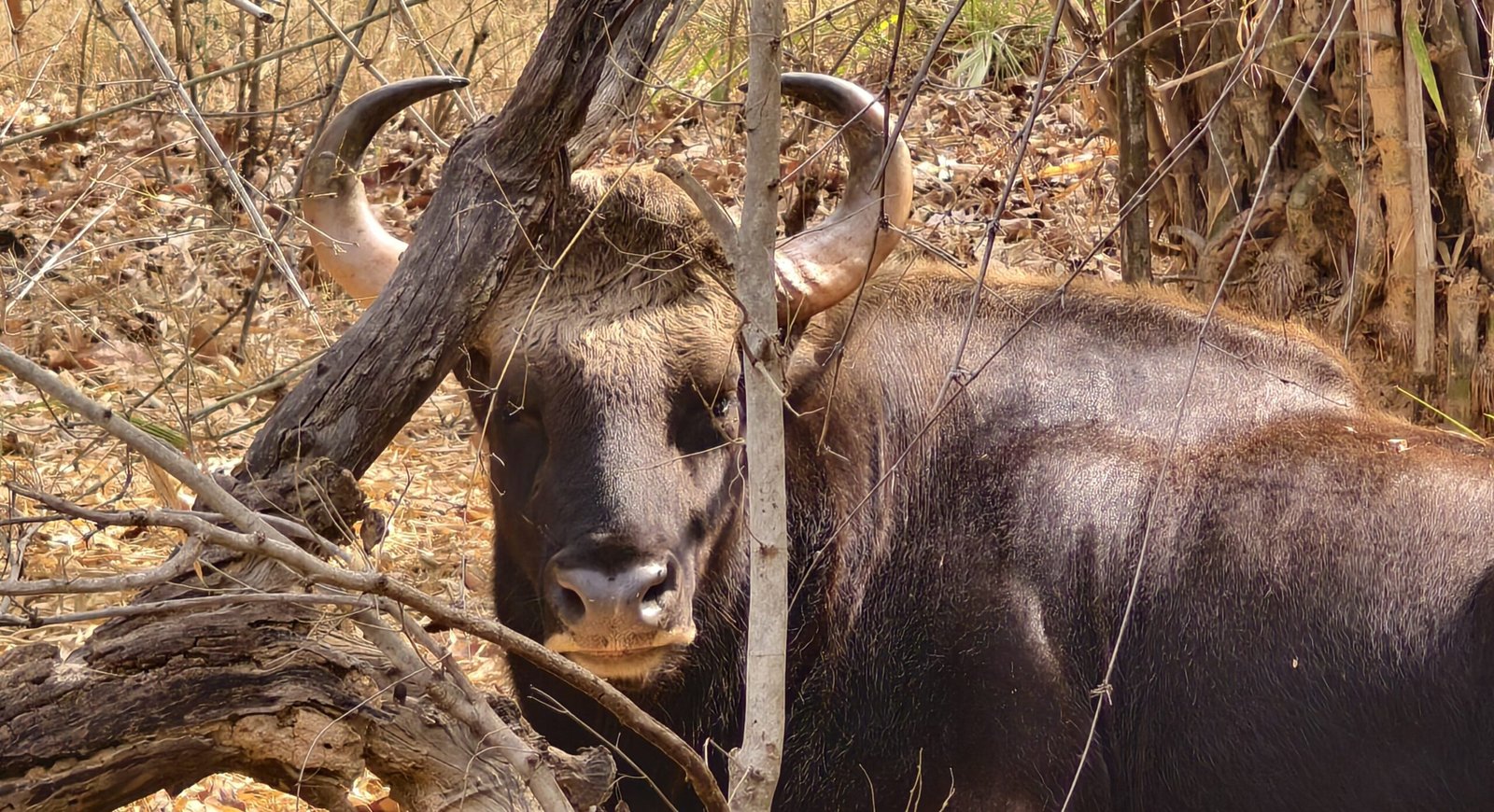
Indian Gaur at Bandhavgarh Tiger Reserve — field footage by Prashant S. Gupta / TravelOnTales. If the video does not load above, watch it directly on YouTube here.
What is the Indian Gaur? The Basics, Clearly
The Indian Gaur (Bos gaurus) is the largest wild cattle species on earth. Not the largest in India — the largest anywhere. It is native to South and Southeast Asia, belongs to the genus Bos (the same biological family as domestic cattle), and is widely — though incorrectly — called the Indian Bison.
That name creates real confusion. True bison belong to the genus Bison and are found in North America and Europe. The gaur is not a bison. It is not a buffalo either. It is something older and more singular: a wild bovine that has been roaming Indian forests for tens of thousands of years, growing into the largest version of itself possible.
Here is what the numbers look like for a mature bull:
- Scientific Name: Bos gaurus
- Common names: Indian Gaur, Wild Indian Bison, Gaur, Indian Bison (colloquial)
- Weight: 650–1,500 kg (bulls regularly exceed a tonne)
- Shoulder Height: 1.7 to 2.2 metres — roughly six feet at the hump
- Colour: Dark brown to near-black body, with distinctive white lower legs — the defining field mark
- Conservation Status: Vulnerable (IUCN Red List)
- State Animal of: Goa and Bihar
The forehead carries a high, pale ridge between the horns — called the boss. The horns themselves curve upward and inward, yellowish at the base and black at the tip. The dorsal hump is more pronounced in males and makes even a distant silhouette unmistakable. If there is one animal in Indian forests that announces its own architecture, it is the gaur.
The Field Mark That Changes Everything: The White Legs
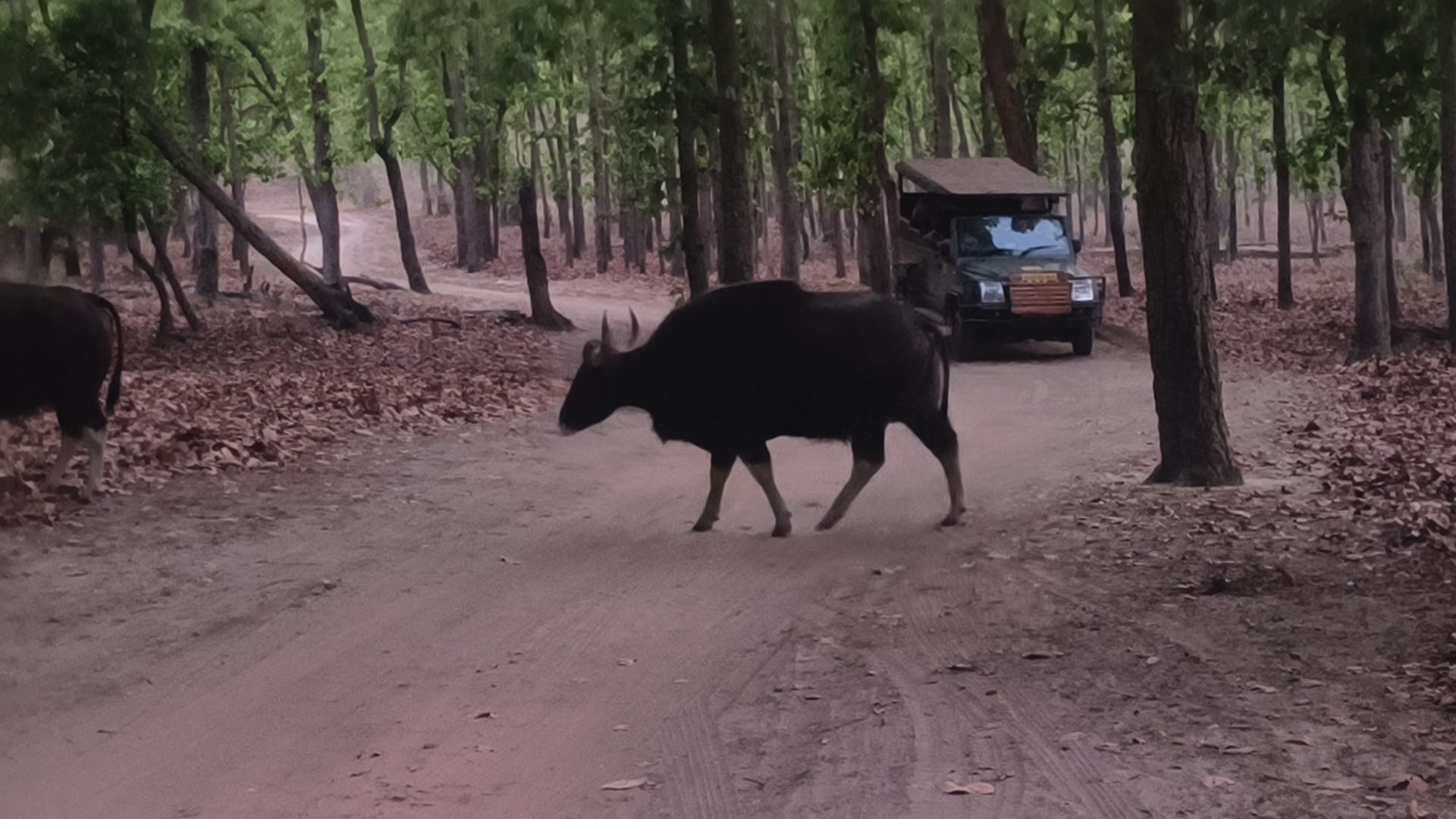
Every large, dark mammal in the Indian jungle has dark legs. Sambar, sloth bear, wild boar — you look at the legs and they match the body. The gaur does not follow this pattern. Its lower legs, from the knee to the hoof, are a clean, cream-to-white colour that stands out sharply against the leaf litter and sal forest floor.
This is your primary identification feature at distance or in low morning light. You don’t need to see the hump, the horns, or even the full body. When something large and dark has white feet, it is a gaur.
The Bandhavgarh Gaur: A Conservation Story Worth Knowing
Here is the fact that most wildlife tourists at Bandhavgarh do not know: the gaur was locally extinct in this park by the late 1990s. Habitat degradation and the pressure of past land use had eliminated the population entirely. For a period, the park that now hosts one of Central India’s most reliable gaur sightings had none at all.
In consultation with the Wildlife Institute of India, the Madhya Pradesh forest department launched a reintroduction programme. Fifty gaurs were translocated from Kanha Tiger Reserve to Bandhavgarh in two phases — in 2011 and 2012. The reintroduction was a success. The animals adapted, the herd grew, and today the Tala and Magadhi zones of Bandhavgarh host a healthy, visible population.
This matters for two reasons. Ecologically, gaur are keystone herbivores — their grazing patterns shape vegetation, their movement through forest maintains corridors, and their presence supports the prey base that tigers and leopards depend on. Photographically, the Bandhavgarh gaur population is now large and settled enough that sightings in the open are genuinely common, especially on early morning drives in the grassland patches and at forest edges during summer.
Gaur Behaviour: What You Will Actually See on Safari
The gaur is a grazer and browser that follows a predictable daily rhythm — and understanding that rhythm is what separates a deliberate gaur sighting from a lucky one.
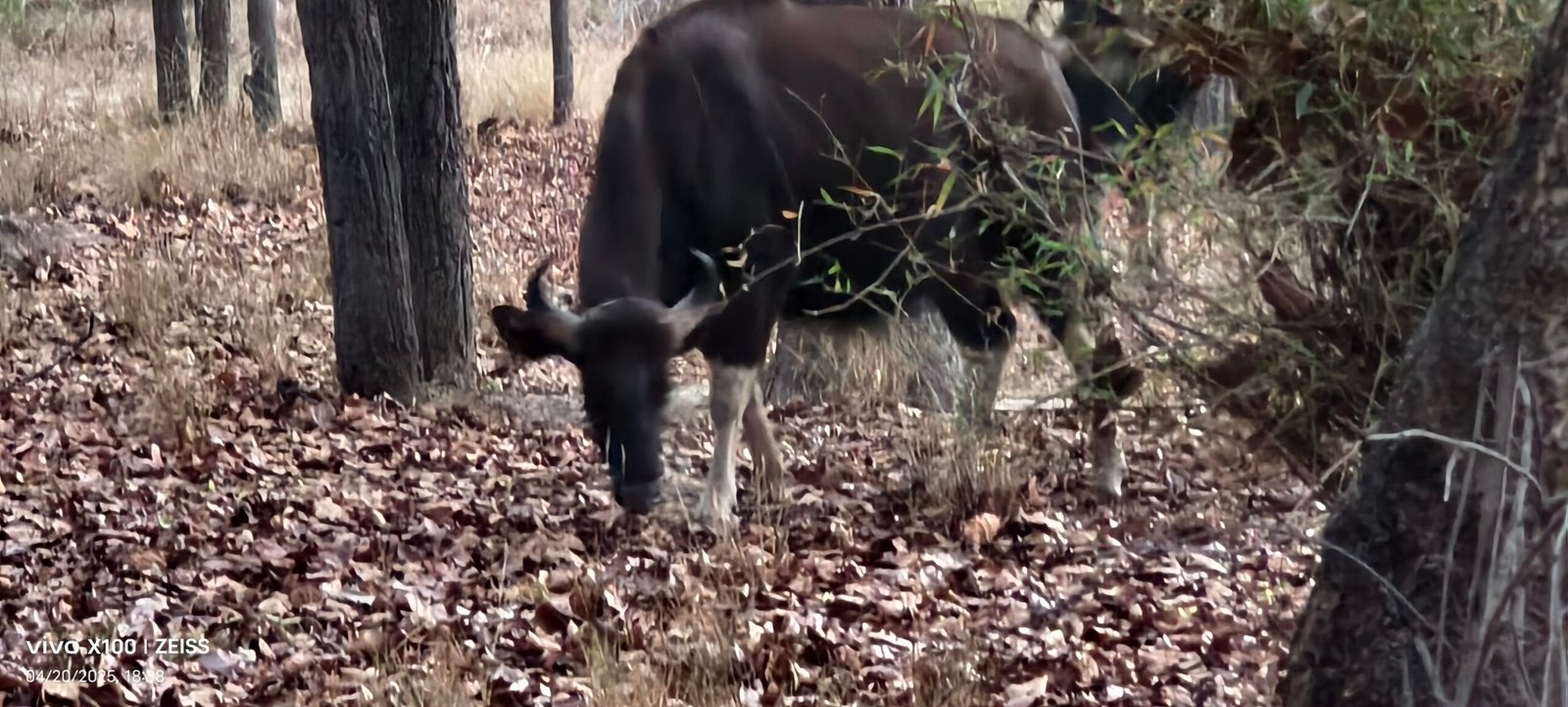
Morning and late evening are the active feeding periods. Herds move to open meadows and forest edges to graze, taking the upper portions of grass blades, shoots, and leaves. In summer, when water is scarce, the gaur concentrates near water sources in the early morning before retreating into shade by mid-morning.
At midday, the animals rest in deep shade. They are almost invisible in this phase — a bulk of darkness in the undergrowth that a passing jeep can drive past entirely. The naturalist, who knows where the animals have been resting for weeks, is the difference between seeing them and not.
Herd composition is typically females with young led by a dominant cow, with adult bulls either loosely associated or semi-solitary. Old bulls — the largest individuals, with the most weathered horns and the deepest colour — often roam alone. These are the most striking subjects photographically and also the most unpredictable behaviourally.
Summer heat makes bulls short-tempered. Gaur bulls have been known to charge without obvious provocation, particularly in May and June when parasitic insects add to their discomfort. The warning signal is the high whistle — a surprisingly sharp, bird-like sound that carries through the forest and alerts the herd. If you hear it from a bull that is facing you, the jeep driver is already reversing.
What the Gaur Eats — And Why It Matters for the Ecosystem
The gaur grazes on a wider variety of plant material than any other ungulate in India. Grasses are the primary food — specifically the upper portions of stems, seeds, and leaves. In drier months, it supplements with bamboo shoots, fallen fruit, bark, and the foliage of deciduous trees. This dietary flexibility is one reason it survives across such varied habitats, from the sal forests of Bandhavgarh to the dry deciduous scrub of Panna and the moist evergreen zones of the Western Ghats.
As a mega-herbivore, the gaur’s grazing actively shapes the vegetation around it. Open meadows in tiger reserves often bear the mark of gaur use — the cropped grass, the disturbed soil at feeding patches, the salt lick zones where herds congregate repeatedly. These open areas, maintained partly by large herbivore activity, are precisely what makes tiger photography in parks like Bandhavgarh and Kanha possible. The gaur is, quietly, part of the reason the grasslands that tigers hunt in exist at all.
Reproduction and the Life Cycle
Gaur breed year-round, but mating peaks between December and June. In Central India specifically, most mating occurs in December and January, with calves arriving in August and September after a gestation period of approximately 275 days — just under nine months, slightly shorter than domestic cattle.
Calves are born a warm golden-yellow, darkening progressively to brown and then near-black over the first years of life. They are weaned between seven and twelve months. Sexual maturity arrives in the second or third year. A gaur in captivity can live up to thirty years; wild lifespans are typically shorter.
The newborn calf is extraordinarily vulnerable. Dhole packs and leopards will take unguarded young. In Bandhavgarh, where tigers are numerous, even healthy young gaur are at risk. It is not uncommon for tigers here to target gaur calves, occasionally escalating to adult females. A fully grown bull, however — weighing close to a tonne with horns designed for combat — is a different proposition entirely. Even the tigers of Bandhavgarh are cautious around mature bulls.
Natural Predators: Only Tigers and Very Large Crocodiles
This is the detail that stops people mid-conversation: of all the predators in Indian forests, only the tiger has been reliably documented killing healthy adult gaur. Saltwater crocodiles have been recorded doing so historically, but habitat overlap between the two species is now minimal.
Leopards and dhole take calves and weakened animals. But a bull gaur, standing nearly two metres at the shoulder and weighing over a tonne, is simply beyond what a leopard or pack of dholes can manage. A gaur that turns to face a threat and lowers its horns has effectively ended the encounter. The tiger’s approach is ambush — targeting animals that are isolated, distracted at water, or caught in difficult terrain. Even then, a gaur fight is not a certainty for the tiger. There are documented cases of tigers being fatally gored by gaur bulls.
Where to See Indian Gaur on Safari
The gaur has a wide range across India’s protected forests, but sighting quality and frequency vary considerably. These are the parks where the probability is highest and the conditions best for photography:
Bandhavgarh Tiger Reserve — Since the 2011–12 reintroduction from Kanha, the population has established well in the Tala and Magadhi zones. April and May offer the best sightings as the animals move to grassland edges during the dry season. Morning drives in the first two hours after gate opening give you the best light and the most active herds.
Kanha Tiger Reserve — One of the strongest gaur populations in India. The open meadows of Kanha, particularly the Kanha and Kisli zones, are excellent for large herd sightings. Kanha is where the Bandhavgarh reintroduction animals came from — the source population.
Nagarhole and Kabini — Karnataka’s gaur sightings along forest roads are exceptional. Large herds, often thirty animals or more, cross roads in early morning. The habitat — denser, taller forest than Central India — creates a different photographic context.
Tadoba-Andhari Tiger Reserve — Strong population with good open-area sightings, particularly around the lake zone and at the waterholes that also attract tigers during summer.
Periyar Tiger Reserve — Kerala’s gaur occupy hilly terrain. The sightings are less predictable but the forest context is different — lush, moist, with different light quality entirely.
Photographing Gaur: Field Notes from Bandhavgarh
The gaur is a photographer’s subject that rewards patience and penalises hurry. A few things I have learned across multiple gaur sightings, including this Bandhavgarh session in April 2025:
Use the light of the first hour. Early morning in April, the quality of the golden sidelight through sal forest is extraordinary. The dark coat of the gaur absorbs rather than reflects — in flat midday light you lose all texture. In low-angle morning light, every muscle and ridge on the shoulder becomes visible. Expose for the white legs in challenging situations — they will blow out before the body is correctly exposed if you are not watching your histogram.
Stay low. A gaur photographed from gypsy seat height against a sky background looks documentary. The same animal photographed from a lower angle with forest behind it looks powerful. Where the vehicle allows, drop the lens as close to the side rail as possible.
Watch the ears, not just the eyes. An alert gaur will rotate its ears before it moves its head. The ears turning toward your vehicle is the first sign of awareness — you have a second or two before the posture changes. That transitional moment — the animal not yet fully alarmed, the ears forward, the body still — is often the strongest frame.
Shoot at distance first, close second. Unlike tigers — where the impulse is to get as close as possible — gaur benefit from some space in the frame. The whole body, the forest context, the herd if present. A full-body portrait with habitat visible reads as a wildlife image. A face-only crop reads as a zoo shot. Close crops of the face work well for detail shots of the boss, horns, or eye texture, but get the full animal first.
Conservation Status: Vulnerable and Under Pressure
The IUCN lists the Indian Gaur as Vulnerable. The global population is estimated between 15,000 and 35,000 individuals, with India holding the large majority. Numbers within protected reserves like Kanha, Nagarhole, and Bandhavgarh are stable or growing. Outside these zones, populations face serious pressure.
The three primary threats are:
Habitat loss. The gaur requires large, undisturbed forest tracts with access to water and open grassland for grazing. Forest fragmentation breaks the movement corridors between populations and isolates herds that then become vulnerable to inbreeding and local disappearance — as happened at Bandhavgarh before the reintroduction.
Disease from domestic cattle. Rinderpest, foot-and-mouth disease, and other livestock diseases have caused significant gaur mortality historically. The boundary zones between protected forests and agricultural land — where domestic cattle graze or stray into forest — are the highest-risk areas for disease transmission.
Poaching. Listed in CITES Appendix I, the gaur is legally protected across all range states. Poaching for meat and trophy hunting continues in parts of Southeast Asia and in less-protected areas of India. The legal protection within tiger reserves is strong; enforcement outside them is inconsistent.
The Bandhavgarh reintroduction is one of India’s cleaner conservation success stories. Fifty animals, two phases, one decade, and a population now visible enough that a tourist on their first jungle safari can see it. That outcome was not inevitable — it required political will, scientific input, and operational competence. It is worth acknowledging.
Common Questions About the Indian Gaur
Is the Indian Gaur the same as the Indian Bison?
They are the same animal — Bos gaurus — called by different names. “Indian Bison” is the popular name used in everyday conversation and across most safari contexts in India. Scientifically, it is not a true bison; those belong to the genus Bison and are native to North America and Europe. The gaur belongs to the cattle genus Bos.
Is the gaur dangerous?
Gaur are generally calm in areas where they have regular exposure to safari vehicles. However, lone bulls — particularly in summer — can be unpredictable and aggressive. The rule at every tiger reserve is the same: vehicle engines stay running, you don’t dismount, and if a bull shows signs of agitation, you reverse. The gaur’s warning whistle is a serious signal, not a novelty sound.
Can a gaur kill a tiger?
Yes. There are documented cases of tigers being killed or seriously injured by gaur. A mature bull gaur weighing over a tonne with curved horns is not prey that any predator takes lightly. Tigers hunting gaur typically target younger animals, females, or isolated individuals — not prime adult bulls.
What does the Indian Gaur eat?
Primarily grasses — the upper stems, leaves, seeds, and flowers of various grass species. It supplements with bamboo shoots, leaves, fallen fruit, and bark. It is an obligate herbivore with no recorded omnivorous behaviour.
Planning a Safari to See Indian Gaur
If seeing the gaur — rather than simply hoping to see it — is part of your safari goal, the following logistics improve your odds significantly:
Time of year: March to June for Bandhavgarh and Central India parks. The summer heat drives animals toward water and open ground, making them more visible and more predictable. April is particularly good — the light is harsh by midday but the mornings are extraordinary, and the herd movements are concentrated.
Zone selection: At Bandhavgarh, the Tala Zone is the most reliable for gaur sightings because it contains the largest open grassland patches and the most established gaur territories since the reintroduction. Ask specifically when booking.
Drive timing: The first drive of the day — from gate opening until mid-morning — is where almost all the productive gaur sightings happen. Afternoon drives produce less, unless you are near water in the late evening.
Full-day permits: Bandhavgarh offers full-day permits that allow you to stay in the park through the midday period and into the afternoon. For gaur photography specifically, a full-day permit lets you photograph in morning golden light, rest while the animals do, and then return to the same individuals in the softer evening light. This is the approach I used during the April 2025 session that produced the photographs in this article.
For wildlife photography visits where gaur, tiger, and leopard are all targets, having a knowledgeable naturalist and pre-booked zone access is not optional — it is the difference between a productive session and an uncertain drive.
Read the full Bandhavgarh planning guide here: Bandhavgarh National Park — A Complete Safari Guide
The Animal That Makes You Recalibrate
I have been asked what is the point of photographing the gaur when Bandhavgarh has tigers. The question misunderstands what the gaur does to the way you see the forest.
After you have watched a thousand-kilogram animal stand at the treeline with absolute composure — unhurried, alert, entirely present — the scale of everything else in the jungle recalibrates. You understand why the forest floor is shaped the way it is. You understand why the grassland openings exist. You understand what the tiger is measuring up against when it selects its prey.
The gaur is not background wildlife. It is an animal that, in the right light, at the right distance, in the right forest — turns a safari morning into something you do not forget.
That is what happened to me at Bandhavgarh in April 2025. I have the photographs. And I will keep going back.
Related: Is the Indian Gaur Dangerous?
Related: Indian Bison: Why the Gaur Is Not a Bison, and Where to See It