
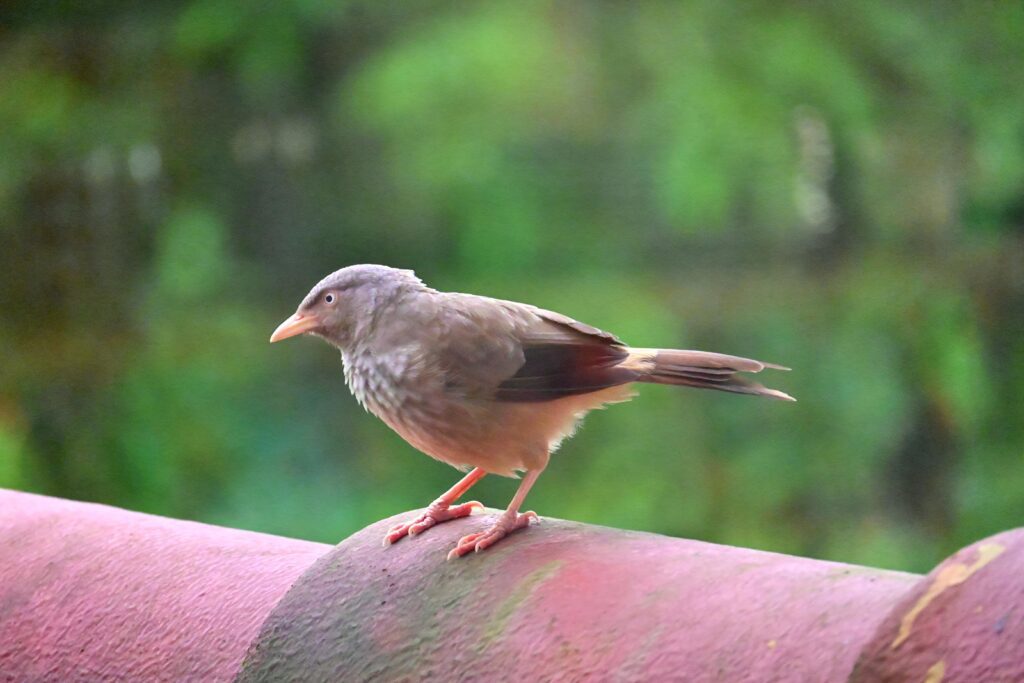
Species Information
- Common Name: Jungle Babbler / Seven Sisters
- Scientific Name: Argya striata
- Family: Leiothrichidae (Laughingthrush family)
- Habitat: Gardens, forests, villages, and urban areas across the Indian subcontinent
- Diet: Insects, fruits, seeds, and human food scraps
“The Noisy Charm of the Jungle Babbler – India’s Seven Sisters”
- Introduction – The friendly, noisy bird often hopping around our backyards.
- Identification – Brown-grey feathers, pale eyes, long tail, and distinct chatter.
- Social Behavior – Why they’re called Seven Sisters (they move in groups of 6–10).
- Role in Nature – Great insect hunters, help control pests naturally.
- Cultural Significance – Mentioned in Indian folklore as “gossiping birds”.
- About
- They rarely fly long distances—prefer hopping around.
- Known as “feathered alarm clocks” because of their loud dawn calls.
- Extremely social—if one is attacked, the whole group rushes to help.
- A reminder that even common backyard birds are full of character and charm.
Fun Facts
- Jungle Babblers are nicknamed “feathered gossipers” because of their constant chattering.
- They are cooperative breeders—group members help raise each other’s chicks.
- In villages, people say if babblers are making extra noise, rain is on the way.
- They’re not great flyers but excellent team hunters, scouring the ground together.
The Seven Sisters
Across much of India the Jungle Babbler is known as the “Seven Sisters” — saat bhai in Hindi, saat bhai chara in Bengali. The name comes from the way they move: never alone, always in a squabbling, chattering party of six to ten birds.
The number is not literally seven. It is just that a group this size is what people notice.
Why they live in groups
Jungle Babblers are cooperative breeders, and this is what makes them genuinely interesting rather than merely noisy.
A breeding pair is helped by other adults in the group — often their own grown offspring from previous years — who feed the chicks, defend the nest and mob predators. A young babbler may spend a year or two helping raise its siblings before it breeds itself.
- More eyes. With several birds watching, one can always be on sentry duty while the rest feed.
- Mobbing power. A group will drive off a snake, a mongoose or an owl that a single bird could not.
- Better survival for chicks. More adults bringing food means more chicks fledge.
That constant noise
The chattering is not aimless. It is contact calling — a running roll-call that keeps the group together in dense cover where they cannot see each other.
If you hear the tone change sharply, look up. Babblers are excellent alarm-raisers, and their scolding is often the first sign of a snake, a raptor or a cat nearby. Experienced guides listen to babblers for exactly this reason.
Identifying it
- Size and shape: about 25 cm, dull greyish-brown, with a longish tail often held slightly cocked.
- Eye: pale, creamy or yellowish — noticeable at close range.
- Bill: yellowish and slightly curved.
- Behaviour: the surest field mark. If it is brown, in a noisy gang, hopping about on the ground and flicking leaf litter, it is a babbler.
They fly poorly and reluctantly, usually in a straggling line, each bird following the last across a gap.
Where to find them
Gardens, scrub, cultivation edges, village trees, roadside thickets and open woodland. They are among the most widespread birds in India and are entirely comfortable near people.
You do not need to go anywhere special. A babbler party will find you.
Photographing babblers
- Wait for them to come to you. Groups work through an area steadily. Sit still and they will pass.
- Shoot the interaction. Two babblers squabbling or preening each other is a far better photograph than a single perched bird.
- Watch for the bathing. Babblers bathe communally in dust and shallow water, which makes excellent behaviour images.
- Expect movement. They rarely hold still. A faster shutter than you think you need.
Frequently asked questions
Why is the Jungle Babbler called Seven Sisters?
Because it moves in noisy parties of roughly six to ten birds. The number seven is figurative, not literal.
Are Jungle Babblers cooperative breeders?
Yes. Non-breeding adults, often previous offspring, help feed and defend the chicks.
Why are they so noisy?
Constant contact calls keep the group together in thick cover. The calls also serve as alarms.
What do Jungle Babblers eat?
Mostly insects taken from leaf litter, plus fruit, nectar and grain.
Are they common?
Very. They are among the most widespread and easily seen birds in India.
Related: Birds of Bhigwan — 39 species and Jungle Myna.
