
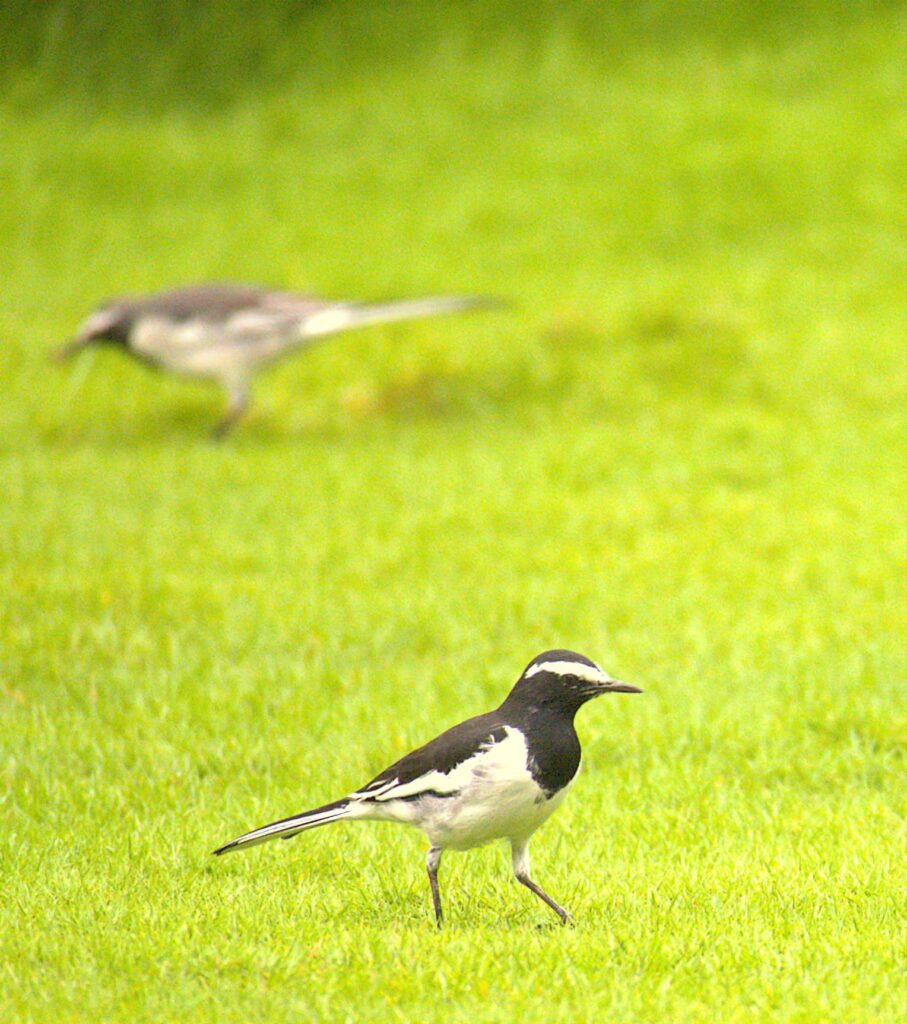
White-browed Wagtail (Motacilla maderaspatensis)

White-browed Wagtail (Motacilla maderaspatensis)

What makes the wagtail unique is its restless energy—rarely standing still, it bobs its tail up and down, almost like it’s keeping rhythm with nature. In many cultures, wagtails are considered symbols of cheerfulness, hard work, and adaptability.


🌟 Fun Facts for Articles

  1. Tail Wagging Mystery: Scientists still debate why wagtails wag their tails—some say it flushes out insects, others believe it’s a signal to predators: “I’m alert, don’t bother chasing me.”
  2. World Traveler: White Wagtails are migratory, traveling thousands of kilometers between breeding grounds in Europe/Asia and wintering in Africa and South Asia.
  3. Human-Friendly: They often live close to humans, seen hopping around gardens, roadsides, and parks, especially near water.
  4. Cultural Symbolism: In Japanese folklore, the wagtail is believed to have brought love into the world.
  5. Bug Control Heroes: A wagtail can eat hundreds of small insects in a single day, making it a natural pest controller.

First, a name worth getting right

This bird is often called a White Wagtail, and it is not one. The bird photographed here is a White-browed Wagtail (Motacilla maderaspatensis), a different species from the White Wagtail (Motacilla alba).

  • White-browed Wagtail: black head, back and breast, a bold white eyebrow through a black face, white belly. The largest wagtail in India. Resident all year.
  • White Wagtail: grey back, white face with a black bib and cap, smaller and slimmer. A winter visitor to most of India.

If the back is black rather than grey, and there is a thick white stripe over the eye, you are looking at a White-browed Wagtail.

Where to find it

This is a bird of fresh water. Riverbanks, streams, reservoir edges, canal banks, village tanks and the wet margins of towns. It does not need wilderness — a stone ghat or a garden pond will do.

It is resident across most of India, so unlike many wetland birds you can look for it in any month.

The tail

Every wagtail pumps its tail up and down almost constantly, and nobody is entirely certain why.

The likeliest explanations are that it flushes insects out of the grass ahead of the bird, or that it signals alertness to a watching predator — a way of saying I have seen you, do not bother. Both may be true. What is certain is that it is the fastest way to recognise the family from a distance, long before you can make out any plumage detail.

Behaviour

White-browed Wagtails walk rather than hop, moving quickly across open ground and stopping abruptly. They take insects from the ground, from shallow water, and sometimes in mid-air.

They are strongly territorial around water. A pair will hold a stretch of bank and see off intruders. The song is loud, clear and surprisingly musical for a bird that looks so severe.

They nest on a ledge or in a cavity close to water — a gap in a wall, under a bridge, in the stonework at the edge of a tank. That tolerance of built structures is why they are among the easier wetland birds to find.

Photographing wagtails

  • Get down to their level. They are ground birds. A camera at standing height gives you a bird on a lawn; a camera at ground level gives you a portrait.
  • Expose carefully. Black and white plumage on a bright bank is a difficult exposure. Protect the whites and lift the shadows afterwards.
  • Anticipate the stop. They run, then pause. Focus where the bird is heading, not where it is.
  • Use the reflection. A wagtail at the edge of still water gives you a mirror image for nothing.

Frequently asked questions

Is the White-browed Wagtail the same as the White Wagtail?

No. The White-browed Wagtail (Motacilla maderaspatensis) is black-backed with a bold white eyebrow and is resident in India. The White Wagtail (Motacilla alba) is grey-backed and mostly a winter visitor.

Why do wagtails wag their tails?

Most likely to flush insects, to signal alertness to predators, or both. It is not fully settled.

Where do White-browed Wagtails live?

Beside fresh water across most of India — rivers, streams, canals, reservoirs and village tanks. They are resident, not migratory.

How big is it?

It is the largest wagtail found in India, noticeably bigger and heavier than the wintering species.

When can I see one?

Any month. Being resident, it does not depend on the migration season.


Related: Birds of Bhigwan — 39 species, Ashy Prinia vs Grey-breasted Prinia and Pied Bush Chat: male vs female.

Scroll to Top