
Bhigwan · Anatidae
Northern Shoveler
Spatula clypeata
There is a group of ducks going in tight circles on the open water. Not one or two — fifteen or twenty, tightly packed, each bird following the one ahead at exactly the same distance. They have been doing this for ten minutes. This is not confusion. This is feeding.
- Status at Bhigwan
- Winter visitor
- How often seen
- Very common
- Size
- 44–52 cm
- Family
- Anatidae
The spinning explained
The circular motion created by a tightly packed group of shovelers generates a slow upwelling in the centre of the ring. Invertebrates — copepods, midge larvae, algae — that live in the sediment are brought up to the surface by this gentle vortex. The birds filter the resulting slurry through lamellae: fine comb-like projections on the inner edges of the bill, which strain food from the water as it passes through. The bird ahead stirs up material that the bird behind filters; the formation is self-reinforcing.
Groups as small as five birds and as large as forty engage in this behaviour at Bhigwan. When it is working well, other ducks — Garganey, Pintail, occasionally Gadwall — drift into the spinning group to freeload, which is why shoveler flocks often appear to accumulate around them.
The bill that gives it away
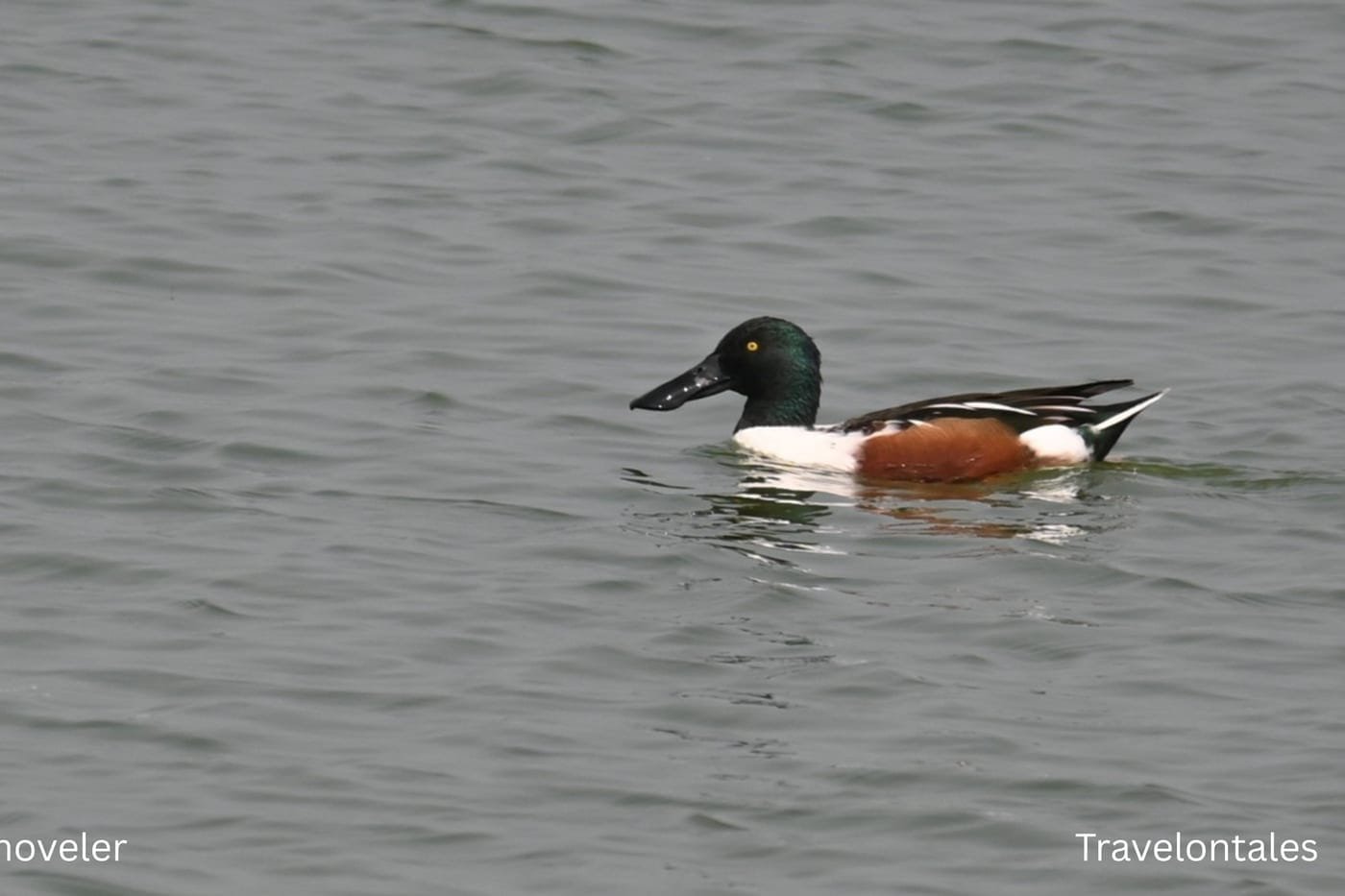
Even at 200 metres, the Northern Shoveler’s spatulate bill is recognisable. No other duck at Bhigwan has a bill that ends in a broad, rounded, shovel-like shape — wider than the head when seen from above. The bill also causes the bird to ride slightly bow-heavy in the water, tipping forward when it feeds, which gives shoveler flocks a characteristic posture when they are feeding en masse.
The breeding male is a striking bird: green head, white breast, chestnut flanks. At Bhigwan in winter, birds are at various stages between eclipse (mottled brown, like the female) and full breeding plumage. Many males begin showing patches of colour from November onwards, and by January the full green-white-chestnut pattern is common in the flocks.
When and where at Bhigwan
Northern Shovelers are among the most abundant winter ducks at Ujani reservoir. The first birds arrive in October and the last leave by April. December and January hold the peak numbers — flocks of several hundred are not unusual in good years. They prefer water of medium depth and congregate in sheltered bays and along the reservoir margins, often mixing with Garganey, Pintail and Common Teal.
Boat safaris bring you alongside the flocks at close quarters. On calm mornings the spinning behaviour is most reliable — wind that disturbs the surface disrupts the upwelling mechanism.
Shooting the flock
The spinning formation is best captured from slightly above, which means from the boat deck rather than at water level. A medium telephoto (200–400 mm) covers the whole flock in one frame. For individual portraits of breeding-plumage males, get as close as the boat allows and look for birds that have separated briefly from the group — a single male on flat water with its own reflection is cleaner than a dense flock shot.
Questions about the Northern Shoveler
How do I tell a female Shoveler from other brown ducks? +
The spatulate bill is the mark that works at every range. Even a female Shoveler in plain brown plumage has a bill that looks wider and rounder-tipped than any other dabbling duck’s. In flight, both sexes show a pale blue forewing panel that distinguishes them from Garganey (which has a striking white supercilium instead). Orange legs and feet are also visible when birds are standing or landing.
Are the shovelers at Bhigwan from far away? +
Yes — Northern Shovelers breed across Europe, Central Asia and parts of Siberia. The birds that winter at Bhigwan have typically migrated several thousand kilometres from their breeding grounds. Ringing and satellite tracking studies have shown that individual birds return to the same wintering sites year after year, which means the shovelers you see in December may have been at Bhigwan in previous winters too.
What does the Northern Shoveler eat besides plankton? +
The Shoveler’s diet at Bhigwan is more varied than the spinning-flock feeding behaviour suggests. It takes aquatic invertebrates including midge and mosquito larvae, tiny crustaceans, seeds of aquatic plants, and occasionally small fish fry. The lamellae in the bill filter particles as small as 0.3 mm, making it one of the most efficient filter feeders among ducks. In shallow water it also up-ends like other dabbling ducks to reach submerged vegetation.
How many Northern Shovelers can you see at Bhigwan in a good winter? +
Peak counts at Ujani reservoir have recorded several thousand shovelers during January surveys. The reservoir is one of the most important sites for this species in Maharashtra. Numbers vary year to year depending on water levels — in years when the reservoir is fuller, with more shallow margins, counts tend to be higher. A typical boat safari in December or January will encounter multiple flocks of 50–200 birds.
Plan your visit
Birds of Bhigwan
The shoveler is one of ten birds covered in this Bhigwan series. The full checklist — with species notes, seasons and what to expect on a boat safari — is on the main page.