
Bhigwan · Nectariniidae
Purple Sunbird
Cinnyris asiaticus
The Purple Sunbird is not a bird you find by searching. It finds you — a fast, audible dash through the thorn scrub, a landing on a flower-cluster, a moment of iridescence that shifts from purple to green to blue as the bird moves, then gone.
- Status at Bhigwan
- Resident
- How often seen
- Common
- Size
- 10 cm
- Family
- Nectariniidae
The light trick
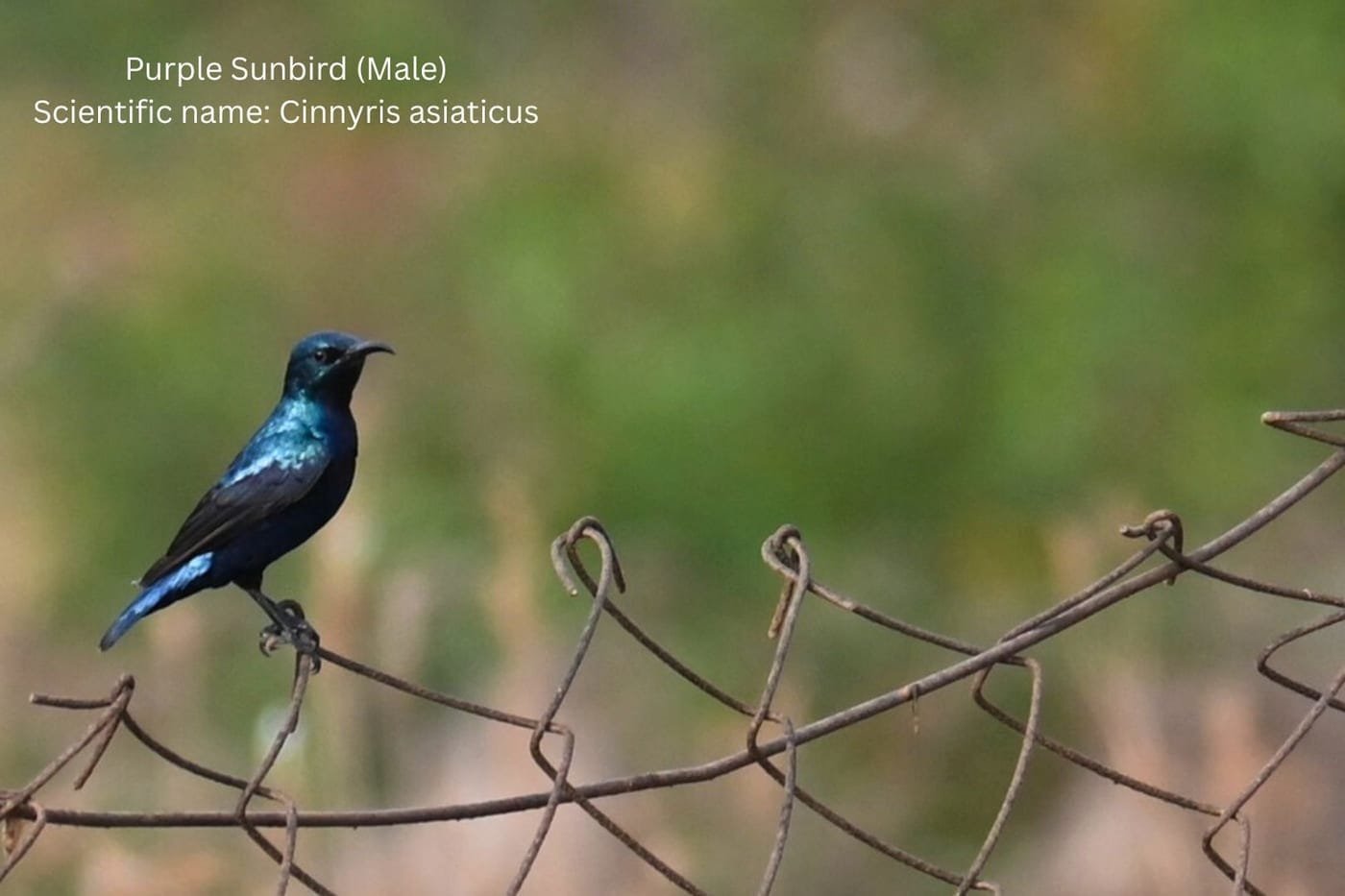
The male Purple Sunbird has no purple pigment. The colour is structural — produced by the microscopic architecture of the feather barbules, which split and reflect light so that different wavelengths are returned to the viewer depending on the viewing angle. Watch a perched male turn his head and the iridescence cycles through purple, blue, and green without the bird doing anything. In flat overcast light the plumage reads almost black; in direct morning sun at the right angle it is vivid enough to stop conversation.
This matters for photography: the iridescence is angle-dependent. A shot from the wrong direction gives you a black bird. The correct angle — roughly with the sun behind and slightly to your left or right — gives the full display.
Look away from the water
The Purple Sunbird is not a waterbird and is almost never seen on the open reservoir. Look instead in the dry scrub and thornbush at the margins — stands of Prosopis juliflora (babhul/mesquite), Calotropis (crown flower), and any flowering tree or shrub at the roadside. The bird is resident year-round at Bhigwan, but is most visible from February to May when males sing constantly from exposed perches and the flowering trees are at their most productive.
The male’s song is an easy identifier once learned: a fast, rising, scratchy whistle — not musical by the standards of other small passerines, but distinctive and persistent. Follow the sound and you will find the bird.
Eclipse plumage — the common confusion
Outside the breeding season, the male moults into what is called eclipse plumage: the iridescent feathers are replaced by brown and yellow, and the bird looks like a completely different species — streaked yellow-brown below with a dark stripe down the centre of the throat and breast. Many birders see an eclipse male and record it as a new species before realising what it is. The dark central stripe, which is absent in the female, is the mark that identifies eclipse males. By January the iridescent feathers begin returning, and by February most males are back in breeding dress.
Females are olive above and yellow below throughout the year, with a pale supercilium. They are active and conspicuous in flowering trees and can be found even when the males are in eclipse and difficult to identify.
Feeding behaviour
Despite the reputation of sunbirds as hoverers, the Purple Sunbird perches more than it hovers. It clings to flower clusters at awkward angles, using the long curved bill to probe deep into tubular flowers. Hovering is reserved for larger flowers that cannot support the bird’s weight. Watch for the tongue — it is long and tubular, designed to reach nectar in the deepest flowers, and flicks in and out too fast to see easily but occasionally catches the light.
Photographing iridescence
Find a flowering babhul or Calotropis bush that a bird visits regularly, then sit or crouch with the morning sun at your back. Wait for the bird to perch at branch level with an open background behind it. Use the widest aperture your lens allows to blur the thorny background. Burst-shoot when the bird moves its head — one frame in twenty will have the iridescence at its peak angle. 1/2000 sec is fast enough for a perched bird; go faster if it is hovering.
Questions about the Purple Sunbird
Where exactly at Bhigwan should I look for Purple Sunbirds? +
The road from Bhigwan towards Kumbhargaon passes through scrub with flowering Prosopis and Calotropis on both sides — these are your first stops. The village itself and any garden trees in Kumbhargaon are also productive. The bird is not found at the water’s edge; if you are standing on the reservoir bund looking at ducks, turn around and check the scrub behind you.
Is the Purple Sunbird the same as a hummingbird? +
No — sunbirds and hummingbirds are not related at all. They are a famous example of convergent evolution: two unrelated bird groups that independently evolved similar body shapes, long curved bills, and nectar-feeding behaviour to exploit the same ecological niche. Hummingbirds are found only in the Americas; sunbirds are an Old World family found across Africa and Asia.
Does the Purple Sunbird build its own nest? +
Yes — the female builds a distinctive hanging purse nest, suspended from the tip of a thin branch or from a thorny stem. The nest is made from plant fibres, grass, bark strips and spider silk and is covered on the outside with insect frass, lichen and other material that camouflages it as a lump of debris. It has a porch-like entrance at the side near the top. The nest is constructed entirely by the female, though the male stays close and sings throughout the building period.
Can Purple Sunbirds be found in Bhigwan town as well as at the reservoir? +
Yes — the species is common in gardens and around human habitation wherever there are flowering trees and shrubs. Any house with a flowering Ixora, Callistemon or bougainvillea in Bhigwan town or Kumbhargaon village is likely to have sunbirds visiting. In fact, the village is often a more reliable spot to find Purple Sunbirds than the open reservoir, where there is nothing for them to eat.
Plan your visit
Birds of Bhigwan
Ten species from a single winter morning at Ujani reservoir — the full guide is on the Birds of Bhigwan page.
More Purple Sunbird photographs
Plan your trip: Bhigwan Bird Sanctuary: Complete Travel and Birding Guide