
Almost everything about this bird is the wrong way round.
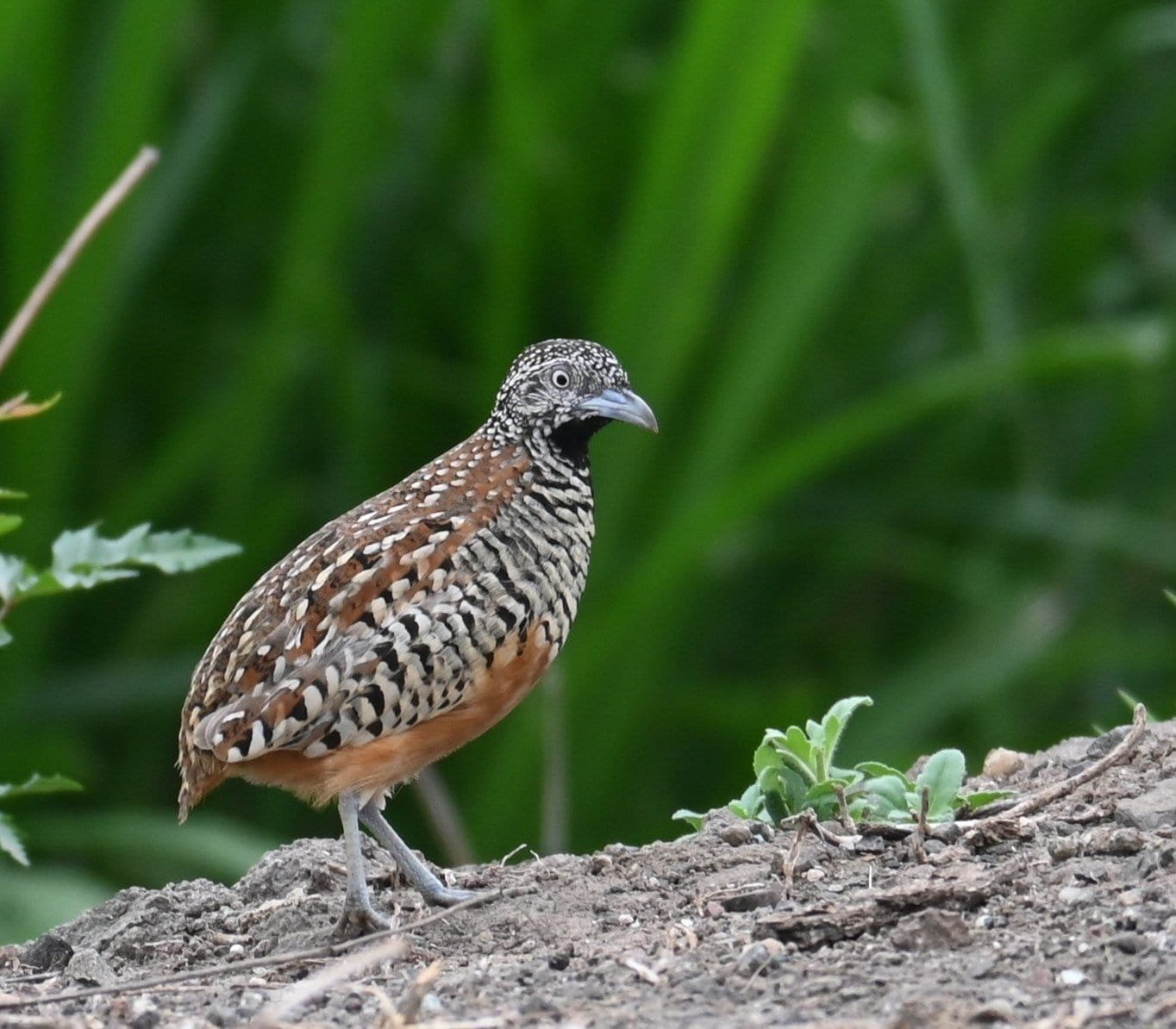
The female is the larger of the pair and the brighter. She is the one with the black throat. She is the one who calls — a deep, carrying, mechanical booming that you will hear far more often than you see the bird. She holds a territory, she fights other females over it, and she mates with several males in a season.
The male gets the eggs. He incubates them alone, raises the chicks alone, and she takes no part in it whatsoever before moving on to the next male.
This is rare, and it has a name
The arrangement is called classical polyandry, and among birds it is genuinely uncommon — a few hundred species out of ten thousand or so. Buttonquails, jacanas, phalaropes and painted-snipe are the Indian examples, and in every one of them the usual pattern of showy male and drab female is reversed.
It changes what you should expect in the field. When you see a buttonquail with chicks, you are almost certainly looking at a single father. When you hear that booming call at dusk, it is a female advertising. And the bird that looks the most striking is the one doing the leaving, not the raising.
Knowing it is a buttonquail at all
Buttonquails are not quails. They are not closely related to them, despite looking almost identical — they sit in an order of their own, closer to waders than to gamebirds, and the resemblance is convergence rather than family.
Two things separate them from the real bush quails you will find in the same country. Buttonquails have no hind toe, which you can occasionally see on bare ground. And the female Barred Buttonquail has that solid black throat and breast centre, which no bush quail shows.
The rest of her is a good description of the species: finely barred flanks, bold black spotting across the shoulders, a warm chestnut wash on the wing coverts, a heavy blue-grey bill and a pale eye. The male is duller, browner, and lacks the black.
Behaviour that makes them hard
Buttonquails would rather walk than fly, and given a choice will freeze, then creep away through the grass. When they do flush it is sudden, low and brief, and they drop back into cover within twenty metres.
They live in scrub, crop edges, fallow ground and the rank grass beside fields, and they move around a good deal as habitat dries out and gets cut, so they are unpredictable in a way that resident birds are not.
The practical advice, if you want to see one, is to walk field edges and rough ground slowly at first light and last light, listen for the boom, and pay attention to anything small that runs rather than flies. The bird above was on open earth at the edge of a track, which is where you will get your best look at one.
Where this fits at Bhigwan
Most people come to Bhigwan for the water and leave having seen the water. The birds that make the place genuinely interesting — buttonquails, bush quails, sandgrouse, larks, coursers, harriers — are all in the dry ground behind it.
That habitat is covered properly in the piece on the Kadbanwadi grassland, and if you are planning a first visit, the Bhigwan guide has the practical side of it. For the wetland birds themselves, this one covers what turns up once the flamingo boats have gone home.
A note on names: we identify these birds ourselves and we do not always get it right. If you think we have called one wrongly, tell us — we would rather fix a name than leave it standing.