
You will almost never see the first bird. What happens is that the ground explodes.
A covey of bush quail sits tight until you are a few feet away and then goes up all at once, eight or ten birds whirring off low in different directions with a noise like a pack of cards being shuffled hard. By the time you have worked out what happened they are down again in the grass, silent, fifty metres away.
What you are looking at
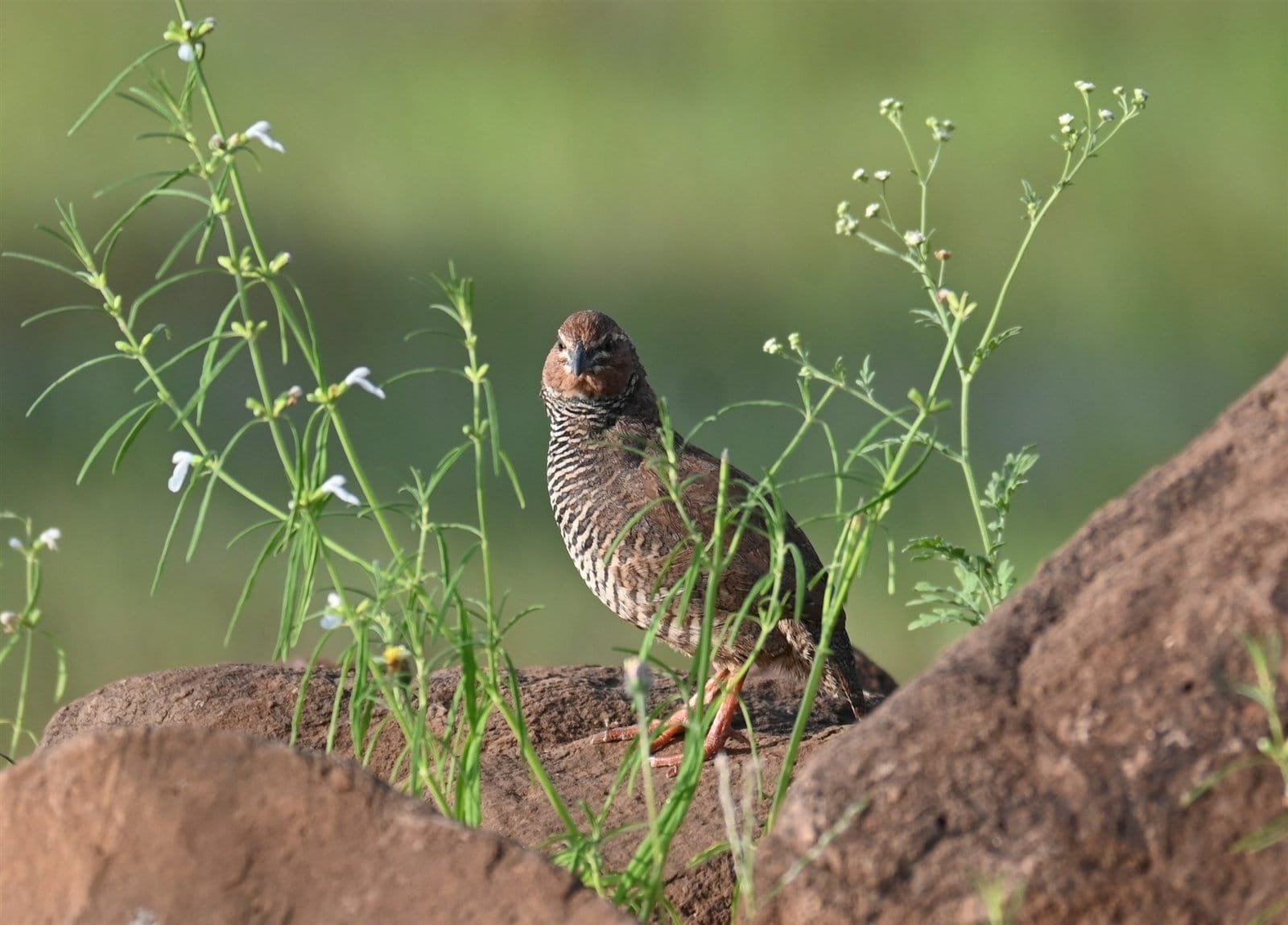
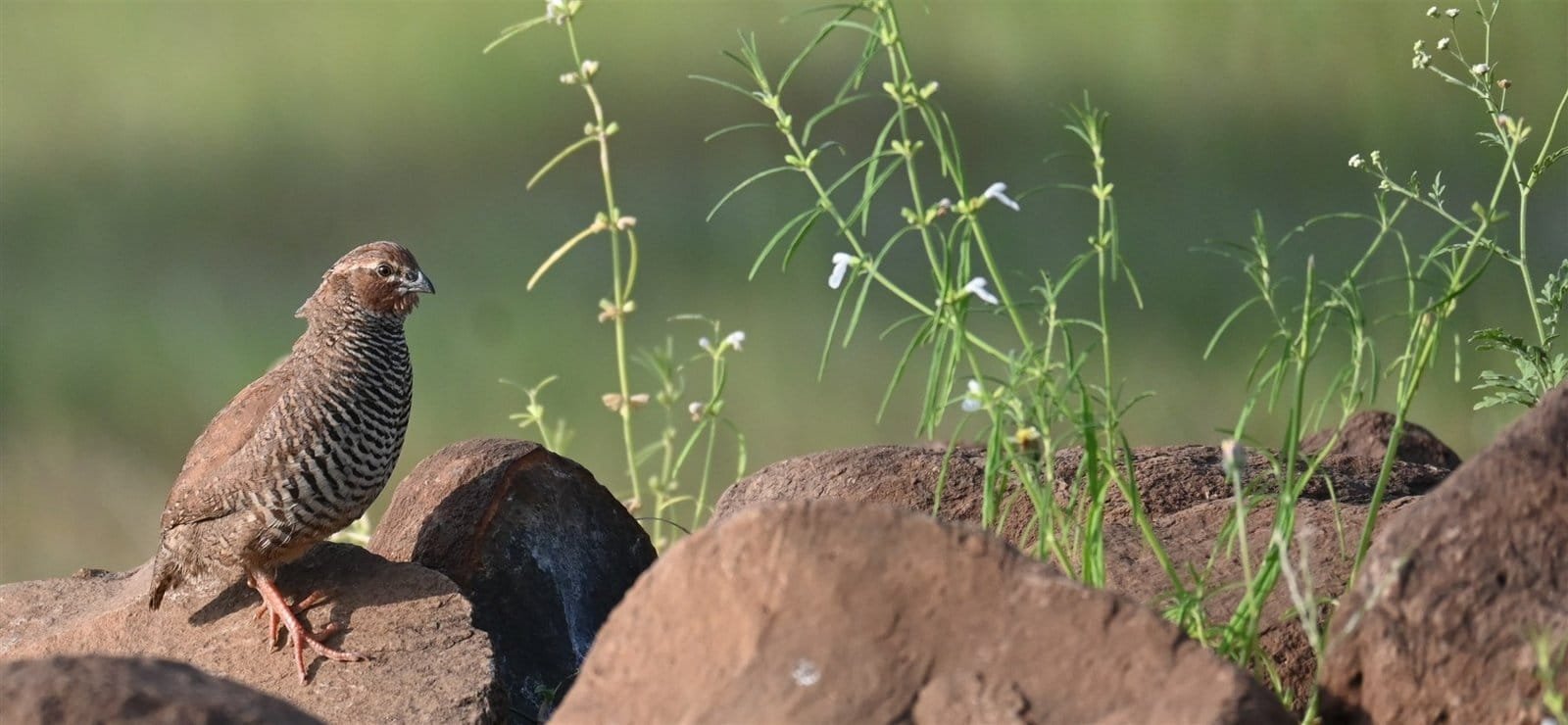
This is a Rock Bush Quail — a small, round, ground-dwelling bird of dry stony country, heavily barred black and white below, warm brown above, with a rufous face and throat and orange-red legs.
The one you have to separate it from is the Jungle Bush Quail, which shares the barred underparts and much of the range. The cleanest difference is the face. A male Jungle Bush Quail has a white throat with a dark border and bold white stripes above and below the eye. On the Rock Bush Quail the whole face and throat are washed rufous, with a paler line over the eye but nothing like that crisp white pattern.
Habitat is the supporting clue rather than the deciding one. Rock Bush Quail favour exactly what the name suggests — rocky slopes, stony scrub, boulder-strewn ground with thin grass. Jungle Bush Quail prefer grassier, bushier country. There is plenty of overlap, and I would not identify one on habitat alone.
They live and die as a group
Bush quail spend their entire lives in coveys — usually a family party, six to a dozen birds, feeding together, dust-bathing together and staying in contact with a soft repeated whistle.
At night they roost in a tight circle on the ground, bodies pressed together and heads facing outwards. It keeps them warm and means something approaching from any direction meets an alert bird. When the covey is scattered by a predator or a walker, they call each other back together afterwards with a rallying whistle, which is often the easiest way to find them again.
That whistle is worth learning. In this country you will hear bush quail far more often than you will see them.
Why the stony ground matters
Bush quail eat grass seed, small grains and insects, and they need bare patches to dust-bathe in and thin cover to hide under. Rocky, broken, half-grassed ground — the sort of land nobody wants — is ideal.
It is also the habitat that vanishes fastest, because it is the easiest to write off. Grassland and stony scrub in India are still classed as wasteland in most official reckoning, which makes them the first choice for anything that needs empty land. The birds that depend on it are not rare because of persecution. They are rare because the ground itself keeps being converted.
The same argument runs through the piece on the Kadbanwadi grassland, which is the best surviving example of it near Pune.
Finding them
Walk slowly along tracks through stony scrub in the first two hours of light. Watch the edges of the path — coveys feed in the open early and retreat as the day heats up. Stop often, because they freeze when you stop and move when you move.
And when one goes up, do not follow the flush. Mark where they came down, wait, and listen for the rallying call. Coveys reassemble within a few minutes, and a bird walking back to its family is far easier to photograph than one that has just been startled off the ground.
The other ground birds of this landscape are worth the same patience: the Barred Buttonquail, where the female does the calling and the male raises the chicks, and the Painted Sandgrouse, whose males carry water to their young in their belly feathers.
A note on names: we identify these birds ourselves and we do not always get it right. If you think we have called one wrongly, tell us — we would rather fix a name than leave it standing.