
A bee-eater that swallowed a bee whole would be in serious trouble. So it does not.
It takes the insect in mid-air, carries it back to a perch, and then beats it — hard, repeatedly, against the branch, turning it and striking it until the sting is discharged and the venom gland is squeezed out. Only then does it swallow. Young birds have to learn this, and they get stung while they are learning.
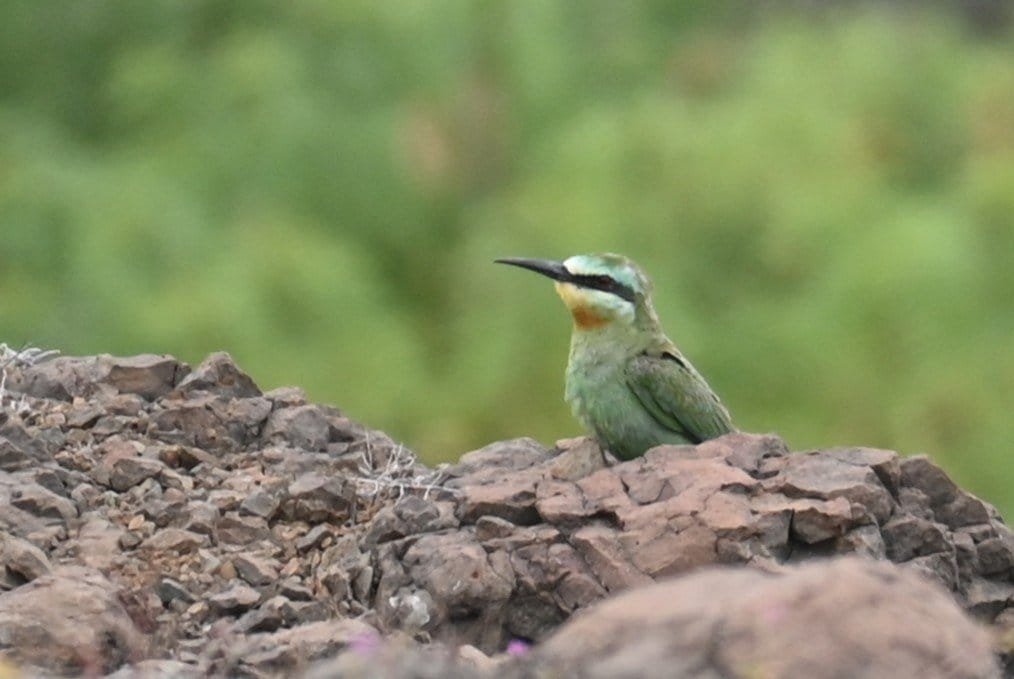
The bird in the picture
Green body, long decurved black bill, a black mask through the eye with pale blue lines above and below it, and a warm rufous-orange wash on the chin and throat.
That combination puts it in a small group. The everyday Green Bee-eater that sits on every wire in the country is out — it has a blue chin and a thin black band across the throat, not an orange one, and it is smaller with a black-tipped central tail.
That leaves the Blue-tailed Bee-eater and the Blue-cheeked Bee-eater, and this is where I will be straight with you: I am not certain which of the two this is. Both are larger than the Green, both have the dark mask, and both show rufous on the throat.
The Blue-tailed is much the commoner of the two in Maharashtra and has a yellow chin above a chestnut throat with a narrow blue line under the mask. The Blue-cheeked is scarcer, has more extensive pale blue on the face both above and below the mask, and a throat that runs more rufous than yellow. What I can see here leans towards the Blue-cheeked, and the bird is in exactly the dry open country it favours, but the light is flat and the angle is not ideal. If you can settle it, I would like to know.
How they hunt
All of them work the same way. Sit on an exposed perch, watch, launch, take the insect in the air with an audible snap, and return — usually to the same perch, which is what makes them one of the easiest families to photograph in flight.
They take bees and wasps, but also dragonflies, butterflies, flying ants and beetles. Near water they will hunt over it. In dry grassland like this they work low over the ground and the tops of bushes.
The perch habit is worth exploiting. Watch for two minutes, identify the branch or rock the bird keeps coming back to, prefocus on it, and wait for the return rather than chasing the flight. That single change is the difference between a folder of blurred green streaks and one clean frame.
Nesting in the ground
Bee-eaters dig. They tunnel into sandy banks, the sides of dry riverbeds, road cuttings and sometimes flat open ground, excavating a burrow that can run a metre or more, with a chamber at the end.
Blue-tailed Bee-eaters often nest colonially, which means a bank can hold dozens of holes and the whole area is alive with birds through the breeding season. The tunnels are dug with the bill and kicked clear with the feet, and a pair will work at it for weeks.
It is also why they are vulnerable in a way a tree-nesting bird is not. Bank stabilisation, sand mining and road works remove the nesting habitat entirely, and a colony site lost is not easily replaced.
Where to look at Bhigwan
Away from the water, in the open dry ground, on the same low perches that hold the rollers — rocks, stumps, fence wires, the tops of thorn bushes. Early morning and late afternoon, when insects are flying and the light is low enough to be useful.
It is the same stretch of country that holds the bush quail and the sandgrouse, and a morning walked slowly there will give you more than a morning on the boat. The grassland itself is covered in the Kadbanwadi piece.
A note on names: we identify these birds ourselves and we do not always get it right. If you think we have called one wrongly, tell us — we would rather fix a name than leave it standing.