
There is a roller on almost every wire in this country. You stop noticing them. Then one morning in the dry grassland behind Bhigwan a roller went up off the rocks in front of us and the blue was wrong.
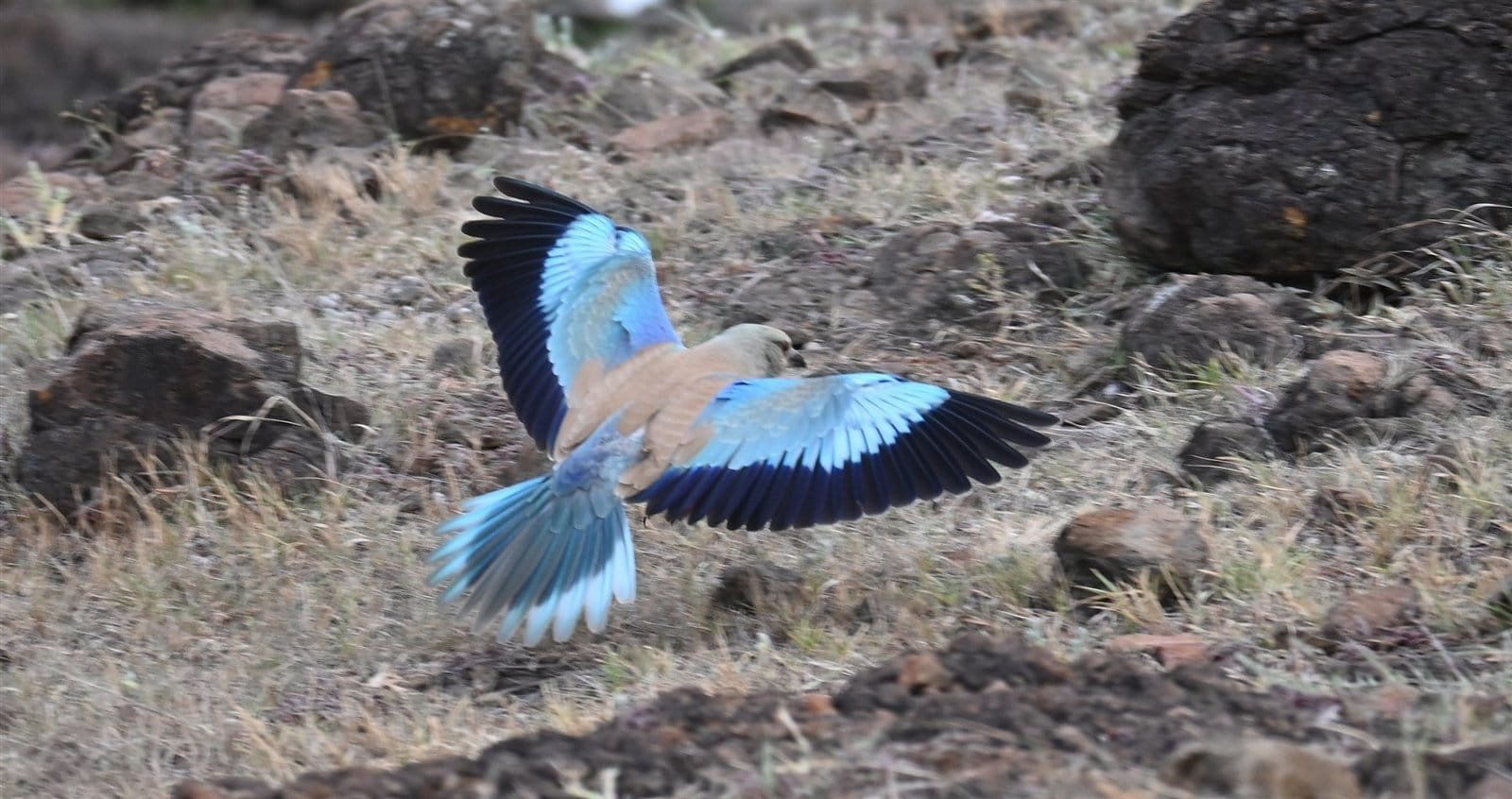
Not the hard turquoise-and-navy of the Indian Roller, which flashes like a struck match. This was paler, softer, almost washed out, with a sandy-brown back instead of a rufous one. A European Roller, several thousand kilometres from where it was born and not finished travelling.
Telling it from the one you see every day
The Indian Roller is a resident, sits on wires and fence posts everywhere, and has a rufous-brown breast with a bright blue crown and vent. The European Roller is a passage migrant, much scarcer, and is essentially a pale blue bird with a cinnamon back.
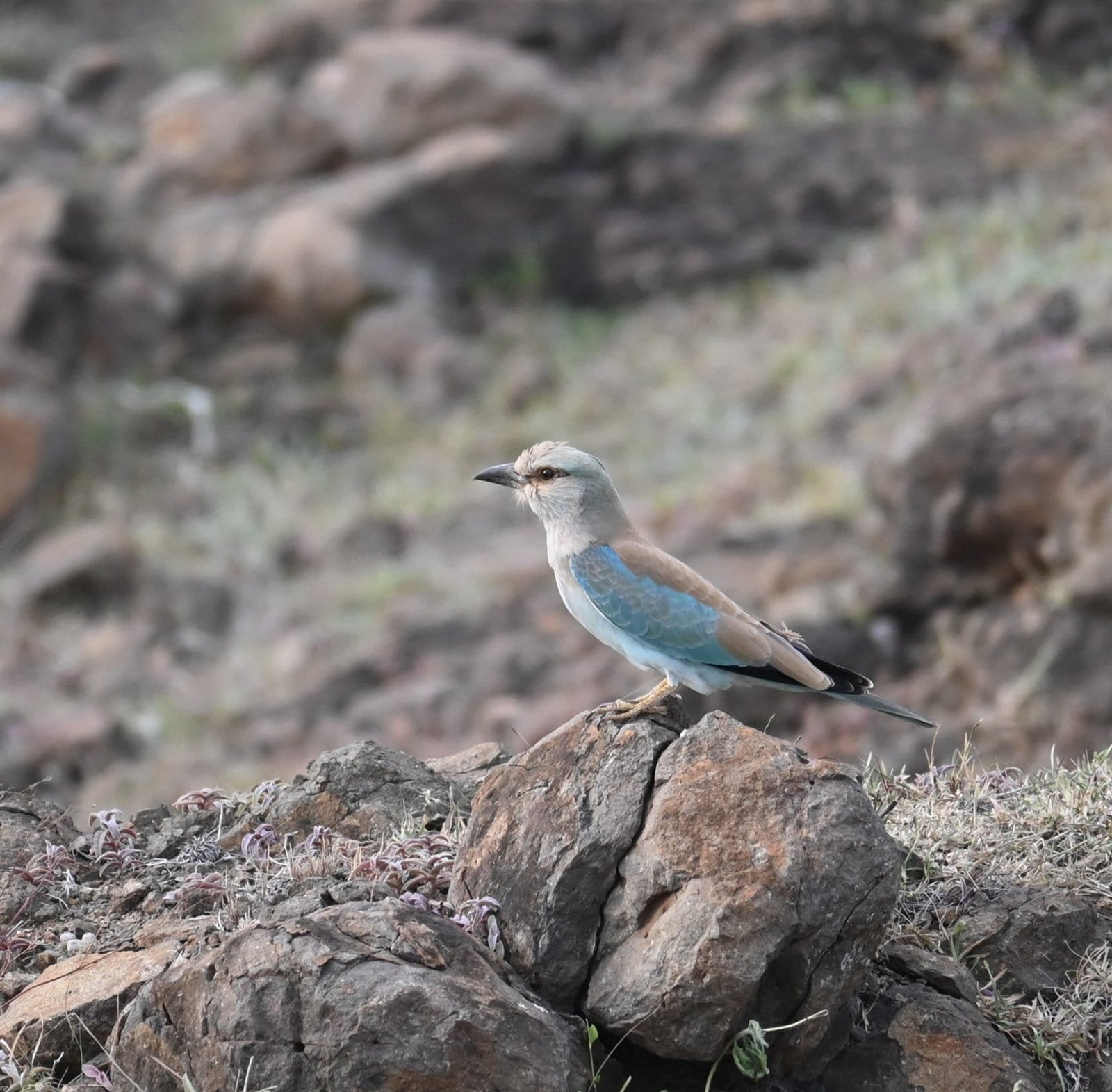
Perched, the differences are obvious once you have both in your head. The European Roller looks pastel. The whole head, throat and underside are a soft greenish-blue, the mantle is the colour of dry sand, and there is none of the streaking on the throat that the Indian Roller has.
In flight the difference is even clearer. The Indian Roller opens its wings and shows two bands of blue, a bright one and a deep one, in a pattern you can pick out from a moving car. The European Roller shows a large pale blue panel with black outer feathers and no banding at all. That is the mark I would trust at distance.
It was on its way to Africa
This is the part worth stopping over. The European Roller breeds across a huge band from Spain and Morocco east through Turkey and Iran into Central Asia. Every one of them winters in sub-Saharan Africa.
The birds that pass through western India are from the eastern end of that range, and they cross the subcontinent on the way down to Africa and again on the way back. So a roller on a rock outside Bhigwan in autumn is somewhere in the middle of a journey of several thousand kilometres, using our dry grasslands as a filling station.
It will eat well here. European Rollers hunt large insects — grasshoppers, crickets, beetles, the occasional lizard — from a low perch, dropping onto them exactly the way a shrike or a kingfisher does. It is the same sit-and-drop method half the birds in that landscape use, and open stony ground with scattered rocks is close to perfect for it.
Which is also the problem
The European Roller is in trouble across much of its range, and the reasons are the familiar ones: pesticides removing the large insects it lives on, old trees with nest holes being cut, and grassland being ploughed or built on at both ends of the journey and everywhere in between.
A bird like this makes the case for places like Kadbanwadi better than any argument I could write. It does not need a national park. It needs somewhere open and stony with enough grasshoppers in it to refuel, and those places are quietly disappearing because on paper they are classed as wasteland.
If you want to find one
Look in the dry country away from the water, not on the backwater itself. Autumn and spring are the windows — this is a passage bird, not a winter resident, so it is a matter of catching it moving through.
Scan the low perches: rocks, earth banks, stumps, fence posts, the tops of small bushes. And check every roller you pass rather than assuming. That is the whole trick. Most will be the common one. One will not be.
The same ground holds bush quail, sandgrouse, buttonquail and bee-eaters, and there is a lot more than flamingos out there once you stop looking at the water, which I have written about at more length in six birds from a winter morning at Bhigwan.
A note on names: we identify these birds ourselves and we do not always get it right. If you think we have called one wrongly, tell us — we would rather fix a name than leave it standing.