
The Indian Courser is a slim grassland bird that prefers running to flying. It dashes across bare ground, stops, stands tall and dashes again. We saw one far away in the morning and another close up in the evening at Kadbanwadi, near Bhigwan.
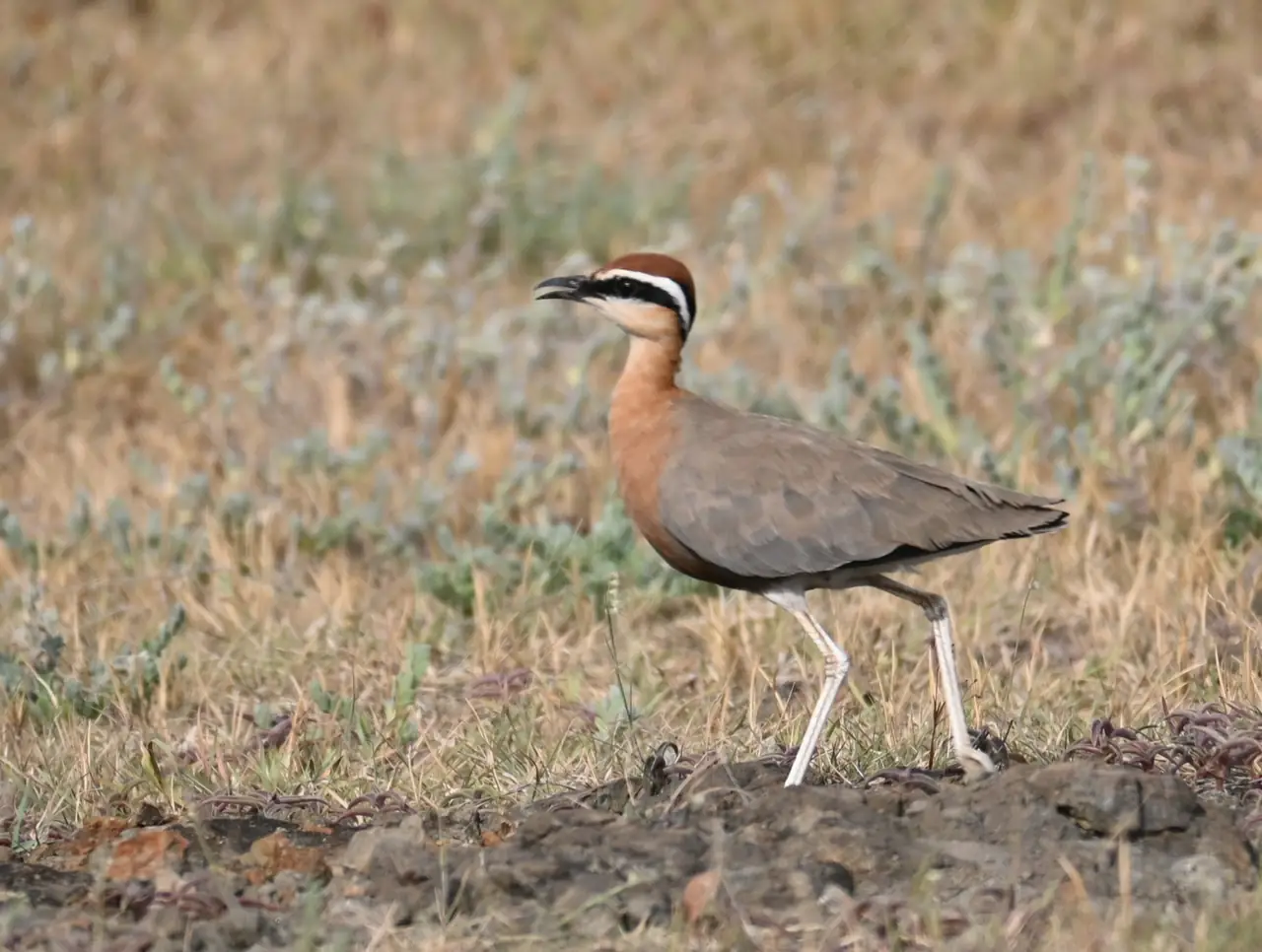
How to recognise an Indian Courser
- A chestnut cap on the head.
- A black and a white stripe running back from the eye.
- A warm orange-brown neck and breast, with a dark patch on the belly.
- Long, pale legs made for running.
In flight, the wings show black underneath, which makes it easy to spot.
Where it lives
Indian Coursers live in dry, open, stony ground with short grass, fallow fields and grassland. The grasslands around Bhigwan and Kadbanwadi in Maharashtra are excellent places to look.
Food and habits
The courser eats insects such as beetles, grasshoppers and termites. It runs a few steps, stops to look, and then darts forward to pick up its prey. It usually moves in pairs or small groups.
Nesting
Coursers nest on bare ground. The eggs are spotted and look just like small stones, which keeps them well hidden.
Read about both sightings in our Bhigwan trip story.
Indian Courser or Cream-coloured Courser?
The Cream-coloured Courser is a pale, sandy bird of desert regions. The Indian Courser has a richer chestnut cap, a warmer orange-brown breast and a dark belly patch. Around Bhigwan, the Indian Courser is the one you will meet.
Our two sightings
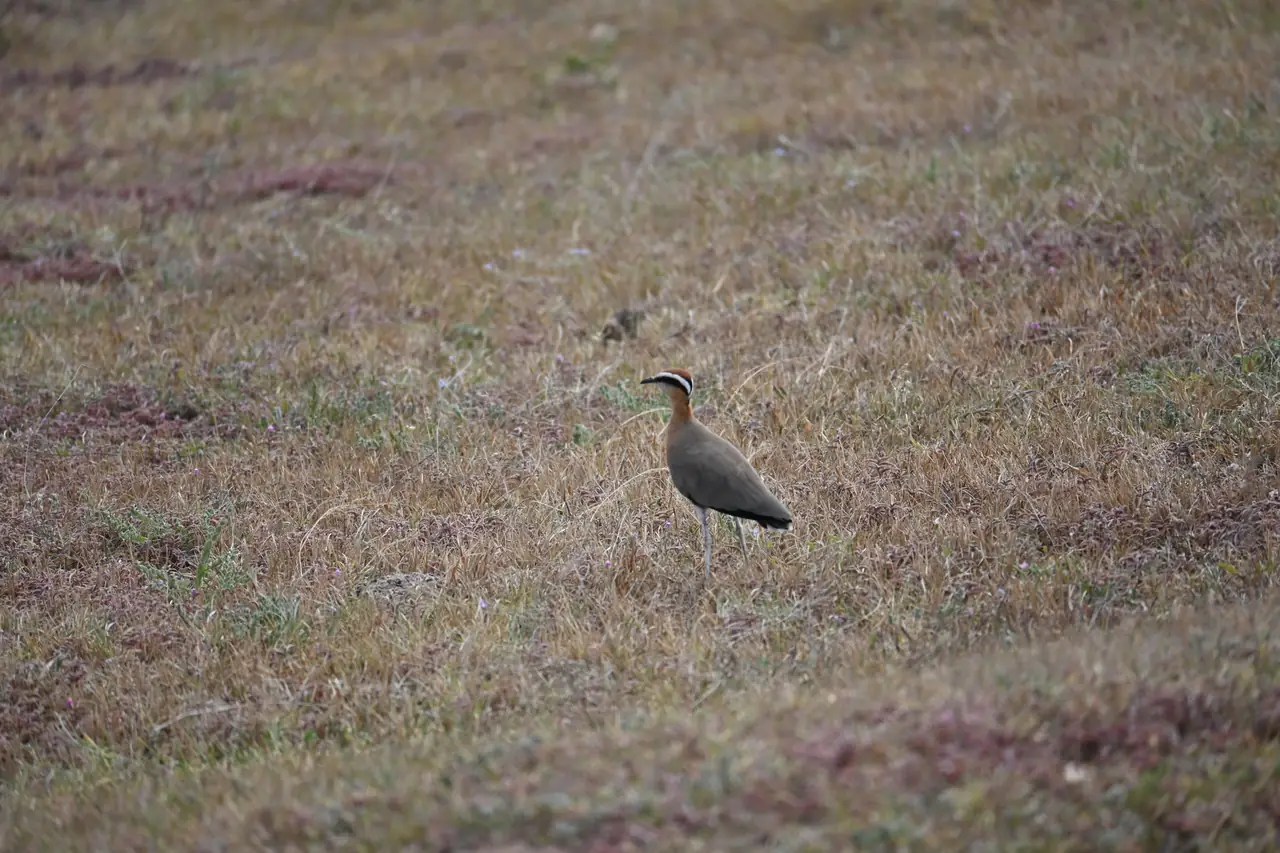
Our first courser stood far out on the open grassland at 9.44 in the morning, a small upright shape against the grass. That evening at Kadbanwadi, at 4.15 pm, another walked across the stony ground close enough to fill the frame, showing every stripe on its head.
Behaviour to watch for
- The run-stop-look pattern while feeding.
- Standing very upright and still when watching you.
- A short, low flight showing black underwings, then landing and running again.
Photography tips
- Get low; a courser looks best at eye level.
- Stay in the vehicle and let the bird walk closer.
- Use a fast shutter speed for the quick dashes.
Best time of year
Coursers are seen year round in the dry grasslands. September and October are lovely, with fresh green grass and soft light, and winter mornings are clear and cool.
How to reach Bhigwan and Kadbanwadi
Bhigwan is on the Pune–Solapur highway (NH65), about 105 km from Pune. The nearest airport is Pune, and Bhigwan has its own railway station (BGVN), with Daund Junction about 26 km away for more trains. State Transport buses from Pune to Solapur stop at Bhigwan. Kadbanwadi is a short drive away, and most homestays in Kumbhargaon arrange transport and local guides.
Frequently asked questions
Is the Indian Courser a rare bird?
It is a bird of dry open country and is seen regularly in the right habitat, such as the grasslands near Bhigwan.
Why is it called a courser?
Because it is a fast runner. It covers ground on foot and flies only when it needs to.
Where can I see an Indian Courser near Pune?
In the grasslands around Bhigwan and Kadbanwadi, especially in the morning and evening.