
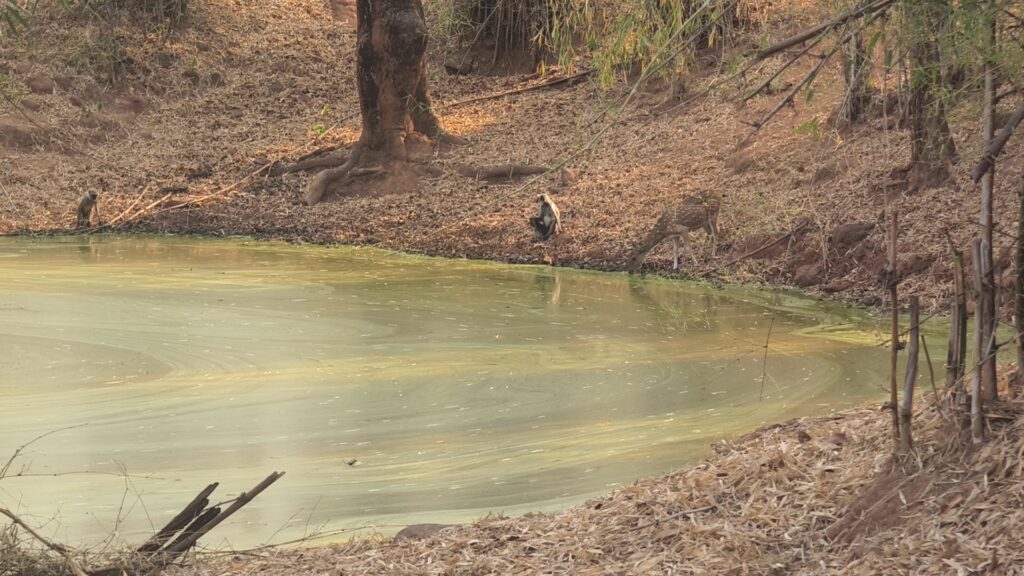
When it comes to Bandhavgarh National Park, most people think of the majestic Bengal tiger. But the park is also home to countless other species that make safaris equally enchanting. This photo, clicked during a Bandhavgarh safari, captures a serene scene of langurs (monkeys) and a spotted deer gathered near a tranquil waterhole — a reminder that the jungle is full of life beyond the tiger.
Wildlife at Bandhavgarh’s Forest
Waterholes are the lifelines of the forest. During the dry season, they become bustling gathering points where animals meet — often unknowingly creating some of the best safari moments.
- Langurs (Gray Monkeys): These clever primates are known as the “alarm system of the jungle.” When they spot a predator like a tiger or leopard, they give out loud warning calls, alerting other animals.
- Spotted Deer (Chital): Graceful and cautious, they are usually seen grazing near water sources. Interestingly, deer often stay close to langurs because the monkeys’ alarm calls help them detect danger early.
Fun Facts About Langurs & Deer in Bandhavgarh
- Jungle Allies: Langurs and spotted deer have a unique partnership. Deer eat the fruits that langurs drop from trees, while langurs benefit from deer’s sharp senses.
- Alarm Calls: A langur’s loud “whoop” is often the first clue that a tiger may be nearby. Safari guides rely on these sounds to track predators.
- Spotted Deer Spots: The white spots on a chital’s coat act as camouflage, helping them blend into the forest’s dappled light.
- Waterhole Strategy: Animals visit waterholes mostly during early mornings and evenings when predators are less active.
- Monkey Troops: A troop of langurs can have up to 20–30 members, often led by a dominant male.
Why This Scene Matters
This image isn’t just about a peaceful waterhole — it’s about wildlife harmony in Bandhavgarh. While tigers are the ultimate attraction, watching the smaller residents of the jungle — monkeys leaping through bamboo groves or deer cautiously drinking water — gives visitors a deeper appreciation for the ecosystem.
A Bandhavgarh safari is not only about chasing tiger sightings but also about cherishing these subtle, everyday jungle interactions. The bond between langurs and spotted deer at the waterhole is a fascinating example of how different species coexist and survive together in the wild.
Everything that is not a tiger
Bandhavgarh is sold on tigers and most visitors spend three drives looking for one. That is a reasonable use of a permit, but it means a lot of the reserve gets driven past.
Here is what is actually there, and what to watch for once you stop treating everything else as filler.
The mammals
- Leopard: present in good numbers and genuinely hard to see, because they avoid the areas tigers use most. Rocky edges and early mornings.
- Sloth bear: often around termite mounds and the fort slopes. Look for freshly dug earth.
- Dhole: uncommon here but recorded.
- Indian wild boar: everywhere, and worth watching properly — the sounders are organised and noisy.
- Nilgai and chausingha: the four-horned antelope is small, shy and easily missed in the drier parts.
- Langur and rhesus macaque: your best alarm system. A langur staring fixedly downward is worth more than any guide’s hunch.
- Jackal, jungle cat and civets on the edges and at dusk.
The birds
Bandhavgarh’s bird list runs past 250 species, and the sal forest plus the grassland plus the wet patches gives you three quite different sets of birds inside one drive.
- Raptors: crested serpent eagle, changeable hawk-eagle, shikra, and vultures on the cliffs.
- Woodland: Indian roller, Malabar pied hornbill, paradise flycatcher, minivets, drongos.
- Grassland and open: lapwings, larks, pipits, and harriers in winter.
- Water: storks, herons and kingfishers around the tanks.
- Owls: mottled wood owl, jungle owlet and brown fish owl, all resident.
The forest itself
The dominant tree is sal, and the reserve’s character comes from it — tall, straight, shady, with a fairly open floor that makes visibility better than it looks from a distance. Mixed in are bamboo stands, and in the valleys there is grassland which is where most of the herbivore concentration sits.
The cliffs above are what make Bandhavgarh look unlike Kanha. They hold the fort, the vultures, and a lot of leopard.
How to actually see this
- Ask your guide, at the gate, for a wildlife drive rather than a tiger drive. They will route differently.
- Carry binoculars. Most visitors do not, and it is the single biggest difference between a good drive and a dull one.
- Spend time at waterholes instead of driving between them.
- Take the afternoon drive for birds and the morning for mammals.
Frequently asked questions
What animals can I see at Bandhavgarh besides tigers?
Leopard, sloth bear, wild boar, nilgai, chausingha, jackal, jungle cat, langur, macaque and a large deer population.
Is Bandhavgarh good for birdwatching?
Yes, over 250 species, helped by having sal forest, grassland and water in close proximity.
Can I ask for a non-tiger-focused safari?
Yes. Tell your guide at the gate and they will plan the route differently.
What should I carry?
Binoculars, warm layers in winter, dust protection for cameras, and water.
Related: Booking a Bandhavgarh Safari and Wild Elephants at Bandhavgarh.
