
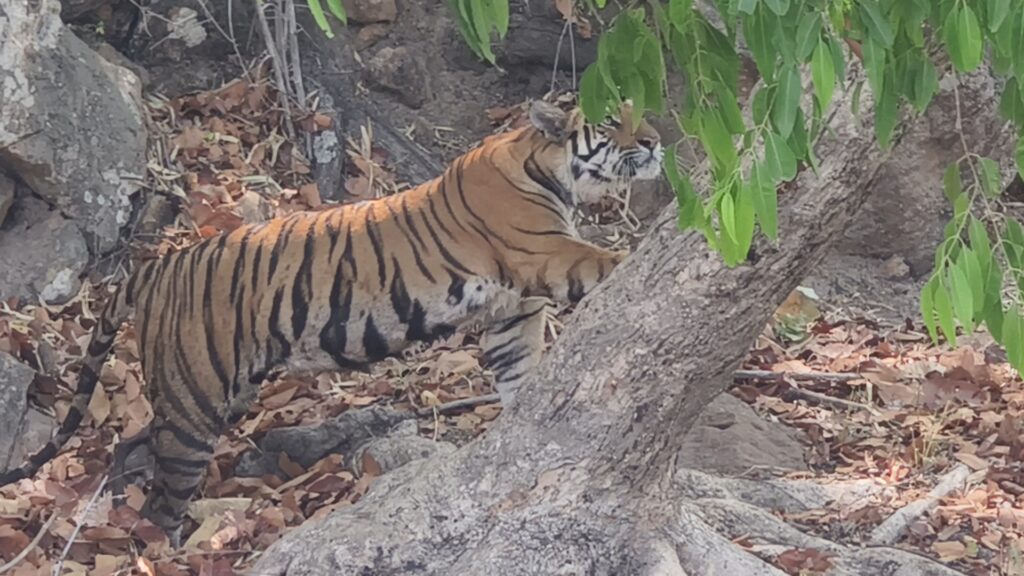
Tiger Territory Marking in Bandhavgarh Safari

Every safari in Bandhavgarh National Park brings a new story from the jungle. While spotting a tiger is thrilling, observing its natural behavior is an experience on another level. This photograph captures a Bengal tiger (Panthera tigris tigris) rubbing against a tree — a classic sign of territorial marking. Such rare sightings make Bandhavgarh one of the most fascinating wildlife destinations in India.


Why Do Tigers Mark Their Territory?

Tigers are solitary animals, and each adult requires a vast territory for survival. Marking is their way of saying, “This land is mine.” They do this by:

  • Rubbing against trees: Scent glands on their cheeks leave behind a strong territorial odor.
  • Scratching tree bark: Visual marks reinforce ownership.
  • Spraying urine: A chemical signal that warns other tigers to stay away.

This behavior ensures that tigers avoid unnecessary conflicts and maintain their hunting grounds.


Tiger Behavior on Safaris

Spotting a tiger marking territory during a Bandhavgarh safari is special because it offers a glimpse into their secret lives. While most tourists hope to see a tiger walking or resting, watching one actively display dominance and survival instincts is a moment wildlife enthusiasts treasure.


Bandhavgarh: Land of the Tiger

Bandhavgarh is famous for having one of the highest tiger densities in India, making it a prime destination for sightings. Safari zones like Tala, Magadhi, and Khitauli often provide opportunities to witness such raw and natural tiger behavior.


Fun Facts About Tiger Marking

  1. Tigers often revisit the same trees to refresh their scent marks.
  2. Other animals, like leopards, sometimes respond to tiger scent marks.
  3. A male tiger’s territory can overlap with those of several females, but rarely with another male.

The grimace you will see if you are lucky

If you watch a tiger approach a marked tree, there is a good chance you will see it pull back its lips, wrinkle its nose and hold its head up with its mouth slightly open, apparently disgusted.

This is the flehmen response, and it is not disgust. It is the tiger reading the mark properly.

What is actually happening

Cats have a vomeronasal organ, also called Jacobson’s organ, in the roof of the mouth. It detects large, heavy scent molecules that ordinary smelling does not pick up well — particularly the ones carrying information about sex and reproductive condition.

Curling the lip opens the ducts to that organ and draws the scent up into it. The tiger is not sniffing; it is tasting the chemical message.

What it learns is specific: which individual left the mark, whether that animal was male or female, how long ago, and if female, whether she is in oestrus.

Why this makes territory work without fighting

A tiger territory is far too large to patrol continuously. Marking with a scent that carries dated, individual information means an animal can be effectively present across its whole range while physically being in one small part of it.

A rival arriving at a fresh mark learns that the ground is held, by whom, and how recently. Most act on that and leave. Fighting is a last resort for an animal that cannot afford an injury — a tiger that cannot hunt starves.

How long a mark lasts

Scent marks degrade over days, faster in heat and rain. This is why tigers re-mark constantly along the routes they use, and why marks cluster on regular patrol paths rather than being spread evenly.

A territory that stops being refreshed is read as vacant, and another tiger will move in. Holding ground is continuous work.

What to watch for on safari

  • A tiger stopping at a particular tree it has clearly used before
  • The lip curl and raised head immediately after sniffing
  • Backing up to the trunk with the tail raised and quivering
  • Rubbing the head and cheek against the bark, depositing scent from facial glands

If your guide stops at a tree and waits, this is usually what they are expecting.

Photographing it

  • Be ready before it happens. The flehmen lasts a couple of seconds.
  • Frame the head. The expression is the picture and it needs to be tight enough to read.
  • Keep the tree in shot for the spray-marking sequence, or the behaviour is unreadable.
  • Silence. A tiger that is marking is relaxed. Noise ends it.

Frequently asked questions

Why do tigers curl their lips?

It is the flehmen response, which draws scent into the vomeronasal organ in the roof of the mouth for detailed analysis.

What information is in a scent mark?

The individual’s identity, its sex, how recently it passed, and for females whether they are in breeding condition.

How long does a tiger scent mark last?

Days, degrading faster in heat and rain, which is why tigers re-mark regularly along their routes.

Do tigers fight over territory?

Rarely if they can avoid it. Scent marking exists precisely so that most disputes are settled without contact.


Related: The four signs a tiger leaves, Reading pugmarks and Bandhavgarh National Park Safari.

Scroll to Top