
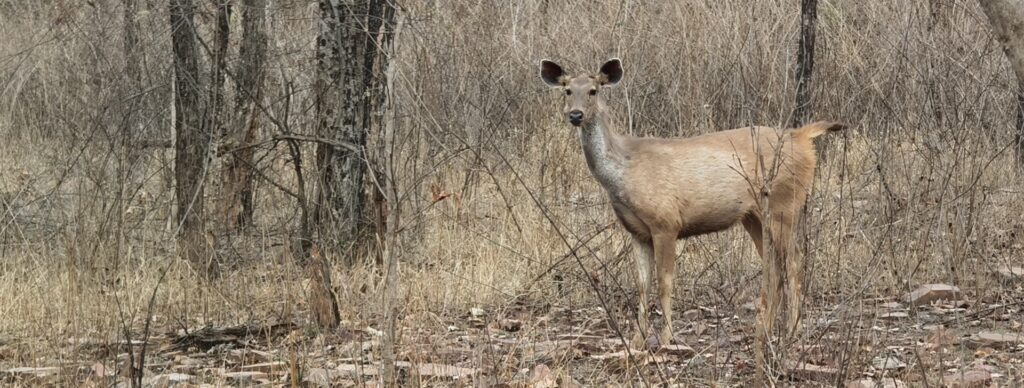
While tigers are often the showstoppers of Indian safaris, the Sambar Deer (Rusa unicolor) is the true guardian of the forest. On a safari through Panna National Park, a glimpse of this majestic animal standing tall among dry sal and teak forests is unforgettable. Its alert stance, deep gaze, and ability to sense danger make it one of the most reliable “alarm systems” of the jungle.
About the Species: Sambar Deer
The Sambar Deer is the largest deer species in India. Males are distinguished by their rugged antlers, while females (like the one in your image) are antler-less but equally graceful. Their coarse brown coat blends beautifully with the forest, providing natural camouflage against predators.
Interesting Facts About Sambar Deer
- Nature’s Alarm Bell: Sambar deer give a sharp, loud “alarm call” when they sense a predator nearby, often alerting other animals and even safari guides to the presence of a tiger or leopard
- Forest Foragers: They are herbivores, feeding on leaves, grasses, and fruits—helping in seed dispersal and forest regeneration.
- Wide Distribution: Found not only in India but also across South Asia, Southeast Asia, and parts of China
- Night Wanderers: Unlike many deer, Sambars are known to be nocturnal grazers, often active at night.
Sambar at Panna Safari Experience
Spotting a sambar deer in the wild is a thrilling experience. Their piercing eyes and still posture can stop you in your tracks. Sometimes, their alarm call is the very reason safari jeeps pause—because
The Sambar Deer of Panna Forest is more than just prey—it’s a keystone species that balances the ecosystem. From alerting the forest of predators to maintaining vegetation, these silent guardians remind us that even the most unassuming animals play a powerful role in the jungle drama.
Antlers are grown and thrown away every year
A sambar stag grows a complete set of antlers, carries them for a season, and drops them. Then does it again. It is one of the fastest tissue growth rates in any mammal.
Antlers are bone, not horn. They grow from pedicles on the skull under a covering of soft, blood-rich skin called velvet, which supplies the growing bone. When growth finishes the blood supply is cut off, the velvet dries and the stag rubs it away against trees.
The sambar rack
Sambar antlers are heavy and comparatively simple — typically three tines per side, with a brow tine and a forked top. They lack the many-branched complexity of a red deer or elk.
What they lack in branching they make up in mass. A mature Panna stag carries a thick, dark, roughly textured set that is unmistakable at distance.
Reading the stage of the year
- Velvet: antlers look soft, rounded, slightly furry. The stag is growing them and will avoid fights.
- Freshly cleaned: pale, sometimes bloodstained, sharp-tipped.
- Stained and hard: darkened from rubbing against bark and soil. This is a stag in rutting condition.
- Cast: one or both antlers missing, sometimes leaving a raw pedicle. Looks alarming; entirely normal.
A stag photographed in velvet and one in hard antler look so different that people sometimes assume they are different animals.
The rut
During the rut stags become vocal and aggressive. They thrash vegetation, wallow in mud and urine to carry scent, and challenge rivals with a display of size before any contact.
Most confrontations are settled by posture. Actual antler-clashing is a last resort, because a locked or broken antler can kill both animals.
Stags also give a loud, coarse call during this period which is quite different from the alarm call, and which carries a long way through the forest at night.
Where to see them in Panna
Along the Ken River, at waterholes and in the more open sal and mixed forest. Early morning and last light.
Panna’s terrain — gorges, plateau and river — means sambar are often visible below you rather than at eye level, which is unusual and worth using.
Photographing antlers
- Get the antlers against sky or water, not against branches. Antlers photographed against a tree canopy vanish into it.
- Shoot the velvet stage. It is a less-photographed and more interesting look than hard antler.
- Side profile shows the rack best. Front-on, you lose the shape entirely.
- Watch for thrashing during the rut. A stag working a bush is real behaviour, not a portrait.
Frequently asked questions
Do sambar shed their antlers?
Yes, annually. They are cast and a new set is grown from scratch.
What is velvet?
The blood-rich skin that covers and feeds growing antler bone. It dries and is rubbed off once growth is complete.
How many points does a sambar have?
Typically three tines per side — a brow tine and a forked top. Heavy rather than highly branched.
Do only males have antlers?
Yes. Female sambar do not grow antlers.
Related: Sambar alarm calls and how guides use them, Panna National Park Safari Guide and Spotted Deer of Bandhavgarh.
