
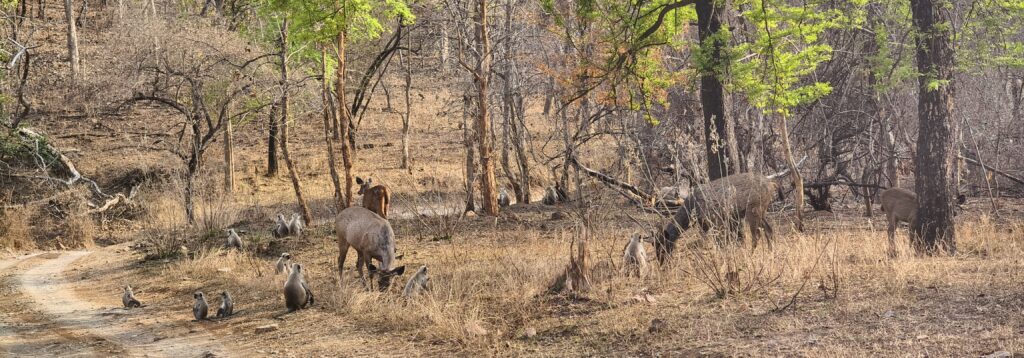
Deer and Monkey Friendship in Panna National Park: A Unique Wildlife Bond

“In the heart of Panna National Park an unusual friendship blooms — deer and monkeys , watch out for each other, share food, and survive together. A jungle lesson: nature thrives on trust.

Panna National Park, among the rustling teak and sal trees, unfolds one of nature’s most fascinating partnerships: the unique friendship between deer and monkeys. At first glance, it may seem unusual — a ground-dwelling herbivore and a tree-dwelling primate forging an alliance. But this bond is not just about companionship; it is a clever survival strategy honed by evolution.


A Partnership Born of Necessity

In the wild, survival often depends on vigilance. Deer, with their sharp hearing and swift legs, are always alert for predators like leopards and tigers. Monkeys, with their high vantage points and sharp eyes, can spot danger from afar. Together, they form an early warning system:

  • Monkeys signal danger from treetops, warning deer of approaching predators.
  • Deer respond quickly, often fleeing before danger arrives, and their sudden movement also alerts monkeys on the ground.

This constant exchange of signals increases both species’ chances of survival.


Sharing Food and Space

The friendship goes beyond predator alerts. When monkeys feed on fruits high in the canopy, they often drop half-eaten or ripe pieces to the ground. Deer happily graze on this “forest bounty”, saving them the effort of searching. In return, deer moving through the undergrowth stir insects and tender shoots, which monkeys sometimes take advantage of.

Thus, the forest floor and canopy become a shared dining hall, with each species unknowingly helping the other.


A Silent Trust

Visitors to Panna often witness heartwarming scenes — monkeys sitting calmly beside grazing sambar or chital deer, both species unbothered by each other’s presence. This trust is rare in the animal world, where competition is fierce. It shows that in the rhythm of the jungle, cooperation can be as powerful as strength.


Lessons from the Forest

The deer–monkey friendship in Panna National Park is more than a survival tactic; it’s a reminder for us humans. In a world where competition dominates, these animals teach us the value of collaboration, trust, and harmony with nature.

Next time you visit Panna and see deer grazing quietly while monkeys chatter in the trees above, remember: what you are witnessing is not just coexistence but a living example of symbiosis — nature’s way of saying, “together, we thrive.”

Where to stay

Almost all Panna accommodation sits near the Madla gate, on the road out from Khajuraho. There is a cluster of resorts along the Ken, a handful of mid-range hotels, and cheaper options in Madla village itself.

  • Riverside resorts near Madla: the most comfortable, and close enough to the gate for a 5:30 start.
  • Staying in Khajuraho: workable if you are combining temples and safari, but it adds an hour of driving before each morning drive.
  • Hinauta side: far fewer options, much quieter, and the gate is less used.
  • MP Tourism properties are dependable and usually the cheapest formal option.

A workable three-night itinerary

  • Day 1: fly or train into Khajuraho, drive to Madla, afternoon drive at Panna.
  • Day 2: morning drive, rest, afternoon boat on the Ken for gharial and birds.
  • Day 3: morning drive, then the Khajuraho temples in the afternoon when the light is best on the western group.
  • Day 4: Pandav Falls or Raneh Falls on the way out, then depart.

The two waterfalls

Both are worth an hour and neither needs a permit.

Raneh Falls is a canyon of coloured volcanic rock — pink, grey and red granite cut by the Ken — and is dramatic in and just after the monsoon. Pandav Falls is smaller, greener, with caves at the base and a short walk down.

Costs and permits

Safari costs at Panna are lower than at Kanha or Bandhavgarh and permits are easier to get, which is one of the underrated arguments for coming here. Book the core zone drives online in advance anyway for the peak season, and confirm the gate with your lodge.

Boat rides on the Ken are booked separately at the gate and are cheap. They are also the only reliable way to see gharial here.

Getting the timing right

  • Mar–May: best sightings, uncomfortable heat, empty gorge viewpoints.
  • Nov–Feb: pleasant, greener, more birds, harder tiger odds.
  • Jul–Sep: core closed. The falls are at their best and Khajuraho is quiet.

Frequently asked questions

Where should I stay for Panna?

Near the Madla gate for the shortest drive to the park. Khajuraho works if you are also visiting the temples but adds an hour each morning.

How many days do I need at Panna?

Three nights lets you do three or four drives, a Ken boat ride, and the Khajuraho temples.

Is a boat ride on the Ken worth it?

Yes, and it is the best chance of seeing gharial and cliff-nesting vultures.

Are Panna safari permits hard to get?

Easier and cheaper than Kanha or Bandhavgarh, but still book the peak season in advance.


Related: Panna Tiger Reserve and Spotted Deer in Panna.

Scroll to Top