
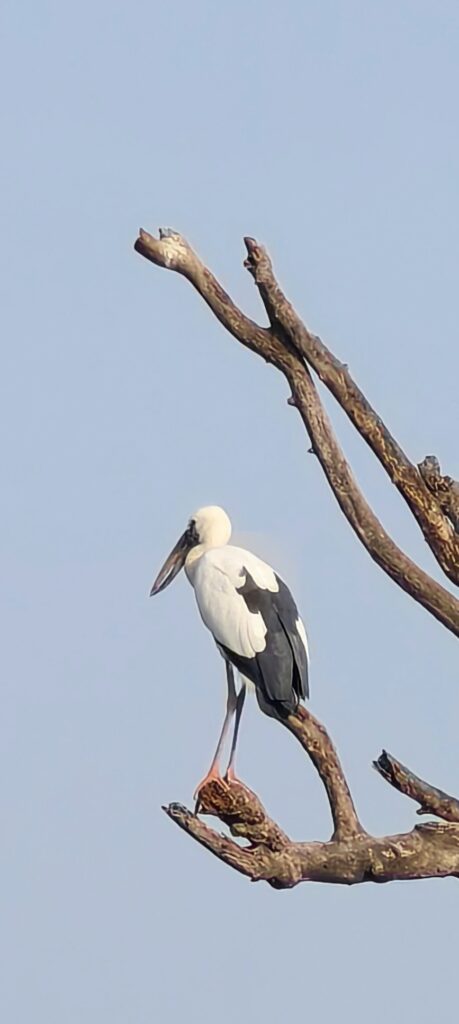
Asian Openbill Stork at Tadoba: A Silent Sentinel in the Skies

Asian Openbill Stork at Tadoba: A Silent Sentinel in the Skies

When people think of Tadoba Andhari Tiger Reserve, tigers and leopards immediately come to mind. But if you lift your eyes to the treetops, you might catch sight of another remarkable resident — the Asian Openbill Stork (Anastomus oscitans).

During a recent visit to Tadoba, this bird was perched quietly against the blue sky, its striking black-and-white plumage glowing in the sunlight. The most fascinating feature is its bill — not fully closed, but naturally gapped, perfectly adapted to crack open freshwater snails, its favourite meal.

Why spotting it at Tadoba is Special

  • Tadoba’s lakes, wetlands, and paddy fields provide the ideal feeding grounds for this species.
  • Their calm posture and elegant flights add a soothing balance to the otherwise predator-dominated wilderness.
  • Birdwatchers often note that Tadoba is not just for big cats — it’s a thriving birding paradise.

Fun Facts about the Asian Openbill Stork

  • Snail Expert: Their beak is custom-built for snail hunting.
  • Farmer’s Ally: By eating snails, they help protect rice fields from infestation.
  • Seasonal Guests: While resident in India, some populations migrate with the monsoon.
  • Silent Watchers: They rarely call; instead, they use bill-clattering to communicate.
  • Birdwatcher’s Delight: Easy to spot in Tadoba, especially perched on bare tree branches.

The heronry

Openbills breed in mixed colonies known as heronries, and a heronry is one of the more remarkable things to come across in the Indian countryside.

A single large tree — often a banyan, tamarind or peepal near a village or waterbody — can hold dozens of nests, and not all of them belonging to the same species. Openbills, egrets, night herons, pond herons and cormorants routinely nest in the same tree at the same time.

Why nest together

  • Safety in numbers. Many adults present means predators are spotted and mobbed quickly.
  • Shared information. Birds returning with food indicate where feeding is good.
  • Limited suitable trees. Large trees near water, safe from disturbance, are scarce. Everything crowds into what exists.

The cost is noise, smell and a build-up of droppings that eventually damages the tree itself. Colonies do move.

Timing

In central India, openbills breed with the monsoon and just after, roughly June through September. This is not arbitrary — it is when the apple snails they depend on are most abundant in flooded fields and shallows.

The whole cycle is timed to snails. Nesting begins as the rains fill the fields, and the chicks are being fed when snail numbers peak.

Raising the young

Both parents build, incubate and feed. The nest is a loose stick platform, added to over the season.

Chicks are fed by regurgitation and grow quickly. Young birds lack the gap in the bill that gives the species its name — it develops as they mature, which is why juveniles in a colony can look like a different species entirely.

Watching a colony responsibly

Heronries are easily disturbed and the consequences are serious. Adults flushed off nests leave eggs and chicks exposed to sun and to crows, which patrol colonies constantly waiting for exactly that.

  • Watch from a distance with a long lens.
  • Do not stand under the tree.
  • Keep visits short, especially in hot weather.
  • Do not make noise to get birds to fly.

Where to look around Tadoba

Colonies are usually near villages and water rather than deep inside the core zone. Large trees on the approach roads, beside tanks and near cultivation are the places to scan.

Frequently asked questions

What is a heronry?

A mixed breeding colony of waterbirds — storks, egrets, herons and cormorants — nesting together in the same trees.

When do Asian Openbills nest?

With and just after the monsoon, roughly June to September in central India, timed to peak snail abundance.

Why do juveniles look different?

Young openbills have not yet developed the gap in the bill, so they lack the species’ most distinctive feature.

Do openbills nest with other species?

Yes, routinely — alongside egrets, pond herons, night herons and cormorants in the same tree.


Related: Asian Openbill: the gap in the beak explained, Lesser Adjutant Stork at Tadoba and Birds of Tadoba.

Scroll to Top