
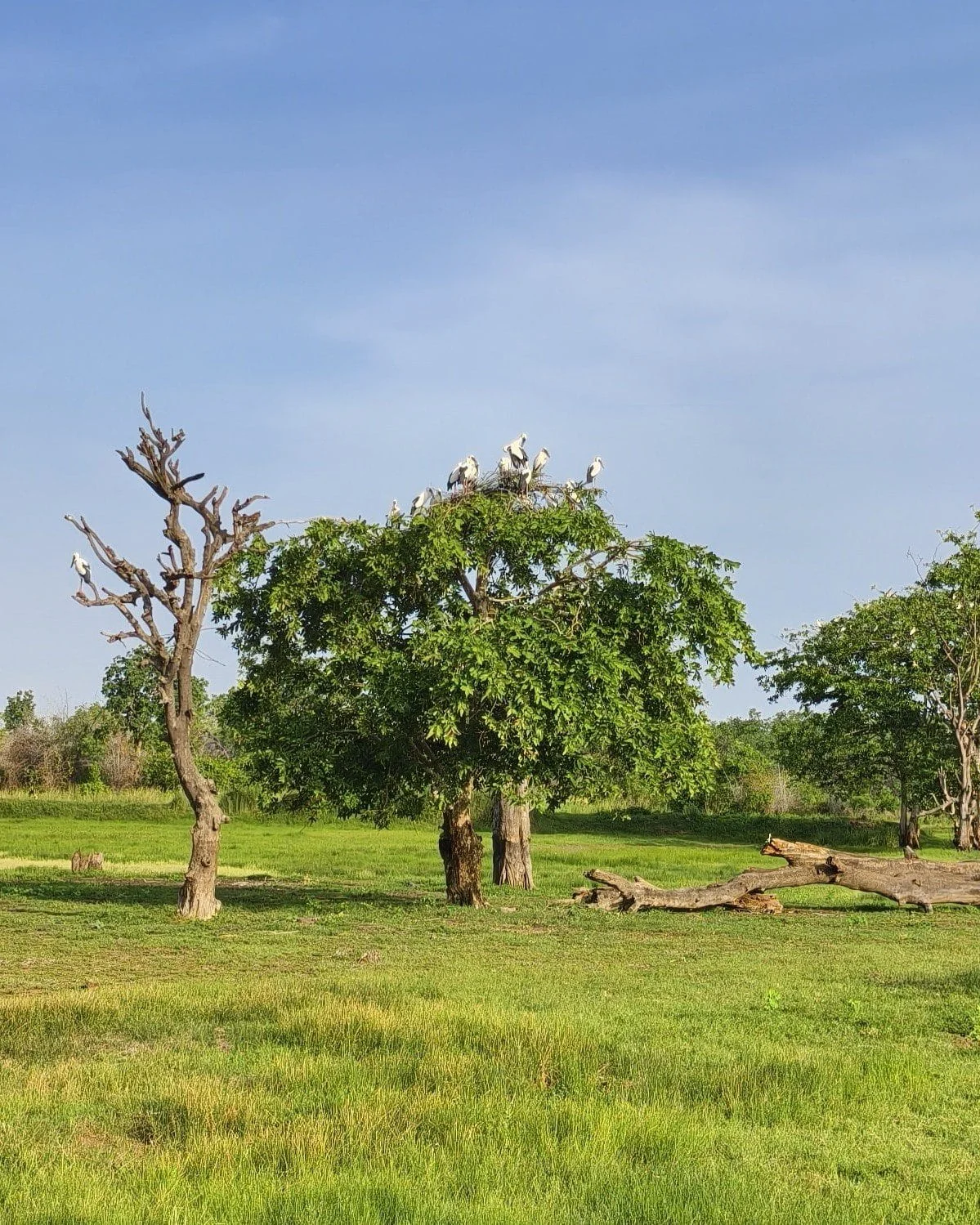
The Asian Openbill is the stork with a gap in its beak. It is common around Tadoba, and in the summer months it nests in noisy colonies at the top of large trees. We watched one of these colonies in June.
Tap any photo to view it full size.
Why is it called an Openbill?
When the beak is closed, the two halves still do not meet in the middle. There is a visible gap between them.
This is not damage or a deformity. It is a tool. The gap lets the bird grip and turn a large water snail, and the tip of the lower bill is used to cut the muscle that holds the snail inside its shell.
What does it eat?
Mainly apple snails. It also takes other snails, mussels, crabs, frogs and large insects.
You will usually see it walking slowly through shallow water with the head down, feeling for snails rather than looking for them.
The nesting colony
Openbills nest together, often with egrets, herons and cormorants in the same tree. A single large tree can hold dozens of nests.
The nests are untidy stick platforms near the top of the canopy. The noise from a busy colony carries a long way, and the smell does too.
At Tadoba we found them nesting in June, at the start of the monsoon. That is normal for central India, where the breeding season runs through the rains when snails are easy to find.
How to identify the Asian Openbill
- Size: about 68 cm tall. Smaller than most other Indian storks.
- Colour: dirty white or greyish body, black wings and tail.
- Bill: heavy, dull grey, with the gap in the middle when closed.
- Legs: long and pinkish.
- In flight: neck stretched out straight, not tucked back like a heron.
Young birds do not have the gap yet. It develops as the bird matures, so a juvenile can be confusing.
Other storks you may see at Tadoba
Tadoba has several large waterbirds. The Openbill is the one you will see most.
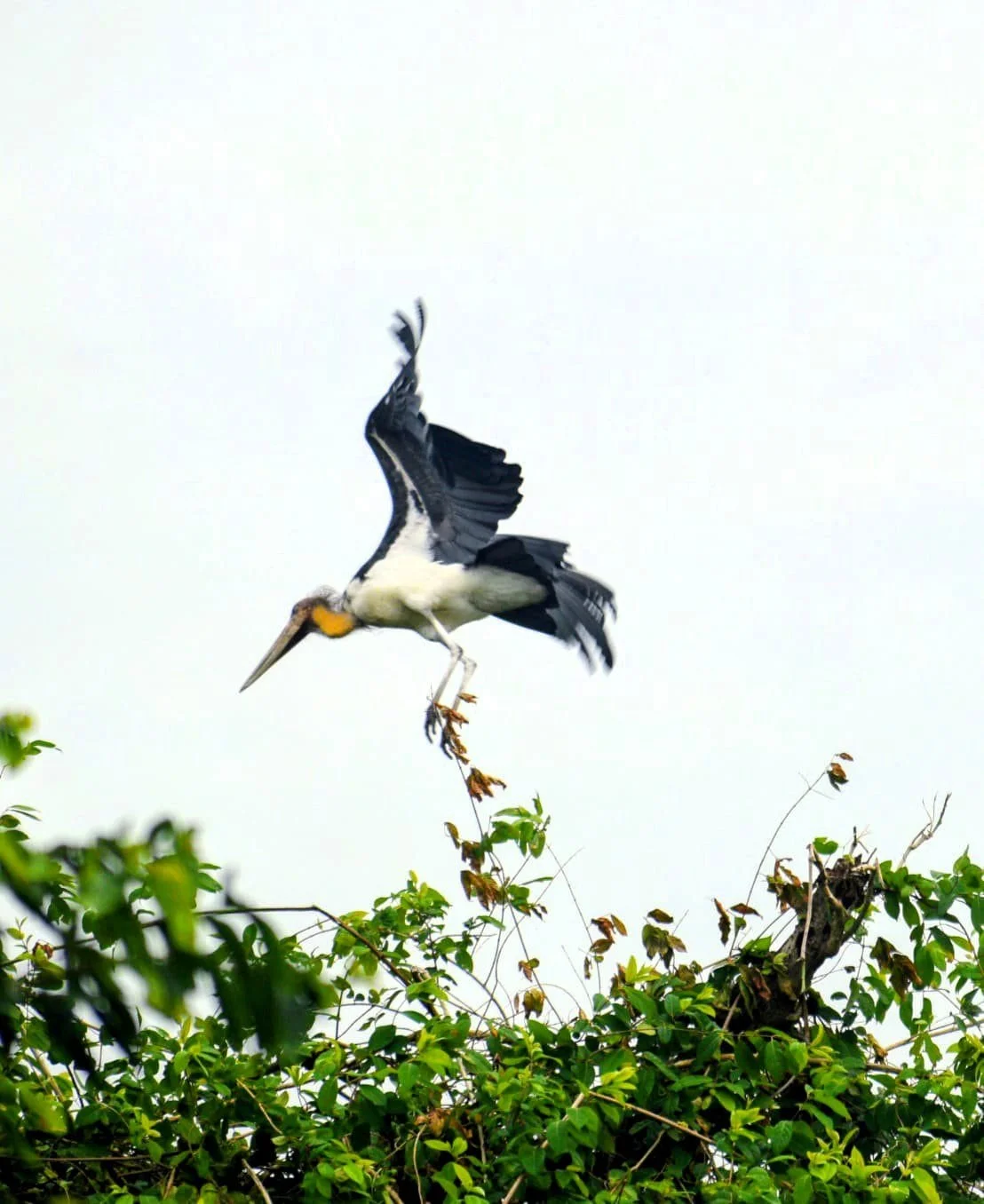
- Asian Openbill: smallest, dirty white, gap in the bill. Very common.
- Woolly-necked Stork: black with a white woolly neck and white underparts.
- Painted Stork: pink on the wings, yellow face, long yellow bill.
- Adjutant: much bigger, bare neck, heavy wedge shaped bill.
Where to look at Tadoba
Look at water. Tadoba lake, Telia lake, the smaller waterholes and the flooded fields just outside the park all hold Openbills.
For a nesting colony, watch the large trees near villages and water on the way in and out of the gates. Colonies are usually close to human settlement, not deep inside the core zone.

Best time to see them
You can see Openbills all year at Tadoba. For nesting colonies with chicks, June to September is the window.
Early morning is best for photography. The birds are active, the light is low and the white plumage does not burn out.
Photography tips
- Do not overexpose. White birds against a bright sky lose all feather detail. Reduce exposure slightly.
- Shoot early or late. Midday light on white plumage is very hard to control.
- Get the bill. The gap is the whole point of this bird. A side-on head shot shows it clearly.
- Keep the nest in frame. A bird on a stick platform tells more of a story than a bird alone on a branch.
- Do not disturb a colony. Stay on the road, keep the engine noise down and do not linger under the tree.
How to reach Tadoba
- Nearest airport: Nagpur, about 140 km, roughly 3 hours by road.
- Nearest railway: Chandrapur, about 45 km.
- Gates: Moharli, Kolara, Navegaon, Khutwanda, Zari and several buffer gates.
- Stay: lodges near Moharli and Kolara are the most convenient.
Frequently asked questions
Why does the Asian Openbill have a gap in its beak?
The gap helps it hold and open large water snails. It is an adaptation for feeding, not an injury.
Is the Asian Openbill rare?
No. It is one of the most common storks in India and is easy to see around Tadoba.
When do Openbills nest?
Around the monsoon. At Tadoba we saw active nests in June.
Do they nest alone or in groups?
In colonies, often mixed with egrets, herons and cormorants in the same tree.
How tall is an Asian Openbill?
About 68 cm. It is the smallest of the common Indian storks.
Related posts: Birds of Tadoba National Parkand Tadoba Tiger Reserve Safari Guide.