
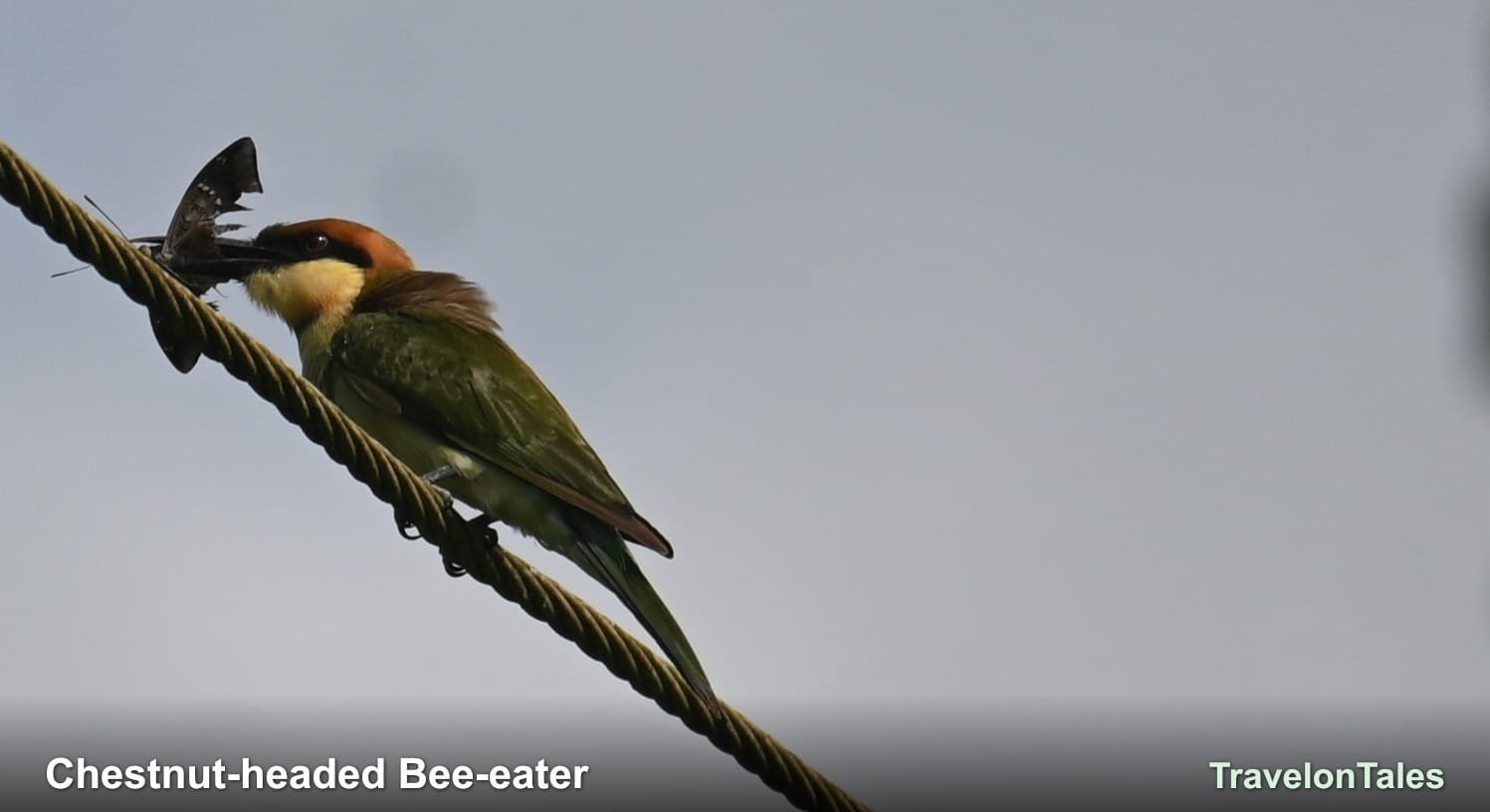
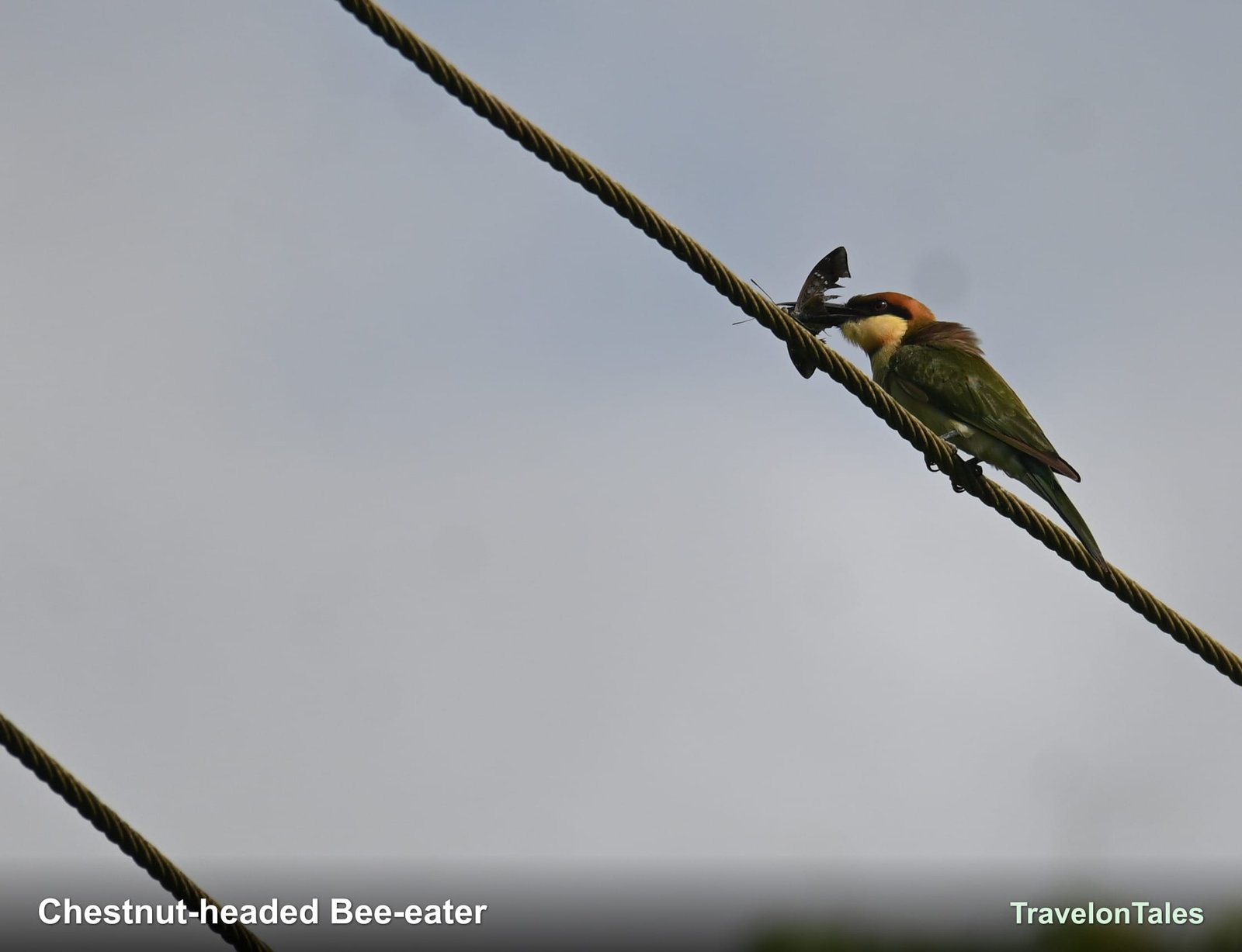
The Chestnut-headed Bee-eater does eat bees. It also eats a lot of other things. We watched this one on a rope near Vanoshi in Sindhudurg, and the first thing it brought back was a butterfly.
Tap any photo to view it full size.
What is the Chestnut-headed Bee-eater?
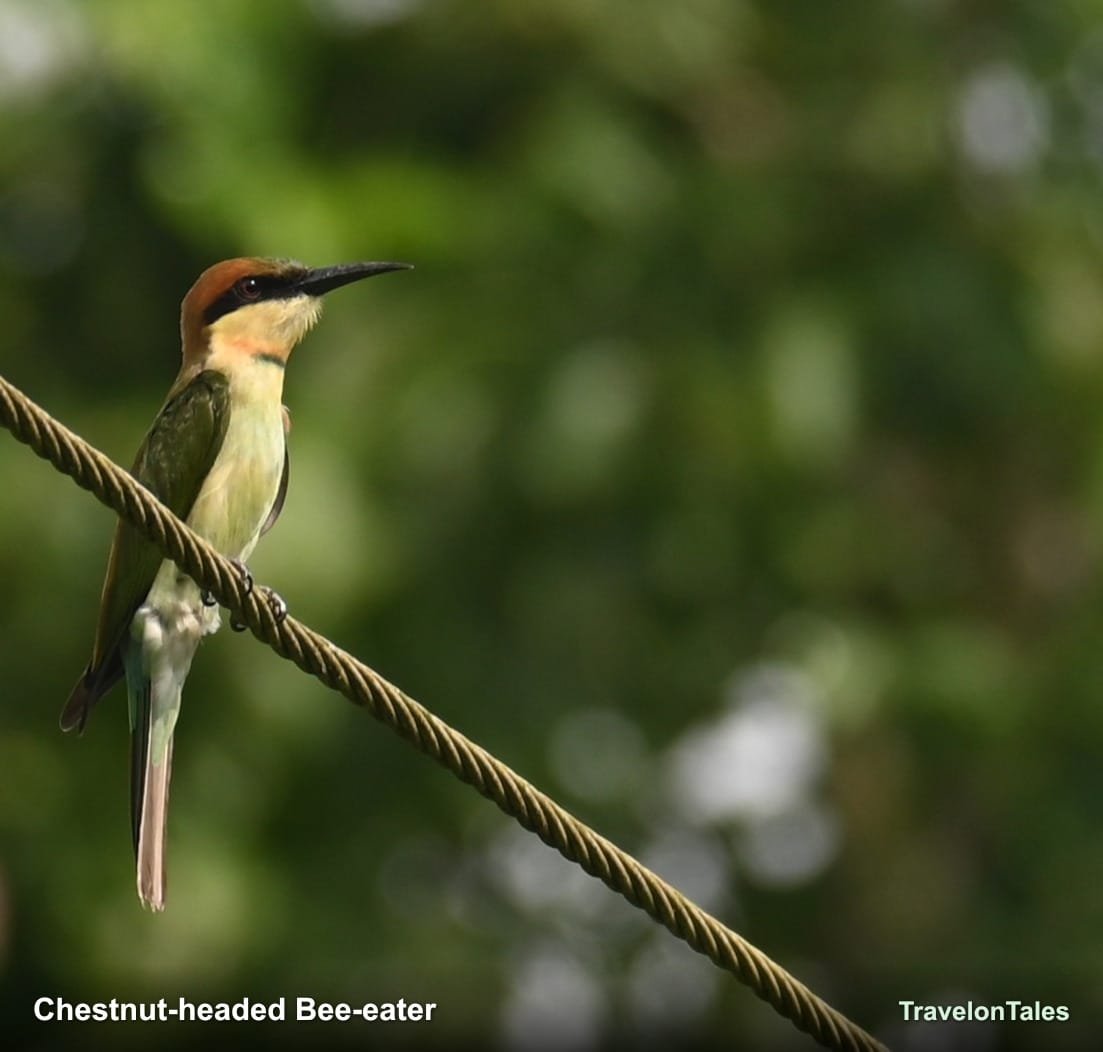
The Chestnut-headed Bee-eater (Merops leschenaulti) is a green bird about 20 cm long with a rich chestnut crown and nape, a yellow throat, a thin black band below the throat and a black mask through the eye.
It does not have the long central tail streamers that the Green Bee-eater and Blue-tailed Bee-eater have. The tail ends square.
How to tell it from other bee-eaters
- Chestnut-headed: chestnut crown and nape, yellow throat, no tail streamers. Forest edges and clearings.
- Green Bee-eater: all green with a blue throat and thin tail streamers. Open country, very common.
- Blue-tailed Bee-eater: larger, blue tail, chestnut throat, long streamers. Near water.
- Blue-bearded Bee-eater: much bigger and heavier, shaggy blue throat feathers. Deep forest.
If the head is chestnut and the tail is square, it is this one.
What does it actually eat?
Bees and wasps make up a large part of the diet, but it takes almost any flying insect: dragonflies, butterflies, moths, flying ants, beetles and cicadas.
It hunts from a perch. It sits, watches, flies out, catches the insect in the air and comes back to the same spot.
How it handles a sting
A bee-eater does not swallow a bee whole. It beats the insect against the perch to kill it, then rubs the tip of the abdomen hard against the branch to squeeze out the venom before eating it.
If you watch one for a few minutes you will see this whole routine. It is the reason the bird almost always returns to a perch instead of eating on the wing.
Where to see it in Sindhudurg
Forest edges, clearings, open ground next to woodland, and anywhere with an exposed perch and open air in front of it. Wires, ropes, bare branches and fence posts are all favourites.
We found this one on a rope stretched across a clearing near Vanoshi. It used the same spot repeatedly through the morning.
Best time to see it
It is present in the Western Ghats through the year, and it is easiest to see when insects are active. Warm mornings after rain are very good.
For photography, early morning gives the best light and the most hunting activity.
Photography tips
- Watch the perch, not the sky. It returns to the same spot. Frame the perch and wait for it to come back with prey.
- Use a fast shutter. 1/2000 if you want the return flight. 1/800 is enough for a perched bird.
- Wait for the prey. A bee-eater with an insect in its bill is a far better photograph than one sitting empty-billed.
- Mind the background. A plain sky is clean but flat. Try to get an angle with green behind the bird.
Other birds in the same forest
This is a good forest for a mixed list. On the same trip we recorded:
- Oriental Dwarf Kingfisher
- Blue-eared Kingfisher
- Brown Wood Owl
- Malabar Grey Hornbill
- Indian Pitta
- Grey-fronted Green Pigeon
- Crimson-backed Sunbird
Frequently asked questions
Do bee-eaters only eat bees?
No. Bees and wasps are important but they take dragonflies, butterflies, moths, beetles and flying ants as well.
How do bee-eaters avoid being stung?
They beat the insect against a branch and rub out the venom before swallowing it.
How big is the Chestnut-headed Bee-eater?
About 20 cm, including the tail. It is slightly bigger than the Green Bee-eater.
Does it have tail streamers?
No. That is one of the quickest ways to separate it from the Green and Blue-tailed Bee-eaters.
Where does it nest?
In tunnels dug into earth banks, often in small colonies. Several bee-eaters and kingfishers share this nesting habit.
Related posts: Oriental Dwarf Kingfisher in Sindhudurg, Blue-eared Kingfisher in Sindhudurg and Sindhudurg Monsoon Birding Guide.