
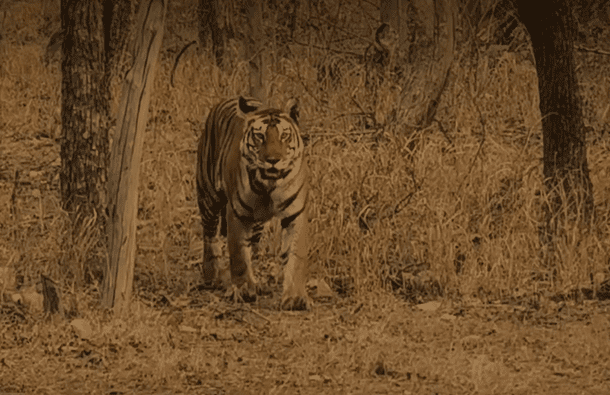
The Bengal Tiger strides as a living symbol of strength, survival, and India’s conservation triumph.
Bengal Tiger at Panna National Park: A Symbol of Survival and Strength
The Comeback Story of Panna’s Tigers
This image of a Bengal Tiger (Panthera tigris tigris) was captured at Panna National Park in Madhya Pradesh, India. Once declared tiger-less in 2009, Panna’s inspiring reintroduction program has restored its tiger population, turning the reserve into a beacon of hope for global conservation. Today, sightings like this tiger represent resilience, survival, and India’s commitment to protecting its natural heritage.
Bengal Tiger – The Pride of India’s Forests
The Bengal Tiger is the apex predator of India’s ecosystem. With its powerful build, striking stripes, and regal presence, the tiger embodies both strength and grace. In this photograph, the tiger blends seamlessly with the dry deciduous forest of Panna, showcasing its incredible camouflage and adaptation to diverse landscapes.
Wildlife Beyond Tigers
Panna is more than just a tiger reserve — it’s a biodiversity hotspot. Alongside tigers, visitors can encounter:
- Leopards
- Sloth Bears
- Gharials
- Over 200 bird species
This makes Panna a must-visit for wildlife enthusiasts, photographers, and nature lovers seeking raw, untamed experiences.
Why Panna Matters
Every tiger sighting here carries profound significance. It’s not just an exciting moment for safari-goers but also a living testament to successful conservation efforts in India. For travelers, Panna offers silence, wilderness, and the unforgettable thrill of witnessing the jungle king in his natural habitat.
Fun Facts About Tigers
- No two tigers have the same stripe pattern — like fingerprints, each is unique.
- Tigers can eat up to 40 kg of meat in one sitting.
India holds most of the world’s wild tigers
The Bengal tiger (Panthera tigris tigris) is the most numerous of the surviving tiger subspecies, and India holds the large majority of the global wild population.
That is a recent recovery, not a historical constant. Tiger numbers in India fell catastrophically through the twentieth century — hunting first, then habitat loss and poaching.
Project Tiger
Project Tiger was launched in 1973 with nine reserves. The idea was straightforward: protect large blocks of habitat with an undisturbed core, rather than protecting the animal in isolation.
The network has since grown to more than fifty tiger reserves. India now runs a national estimation exercise every four years using camera traps and stripe-pattern matching, which is why population figures are quoted with reasonable confidence.
What went wrong at Panna, and what it proved
Panna is the case study that matters, because it failed completely and then recovered.
By 2009 the reserve was confirmed to hold no tigers. Poaching had removed them all. Tigers were then translocated in from other reserves and monitored intensively while they established territories and bred.
The population rebuilt. What Panna demonstrated is that habitat, once tigers are gone, does not lose its capacity to hold them — the limiting factor was protection, not the forest.
What still threatens them
- Poaching for skins and body parts, driven by demand outside India.
- Habitat fragmentation. Reserves are increasingly islands. Young tigers dispersing between them cross roads, rail lines and farmland.
- Corridor loss. Without connections, small populations become genetically isolated.
- Conflict. Tigers moving through human-dominated landscapes take livestock, and retaliation follows.
Corridors are the current central concern. Protecting the reserves was the first problem; connecting them is the harder second one.
What a visitor actually contributes
Safari tourism, done properly, gives the forest a measurable local economic value and employs people from surrounding villages as guides, drivers and lodge staff.
That matters. A forest that generates livelihoods has defenders. The practical things a visitor can do are to book through operators employing local staff, follow the rules that exist to reduce disturbance, and not pressure a driver to break them for a better photograph.
Frequently asked questions
How many wild tigers are there in India?
India holds the large majority of the world’s wild tigers, assessed every four years through a national camera-trap based estimation.
What is Project Tiger?
A conservation programme launched in 1973 to protect tigers by protecting large blocks of habitat. It now covers more than fifty reserves.
Why did Panna lose its tigers?
Poaching. The reserve was confirmed empty in 2009, and tigers were subsequently reintroduced from other reserves.
What is the biggest threat to tigers now?
Poaching remains serious, but habitat fragmentation and the loss of corridors between reserves are the growing structural problem.
Related: Panna National Park Safari Guide, Tiger stripes and how tigers are counted and Where to see tigers and leopards in India.
