
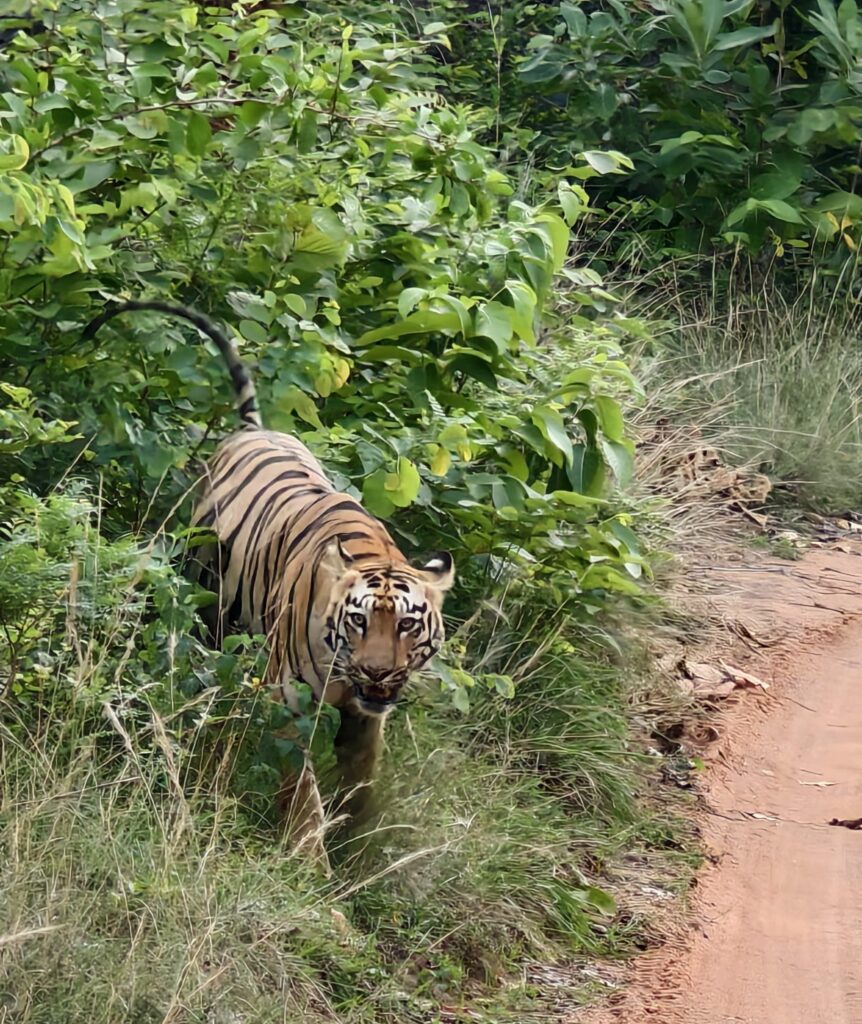
Tiger at Tadoba National Park – The Wild Majesty of Maharashtra
If there’s one place in India where the jungle breathes through the stripes of a tiger, it’s Tadoba National Park.
Officially known as the Tadoba Andhari Tiger Reserve, this magnificent wilderness is a paradise for wildlife photographers, nature enthusiasts, and safari lovers who seek the raw thrill of spotting a tiger in its natural kingdom.
The Thrill of a Tiger Sighting at Tadoba
The moment you spot a tiger emerging from the bamboo and teak forest—like the one in this photo—it’s not just a sighting; it’s a heartbeat.
The tiger pauses, locks eyes with you, and in that second, the forest falls silent. This is why Tadoba is one of India’s top tiger reserves, where sightings are almost guaranteed during peak months (March to May).
Tadoba Safari – Into the Heart of the Jungle
Tadoba offers multiple safari zones such as Moharli, Kolara, and Navegaon.
Each has its own personality—some open and dry, others dense and mysterious.
Early morning safaris offer the best chance of spotting tigers, leopards, and wild dogs.
For travelers, booking official safaris through MTDC or Tadoba’s portal ensures legitimate and sustainable wildlife tourism.
Best Time to Visit Tadoba
- Summer (March–May): Best chance of tiger sightings near waterholes
- Winter (Nov–Feb): Ideal for birdwatching and cooler safaris
- Monsoon (Jun–Sep): Park remains closed for regeneration
Travel Tips
- Always book safaris in advance.
- Carry binoculars and a telephoto lens.
- Maintain silence during sightings.
- Avoid littering or feeding wildlife.
- Respect the jungle and its rhythm.
Some more tiger photos from Tadoba National Park
Which tiger did you actually see?
At Tadoba, as at most Indian reserves, individual tigers are known by name — Maya, Chhoti Tara, Matkasur and others have been followed for years. Guides identify them on sight.
You can learn to do it too, and it turns a sighting into something you can place in a story rather than a photograph of a generic tiger.
How guides tell them apart
- Facial stripes. The pattern above the eyes and on the cheeks is unique and is the primary feature used.
- Flank pattern. Each side differs, so a good side-on photograph is what researchers want.
- Size and build. Males are noticeably heavier with broader heads and pronounced ruffs.
- Scars and notches. Ear tears, healed wounds and tail kinks are quick identifiers.
- Territory. Knowing which tiger holds which area narrows it down before you look at anything.
Photograph the face and one full flank if you can. That is enough for a guide to name the animal afterwards.
Territory is the key to sightings
A male holds a large territory that overlaps several female ranges. Females hold smaller, more stable areas centred on water and reliable prey.
This is why sightings are not random. A tigress with cubs will use a compact area for months, which is why certain zones become reliable for a season and then go quiet when she moves.
Ask which tiger is being seen where. It is a better question than “will we see a tiger”.
Why Tadoba is good for this
Tadoba has a high density of tigers and a long history of individuals being tracked and named, so the local knowledge is unusually good.
The buffer zones matter here as much as the core. Several well-known individuals use buffer areas heavily, and buffer safaris are cheaper, less crowded and often more productive than people expect.
Managing your expectations
A tiger sighting is not guaranteed on any single safari anywhere. Two or three drives gives you a reasonable chance at Tadoba; one drive is a lottery.
The reserve is also worth the trip without a tiger. Gaur, sloth bear, dhole, leopard and a long bird list are all there, and a visitor fixated on tigers alone usually misses them.
Photographing for identification
- Get the face straight on at least once, even if the light is poor. That frame is what identifies the animal.
- Then get a clean flank. Full body, side on, unobstructed.
- Note the time and location. Guides can place a sighting far more confidently with both.
- Do not delete the “bad” frames until you have shown them to someone. A soft photograph can still identify a tiger.
Frequently asked questions
How do guides identify individual tigers?
Mainly by facial stripe patterns, supported by flank patterns, size, scars and known territory.
Do tigers have names at Tadoba?
Yes. Individuals have been tracked and named over many years by forest staff, guides and researchers.
How many safaris do I need to see a tiger?
There is no guarantee, but two or three drives gives a reasonable chance at a high-density reserve like Tadoba.
Is the buffer zone worth booking?
Often yes. Buffer zones hold resident tigers, cost less and are usually less crowded.
Related: Buffer vs Core Zone at Tadoba, Tadoba Safari Guide and Tiger stripes as identity.
