
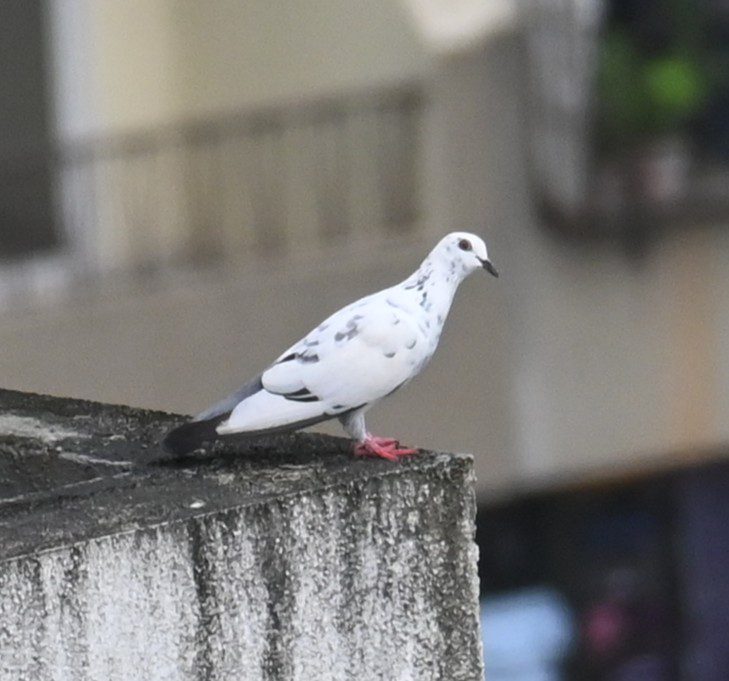
White pigeon
White Pigeon in the City – Finding Calm in Concrete
The city never sleeps — but sometimes, even in its restless pulse, nature finds a way to pause.
This photo captures a white pigeon in the city, resting quietly on a concrete ledge, its feathers gleaming against the muted chaos of the urban skyline.
At first glance, it’s just another pigeon. But look closer — the urban dove stands as a soft reminder of coexistence, resilience, and grace amid grey walls and noise.
The Story Behind the Urban Dove
This pigeon photography moment was captured in a typical Indian city — a fleeting encounter where instinct met architecture. The bird balanced effortlessly on the rough edge, eyes scanning the skyline, ready for its next flight.
In that brief moment, nature and man-made merged — a birdwatching in cities story that felt deeply symbolic.
The Symbolism of the White Pigeon
Across cultures, the white pigeon (or dove) symbolizes peace, love, and hope — universal values that transcend geography. In mythology and art, it’s often the messenger of new beginnings.
In today’s concrete jungles, spotting a white pigeon in the city feels almost like a spiritual encounter — a bird reminding us that nature adapts, evolves, and thrives quietly
Fun Facts About White Pigeons
- Pigeons can recognize themselves in mirrors — a rare trait among birds.
- They were once used as messengers during wars due to their powerful homing instincts.
- White pigeons and doves belong to the same bird family.
- Pigeons navigate using the Earth’s magnetic field — true natural navigators.
- The earliest recorded pigeon messenger dates back over 5,000 years!
Discover More on Travelon Tales
If this story resonated, explore more tales from nature
The most successful bird in the world, arguably
The feral pigeon in an Indian city is Columba livia, the Rock Dove. Every one of them descends from birds domesticated thousands of years ago, which in turn came from wild rock doves that nested on sea cliffs and gorges.
That origin explains everything about how they live now. A building is a cliff. A ledge is a ledge. A city is, from a rock dove’s point of view, an unusually generous mountain range with no predators worth mentioning and a permanent food supply.
Why white ones stand out
Feral pigeons come in an unusual range of colours for a wild bird — blue-bar, checker, red, black, pied and pure white. That variation is the legacy of selective breeding for the dovecote and the fancy pigeon trade.
A pure white bird among grey ones is usually of domestic descent, sometimes released at a ceremony. White pigeons released at weddings and events frequently join local feral flocks rather than returning anywhere.
Their survival odds are worse than the grey ones. White is conspicuous against a wall or a sky, and a raptor hunting a flock takes the bird that stands out.
The shakhas and the raptors
Feeding pigeons is a daily practice in many Indian cities, and the concentrations it creates have a consequence people rarely notice.
Dense, predictable flocks support urban raptors. Black Kites, Shikras and increasingly Peregrine Falcons hunt over Indian cities precisely because pigeons are abundant and reliably located. A Peregrine on a high-rise is there because of the pigeons below it.
The health question, fairly stated
Concentrated feeding does have costs. Pigeon droppings accumulate, and prolonged heavy exposure to dried droppings and feather dust is linked to respiratory problems including hypersensitivity pneumonitis — sometimes called pigeon fancier’s lung.
This is a real but specific risk, associated with sustained close exposure rather than with seeing pigeons in a street. The reasonable position is neither panic nor dismissal: avoid creating dense feeding concentrations near homes and windows.
Watching them properly
Pigeons repay attention that almost nobody gives them. The courtship display — the male bowing, turning a full circle with tail spread and throat inflated, following the female persistently — is as elaborate as anything you will watch on safari, and it is happening on every ledge.
- Photograph the iridescence. The neck is genuinely spectacular in low side light.
- Shoot against architecture. A pigeon on carved stonework or a rusted grille is a picture; a pigeon on grass is not.
- Watch for the bow-and-turn display.
- Look up for raptors wherever pigeon flocks are dense.
Frequently asked questions
What species is the city pigeon?
The Rock Dove, Columba livia. Feral urban birds descend from domesticated stock.
Why are some pigeons white?
Colour variation comes from centuries of selective breeding. White birds are often released stock or their descendants.
Are pigeons bad for health?
Sustained heavy exposure to droppings and feather dust carries a genuine respiratory risk. Casual exposure in the street does not.
Why do peregrine falcons live in cities?
Tall buildings resemble cliff ledges, and pigeons provide an abundant, predictable prey supply.
Related: Rose-ringed Parakeets in urban India and Telling the Indian parakeets apart.
