
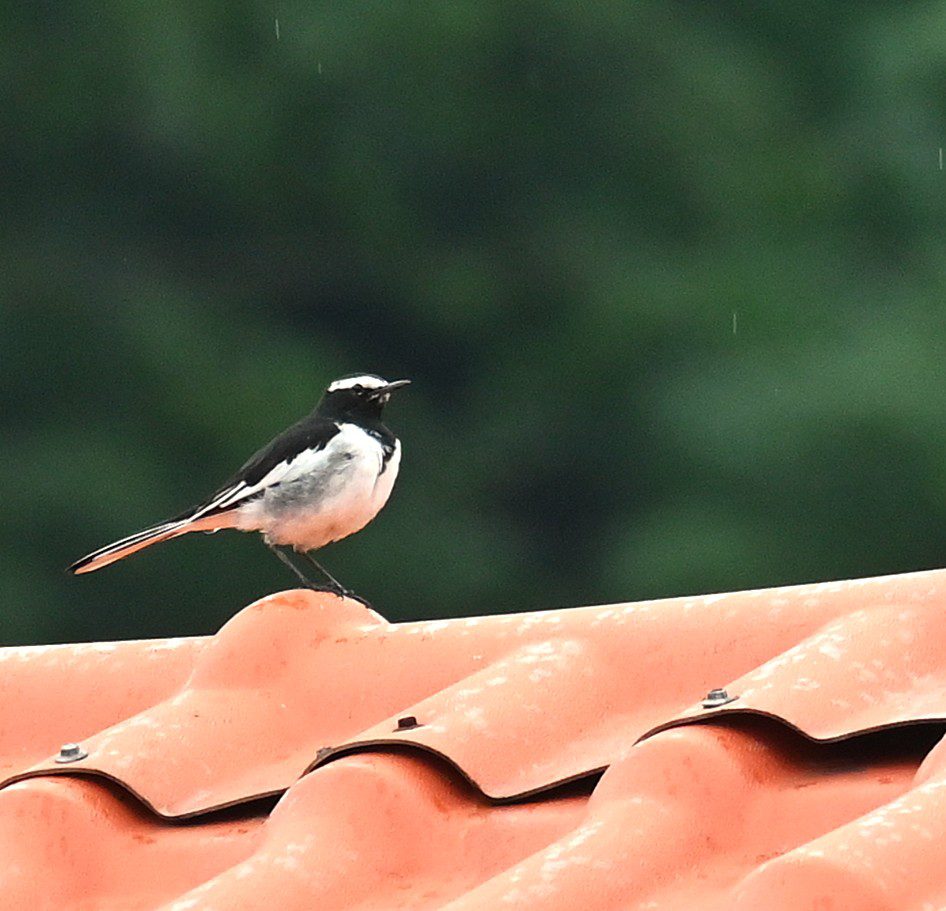
Wagtail Bird – Graceful Rooftop Singer and Urban Nature Delight in India

Wagtail – India’s Rooftop Songbird

Wagtail – The Graceful Tail-Wagger of Indian Roofs

The Wagtail, or Motacilla maderaspatensis, is one of India’s most elegant and musical birds. Known for its contrasting black-and-white plumage and signature tail-wagging dance, this wagtail often graces rooftops, lakesides, and courtyards across the subcontinent.

Appearance

This bird is easy to recognize:

  • A bold white eyebrow running across its black head
  • White underparts and black upperparts forming sharp contrast
  • A long tail, constantly wagging, giving it both grace and character

Behavior and Habitat

The Wagtail thrives in open areas — especially near water bodies like rivers, tanks, and lakes — but is also perfectly at home in cities and villages.
You’ll often see it perched on rooftops after a rain, flicking its tail as if keeping rhythm with raindrops.

They feed mainly on insects and small flies, catching them mid-air or foraging along ground surfaces.

Why It’s Called the ‘Rooftop Singer

This wagtail is a true urban performer.
Its melodious whistles are among the most cheerful sounds in early mornings or post-monsoon evenings. During breeding season, the male often sings from elevated perches — rooftops, poles, or walls — to attract a mate.

Symbolism and Cultural Connection

Across various Indian cultures, the wagtail symbolizes joy, purity, and renewal.
Its tail-wagging behavior is said to represent persistence and positivity — the idea that even after a storm, life must move forward.

To bird lovers and photographers, it represents balance between movement and stillness — a recurring theme in Indian natural beauty.

Conservation and Coexistence

Though the Wagtail is not endangered, its habitat quality depends on clean water sources and green spaces.
Preserving such areas in cities helps these birds thrive and maintain ecological balance.

Fun Facts About the browed Wagtail

  1. It’s the largest wagtail species found in India.
  2. Its scientific name, Motacilla maderaspatensis, means “bird of Madras.”
  3. It’s mostly resident, rarely migrating except in extreme conditions.
  4. The tail-wagging behavior may help flush out prey.
  5. Its songs intensify during breeding season — especially after light rain.

For more stories click here to visit our Safari Tales category on TravelonTales

Why wagtails end up on roofs

A wagtail on a rooftop looks out of place. These are birds of riverbanks and wet mud, and you expect them at the water’s edge, not on tiles.

Roofs work for them because they are flat, warm, insect-rich in the mornings, and offer a clear view in every direction. A wagtail hunting a roof is doing exactly what it does on a sandbar — running, stopping, snatching — just on a different flat surface.

The tail

The constant tail-pumping is the bird’s signature and nobody is entirely sure why it does it. The leading explanations are that it flushes insects out of cover, that it signals alertness to watching predators, or that it advertises fitness to other wagtails.

What is clear is that the rate changes with situation. A nervous bird pumps faster. It is not a mechanical tic.

Which wagtail is on your roof

  • White Wagtail: grey, white and black, a winter visitor over most of India.
  • Yellow Wagtail: yellow underparts, passage and winter, usually near wet grazing.
  • Grey Wagtail: grey above with a bright yellow vent and a very long tail, favours fast streams.
  • Western Yellow and Citrine: both occur, and both cause identification arguments in winter plumage.
  • White-browed Wagtail: the big resident one, black and white with a bold white brow — and the one most likely to be genuinely living on your building.

The White-browed, in particular

The White-browed Wagtail is India’s largest wagtail and an endemic. It is entirely comfortable around human structures, nests on ledges and in wall cavities, and sings a loud, sweet, surprisingly musical song from a high point — often a rooftop.

If you have a wagtail singing from your roof rather than just feeding on it, this is almost certainly the bird.

Watching them well

Wagtails are approachable if you stop moving. They tolerate a stationary observer at surprisingly close range and will carry on hunting. What they will not tolerate is being followed.

Frequently asked questions

Why do wagtails wag their tails?

It is not settled. Likely candidates are flushing insects, signalling alertness to predators, and social signalling.

Which wagtail lives on Indian rooftops?

Most often the White-browed Wagtail, a resident endemic that nests on buildings and sings from high perches.

Are wagtails migratory in India?

Several species are winter visitors, including White, Yellow and Grey Wagtail. The White-browed Wagtail is resident.

What do wagtails eat?

Insects, taken by running and snatching on open ground, and sometimes caught in short flights.


Related: White Wagtail and Grey Wagtail.

Scroll to Top