
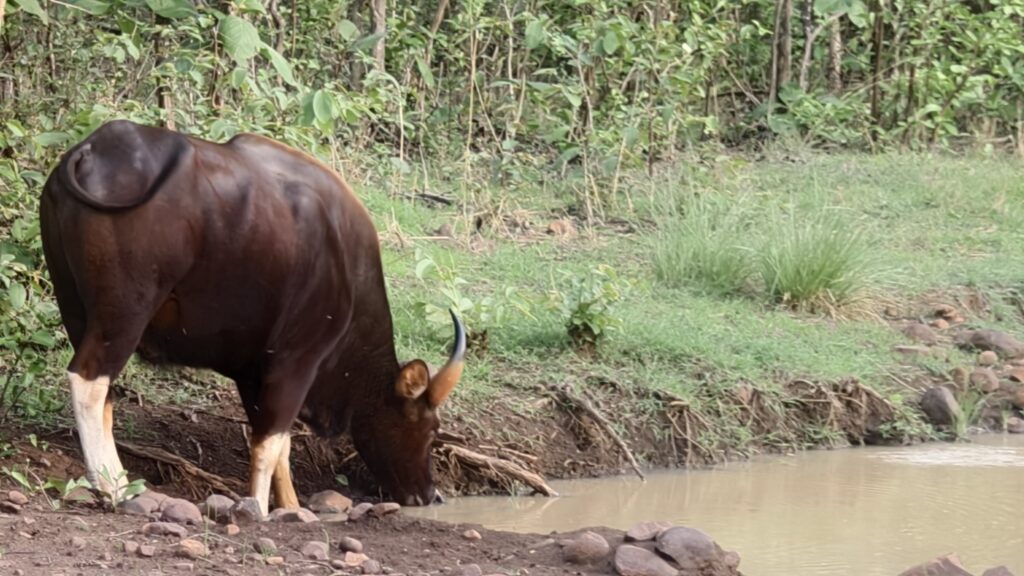
Inidan Gaur Drinking Water at Tadoba National Park
The Indian Gaur, the largest wild bovine in the world, is often described as the “gentle giant” of Indian forests. In this serene moment, we see the muscular beast lowering its head to drink — a rare opportunity to witness its quiet side in the wilderness.
Power and Presence
Gaurs can weigh over 1,000 kg, their sheer bulk and curved horns making them intimidating even to predators like tigers. Despite their size, they are shy and prefer to avoid conflict — unless provoked.
Guardians of the Forest
As natural grazers, gaurs help maintain forest ecosystems, encouraging fresh plant growth and supporting biodiversity in tiger reserves and protected zones.
Hydration in the Wild
In summer, waterholes become lifelines. This scene captures that essential survival behavior — reminding us how crucial water bodies are for wildlife conservation.
Fun Facts
The gaur is bigger than both American bison and buffalo
Tigers only attack gaurs when absolutely necessary — risk is too high
Their loud snorts can be heard from hundreds of meters away
Calves are surprisingly playful and social
They’re sometimes nicknamed “The Asian Bull Dozer”
The Indian Gaur is the largest wild bovine in the world and a true symbol of strength in India’s forests.
More wildlife moments → https://travelontales.com/bengal-tiger-panna-national-park
The largest wild cattle on earth
People call it an Indian bison. It is not a bison. The gaur (Bos gaurus) is wild cattle, and it is the biggest of them anywhere in the world.
A mature bull stands up to about 1.9 metres at the shoulder and can weigh over a tonne. Standing next to a jeep, its shoulder is above the roof line.
The ridge
The feature that makes a gaur unmistakable is the high, muscular ridge running along the back from the shoulders and ending abruptly about halfway down.
It is formed by greatly elongated vertebral spines, and it supports the enormous neck and head musculature. No other Indian animal has this profile — from a distance, the shape alone identifies it.
The white stockings
Every gaur wears white or tan stockings from the knee down, sharply separated from the dark body.
It is the quickest field mark at any distance and in poor light. If you see a large dark bovid with clean pale lower legs, that is a gaur. Buffalo do not have it.
Identifying age and sex
- Bull: almost black, massive, with a pronounced dorsal ridge and a bulging grey forehead patch between the horns.
- Cow: browner, smaller, with a less developed ridge and slimmer horns.
- Calf: reddish-brown, and the stockings are visible from very early on.
- Horns: pale and curving upward and inward, dark at the tips, in both sexes.
Where to see them at Tadoba
Bamboo, mixed forest, and grassy clearings early and late. They avoid the open in the heat of the day and are often found in shaded bamboo.
Herds are usually cows and young together. Old bulls are frequently alone, and a solitary bull is generally the largest and least tolerant animal you will meet in the forest.
Treat them with respect
Gaur are not aggressive but they are enormous and they do not always retreat. A bull that raises its head, turns broadside and stares is telling you something.
Stay in the vehicle, keep noise down and let the driver manage the distance. More people are hurt in Indian forests by large herbivores than by predators.
Photographing gaur
- Expose for the black. A dark animal in dappled bamboo shade is one of the hardest exposures in Indian wildlife photography. Meter for the animal, not the background.
- Get the ridge in profile. Front-on you lose the shape that defines the species.
- Include the legs. A crop that cuts off the white stockings throws away the most distinctive feature.
- Look for the forehead patch on bulls — the pale dome between the horns photographs well in side light.
Frequently asked questions
Is a gaur the same as an Indian bison?
No. Despite the common name, the gaur is wild cattle, not a bison. It is the largest wild bovine in the world.
How big does a gaur get?
Bulls can reach around 1.9 m at the shoulder and exceed 1,000 kg.
Why does it have white legs?
The pale lower legs are a natural marking and the fastest way to identify the species at distance.
Are gaur dangerous?
They are not aggressive by nature but are extremely large and will defend themselves. Stay in the vehicle and keep your distance.
Related: Gaur herds, bulls and behaviour, Indian Gaur at Bandhavgarh and Tadoba Safari Guide.
