
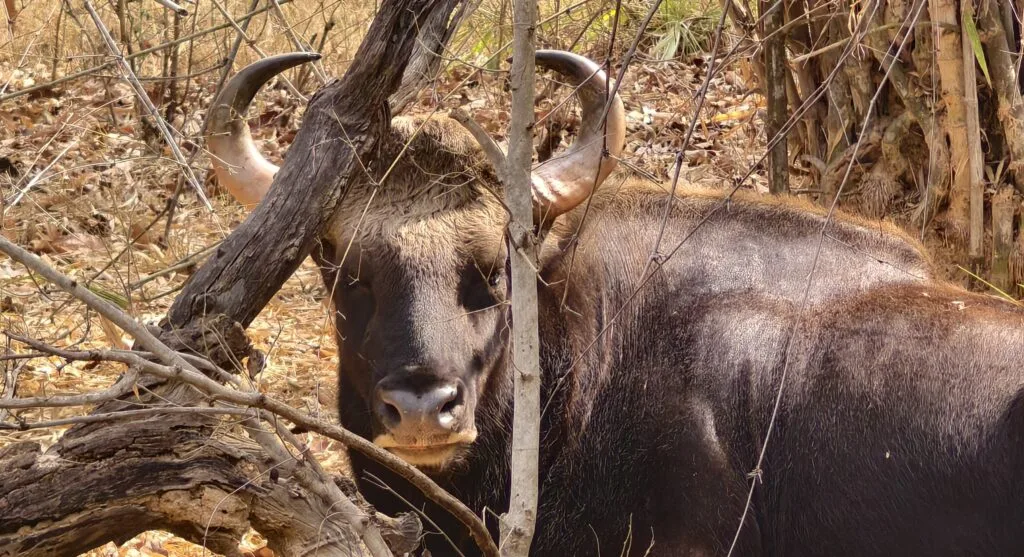
The Indian Gaur (Bos gaurus), often called the Indian Bison. With its towering build, sweeping horns, and commanding presence, it proudly holds the title of the world’s largest wild cattle species.”
🌿 Appearance & Physical Traits
- Height: Up to 220 cm at the shoulder, taller than domestic cattle.
- Weight: 600–1,000 kg; adult bulls can exceed a ton.
- Build: Muscular with a prominent ridge on the back and shiny dark brown to black coat.
- Horns: Curved and strong, serving both defense and dominance in herds.
🌍 Habitat
The Indian Gaur thrives in evergreen and deciduous forests across India, Nepal, Bhutan, and parts of Southeast Asia. In India, they are frequently spotted in reserves like Kanha, Bandhavgarh, Tadoba, and Nagarhole.
🌱 Diet & Behavior
- Herbivorous: Consumes grasses, shoots, bamboo, and fruits.
- Social: Found in small herds led by a matriarch.
- Temperament: Shy and gentle, but protective. If threatened, a gaur can display tremendous power.
🛡 Conservation Status
- Threatened by habitat destruction, poaching, and human-wildlife conflict.
- Conservation efforts in India have stabilized some populations in protected areas.
🎉 Fun Facts About Gaurs
- The largest wild bovine species in the world.
- Often mistaken as “Indian Bison,” though they are not true bison.
- Tigers are their primary predator, but even a tiger carefully chooses its battle with a healthy adult gaur.
How a gaur herd is organised
Gaur live in herds of roughly eight to twenty, though larger aggregations form where grazing is good. The herd is led by an adult cow, not a bull.
Mature bulls spend much of the year apart, either alone or in small bachelor groups, and join herds during the breeding season. The biggest bull you see standing by himself in bamboo is not lost — that is normal.
One of the few animals a tiger thinks twice about
An adult gaur bull is among the largest prey a tiger will attempt anywhere in its range, and many do not attempt it at all.
Tigers do kill gaur, and in reserves like Tadoba and Bandhavgarh gaur form a significant part of the diet. But it is generally calves, sub-adults or lone animals that are taken. A healthy adult bull, over a tonne and armed, is a serious proposition for a predator that hunts alone.
Gaur defend themselves collectively. A threatened herd bunches with calves at the centre and adults facing outward, and dhole packs and tigers have both been driven off by this.
What they eat
Gaur are mixed feeders. They graze on grass and browse on leaves, shoots, bamboo and fruit, shifting seasonally as the forest changes.
That flexibility matters. Pure grazers suffer badly when grass fails in a dry year; an animal that can switch to bamboo and browse has an alternative.
Where they fit in the forest
A herd of large herbivores moving through bamboo does real ecological work — opening paths, controlling growth, dispersing seed and creating the disturbed ground that many other species use.
They are also a good indicator. Gaur need large, connected, relatively undisturbed forest. Where gaur are doing well, the forest itself usually is.
Status and pressures
The gaur is listed as Vulnerable. The threats are habitat fragmentation, poaching, and disease transmitted from domestic cattle grazing at forest edges — foot-and-mouth and rinderpest have both caused serious die-offs historically.
India holds the largest remaining population, which makes reserves like Tadoba internationally important for the species.
Watching a herd well
- Stay still and quiet. A settled herd will carry on feeding and give you far more than a spooked one.
- Watch the lead cow. The herd reacts to her. If she lifts her head and stares, everything is about to move.
- Photograph the group, not just the biggest bull. Herd structure with calves is a better story.
- Late light on bamboo is when this works. Midday gaur are usually deep in shade.
Frequently asked questions
Do tigers hunt gaur?
Yes, though usually calves, sub-adults or lone animals. A full-grown bull is a dangerous target even for a tiger.
How large are gaur herds?
Typically eight to twenty animals, led by an adult cow. Bulls are often solitary outside the breeding season.
What do gaur eat?
Both grass and browse — leaves, shoots, bamboo and fruit — switching seasonally.
Are gaur endangered?
Listed as Vulnerable. Habitat fragmentation, poaching and cattle-borne disease are the main pressures.
Related: How to identify a gaur, Indian Gaur: weight, size and habitat and Tadoba Safari Guide.
