
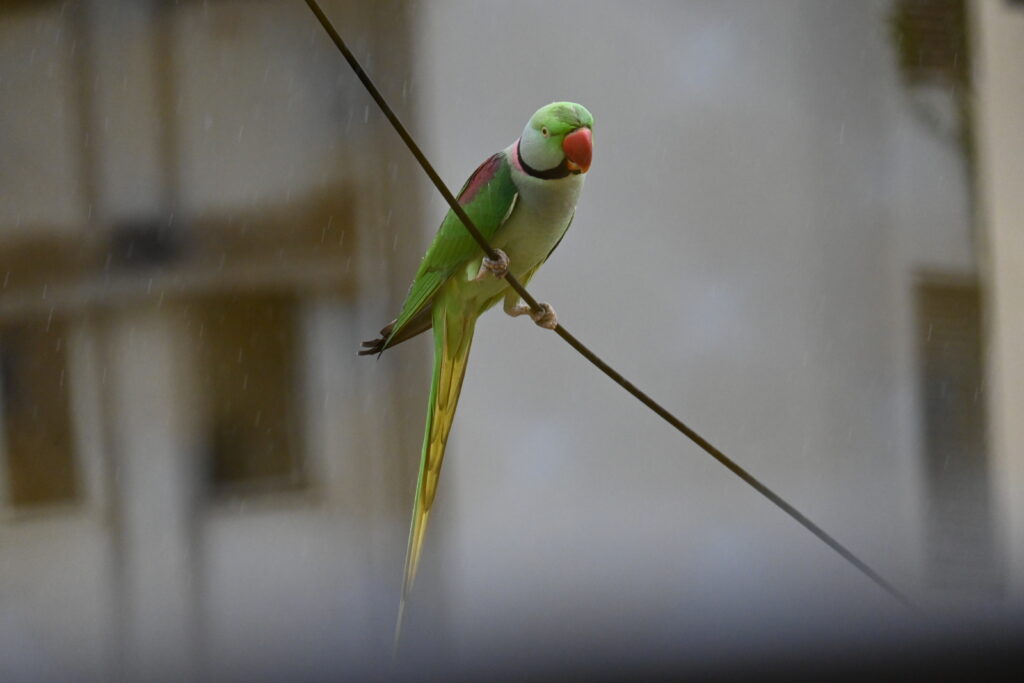
A parrot sits peacefully, showcasing its vivid feathers. This tropical bird image captures the elegance and charm of a parrot in a natural setting. Perfect for wildlife, nature, and exotic bird themes.
Feathers Are Waterproof
Parrots preen with oils from a gland near their tail, making their feathers glossy and waterproof. Nature’s built-in conditioner.
Parrot or parakeet?
In India the birds people call parrots are almost always parakeets — the long-tailed group in the genus Psittacula. The distinction is not pedantry; it is the difference between a family with hundreds of species worldwide and the handful you will actually see here.
There are five you are likely to meet, and they are separable at a glance once you know what to look at.
The five Indian parakeets, and how to tell them apart
- Rose-ringed Parakeet: all green, red bill. The male has a black-and-rose collar; the female has none. By far the most common, and the one in most gardens and cities.
- Plum-headed Parakeet: male has a plum-red head, female a dull grey one. Slimmer, faster, more of a woodland bird.
- Alexandrine Parakeet: like a Rose-ringed but noticeably larger, with a deep red shoulder patch. Heavier bill.
- Malabar Parakeet: blue-grey rather than green. Western Ghats only.
- Vernal Hanging Parrot: tiny, stub-tailed, bright green. Sleeps hanging upside down, which is how it got the name.
Start with size and head colour. Those two answer it in most cases.
Why the collar matters
On a Rose-ringed Parakeet, the black-and-rose ring around the neck belongs only to adult males. Females and young birds have a plain green neck, or at most a faint shadow of a collar.
Males take about three years to develop the full ring. So a bird without a collar is a female, or a young male that has not finished growing up — which is why people often report seeing far more “females” than males.
Feathers that are not actually green
There is no green pigment in a parakeet feather.
The colour is structural. Feathers carry a yellow pigment, and their microscopic internal structure scatters blue light. Yellow pigment plus scattered blue reads to our eyes as green. Crush the feather and the structure collapses, and with it the colour.
This is why a parakeet looks a different shade depending on the angle of light, and why they photograph so differently in shade and in sun.
Behaviour worth watching
Parakeets are loud, social and highly organised. They gather in large communal roosts at dusk, sometimes thousands strong in a single stand of trees, and the noise as they come in is remarkable.
They are cavity nesters, using tree holes and, in towns, gaps in buildings. They will enlarge a hole to fit and will compete hard for a good one — with mynas, with barbets and with each other.
They also feed in an unmistakable way: gripping fruit in one foot, holding it up to the bill, and working it methodically while hanging at improbable angles.
Photographing them
- Green on green is the problem. A parakeet in a tree disappears. Look for birds on a bare branch, a wall or against sky.
- Shoot in soft light. Harsh sun blows out the green and kills the feather detail entirely.
- Wait at the fruiting tree. If a tree is in fruit, the birds will come back to it repeatedly.
- Watch dusk. Roost flights give you flocks in motion, which is a different and more interesting picture than a perched bird.
Frequently asked questions
Is it a parrot or a parakeet?
In India, almost always a parakeet. Parakeets are the long-tailed parrots of the genus Psittacula.
How do I tell a male Rose-ringed Parakeet from a female?
The male has a black-and-rose collar. The female has a plain green neck. Males need about three years to develop it.
Why are parakeets green?
Structural colour, not pigment. Yellow pigment combined with blue light scattered by the feather structure reads as green.
Where do parakeets nest?
In cavities — tree holes, old woodpecker and barbet holes, and gaps in buildings.
Why are they so noisy at dusk?
They gather in large communal roosts. The calling is how a flock coordinates as it comes in to settle.
Related: Rose-ringed Parakeets as urban wildlife and Birds of Bhigwan — 39 species.
