
Common Name: Jungle Myna

Scientific Name: Acridotheres fuscus
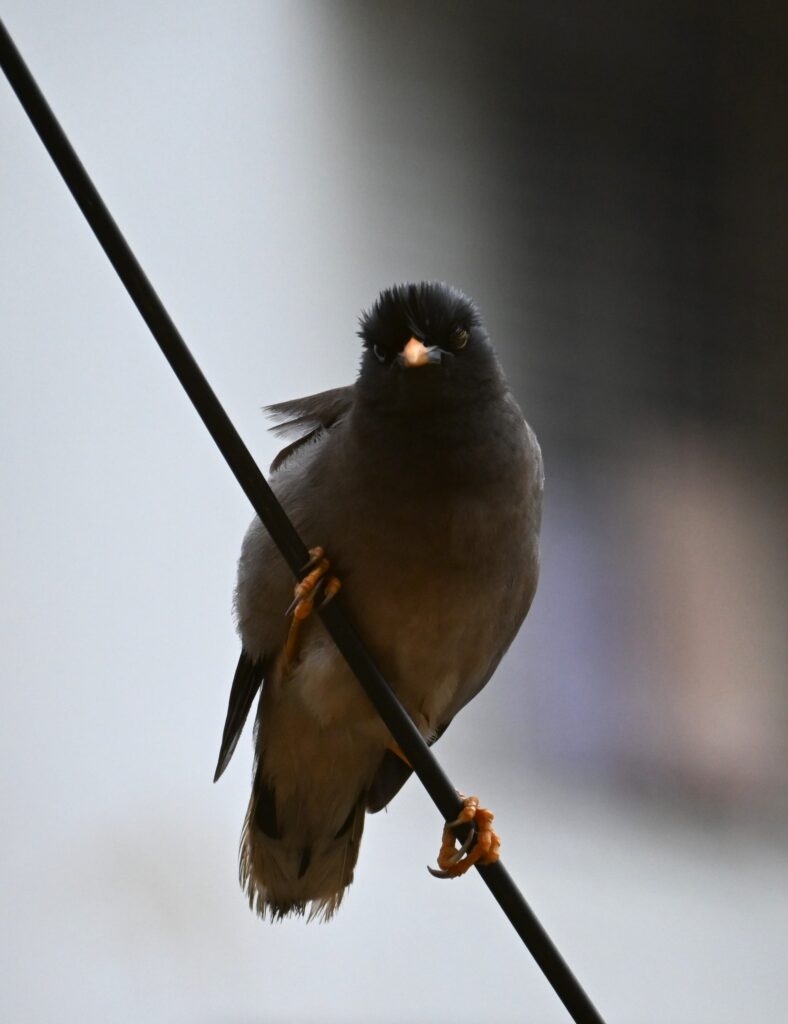
Species Details

  • Common Name: Jungle Myna
  • Scientific Name: Acridotheres fuscus
  • Family: Sturnidae (Starling family)
  • Range: Widely found in India, Sri Lanka, and Southeast Asia
  • Habitat: Open woodlands, farmlands, urban gardens, near human habitation
  • Identification:
    • Sooty grey-black plumage
    • Orange-yellow beak and legs
    • Prominent tuft or crest of feathers on the forehead
    • Blueish tinge on wings visible in better light
  • Feathered Punk Rocker: That stylish forehead crest isn’t just for show — it helps the Jungle Myna stand out from its cousin, the Common Myna.
  • Mimicry Skills: Jungle Mynas are known to imitate human sounds and other birds, often confusing people with their calls.
  • Insect Eater They love insects and help control pests in farms, making them farmers’ unsung allies.
  • Social Bird: Always seen in pairs or flocks, they are highly gregarious and vocal — you’ll hear them before you see them!

How to tell a Jungle Myna from a Common Myna

These two share the same towns, fields and roadsides across much of India, and most people never separate them. It takes about two seconds once you know where to look.

  • The face. The Common Myna has a bare patch of bright yellow skin behind the eye. The Jungle Myna has none — its face is feathered.
  • The tuft. The Jungle Myna has a small forward-curling tuft of feathers at the base of the bill. The Common Myna does not.
  • Eye colour. Jungle Myna eyes are usually pale, often bluish or whitish. Common Myna eyes are dark with that yellow surround.
  • Overall tone. The Jungle Myna is greyer and plainer. The Common Myna is warmer and browner.

In flight both show a bold white wing patch, so that is no help. Go to the face.

Where it lives

Jungle Mynas prefer the edges of things: cultivation next to woodland, tea and coffee estates, grazing land, the margins of villages. They are less tied to dense human settlement than the Common Myna, which will happily live in the middle of a city.

You will often see them around cattle, walking in the grass the animals have flattened and taking the insects they disturb. That habit of following large grazers is worth watching for — it is how many of the best sightings begin.

What it eats

Almost anything. Insects, grubs, worms, fruit, nectar, grain, kitchen scraps. This flexibility is precisely why mynas do so well alongside people while more specialised birds retreat.

During the breeding season the diet shifts heavily towards insects, because growing chicks need protein rather than fruit.

Nesting

Jungle Mynas nest in cavities — a hole in a tree, a gap under roofing sheets, a hollow in a wall, a disused woodpecker or barbet hole. They line it with grass, feathers and whatever else is to hand.

They are noisy and conspicuous around the nest, and pairs will see off birds considerably larger than themselves.

Behaviour worth watching

Mynas are worth more attention than they get. They walk rather than hop, which sets them apart from most small birds at a glance. They are strongly social outside the breeding season and gather in large communal roosts at dusk, often in a single tree, with a great deal of noise before they settle.

They are also capable mimics. Not to the standard of a hill myna, but a jungle myna will pick up sounds from its surroundings.

Photographing mynas

  • Get low. They spend most of their time on the ground. Shooting down at them produces flat, forgettable images.
  • Watch for the face detail. A frame that clearly shows the tuft and the pale eye is worth far more than a distant profile, because it settles the identification.
  • Use the cattle. Birds following grazing animals are relaxed and predictable, and you get behaviour rather than a portrait.
  • Late light helps. Grey-brown plumage looks dull at midday and comes alive at either end of the day.

Frequently asked questions

What is the difference between a Jungle Myna and a Common Myna?

The Common Myna has bare yellow skin behind the eye. The Jungle Myna does not, and has a small tuft of feathers at the base of the bill and a paler eye.

Are Jungle Mynas common in India?

Yes, widely distributed, though they favour the edges of cultivation and woodland more than city centres.

What do Jungle Mynas eat?

Insects, fruit, nectar, grain and scraps. They are opportunistic feeders, which is a large part of their success.

Where do Jungle Mynas nest?

In cavities: tree holes, roof spaces, wall gaps and abandoned woodpecker holes.

Do Jungle Mynas talk?

They mimic sounds from their surroundings, though not as impressively as the hill myna.


Related: Birds of Bhigwan — 39 species and Ashy Prinia vs Grey-breasted Prinia.

Scroll to Top