
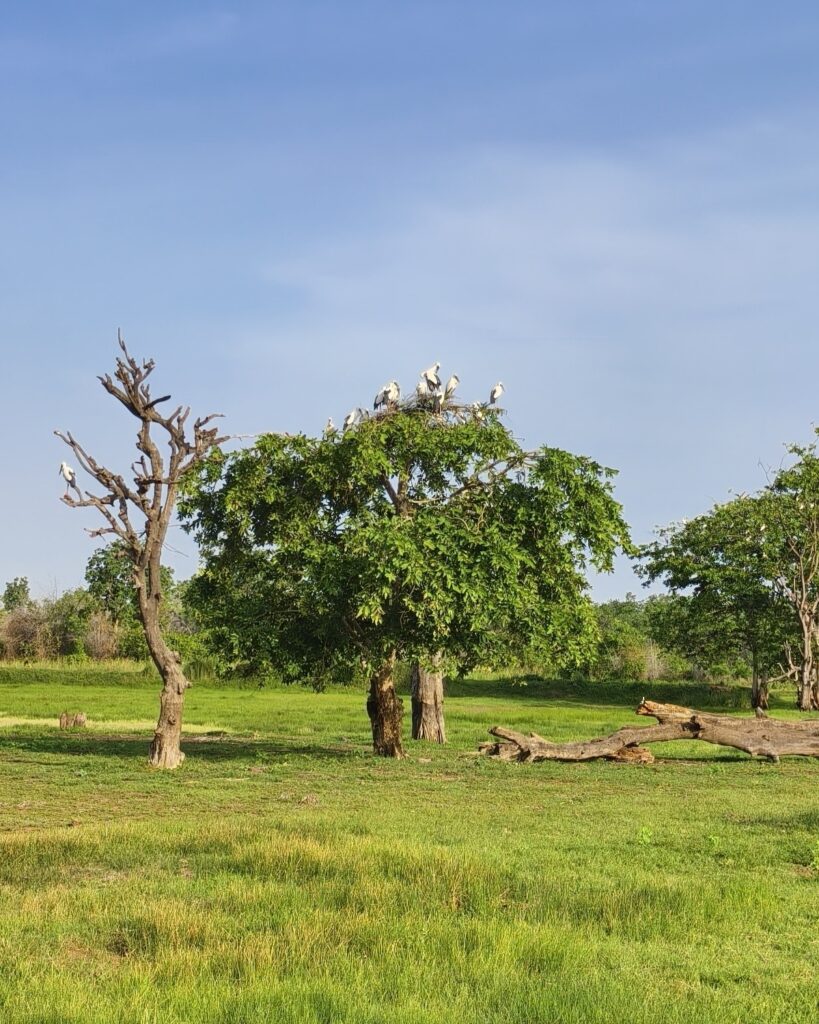
The Sentinels of Tadoba Asian Openbill Stork Colony

Asian Openbill Tadoba
Sentinels of Tadoba Asian Openbill Stork Colony

Sentinels of Tadoba – Asian Openbill Storks

High above the green canopies of Tadoba-Andhari Tiger Reserve, a bustling community of Asian Openbill Storks thrives. These elegant wetland birds gather in large colonies during the breeding season, transforming the treetops into a living, breathing rookery.

What Makes the Openbill Stork Unique?
Their name comes from the distinct gap between the upper and lower bill, a remarkable adaptation used for cracking open freshwater snails—their favourite meal. Efficiency meets evolution.

Treeline Nesting – A Tactical Choice
By nesting high on mature trees, the storks gain:

  • Safety from ground predators
  • Clear lookout points
  • Strong branches for large nests

Here in Tadoba, they benefit from both wetlands for food and forest cover for nesting—a perfect ecological partnership.

Why Their Presence Matters
Asian Openbills help maintain aquatic balance, keeping snail populations under control. Their arrival signals:

  • Healthy wetlands nearby
  • Successful food chain functioning

They are the guardians of India’s freshwater bodies.

Fun Facts — Asian Openbill Stork

The Asian Openbill has a unique beak with a natural gap, perfectly evolved to crack open snails like a built-in nutcracker.
• Interestingly, they are almost silent — instead of calls, their wings make a soft fluttering sound.
• Because they rely on healthy wetlands for food, their presence signals a thriving ecosystem.
• Moreover, these storks nest in huge colonies on tall trees, creating entire rooftop neighborhoods of feathers and sticks.
• As chicks, their beaks are fully closed — the iconic open bill forms only as they grow.
• During monsoon migration, they can travel long distances without stopping.
• Additionally, farmers love them since they control pest snails that attack paddy crops.
• They are extremely patient hunters, capable of standing motionless for hours.
• Despite their slim bodies, they boast a wingspan of over 4 feet — quite impressive in flight.
• And when sunlight hits just right, their feathers reveal a hidden metallic green-blue sheen — a surprise splash of color in wetlands.

For more wildlife stories visit: https://travelontales.com/lesser-adjutant-stork-tadoba/

The gap in the bill

The Asian Openbill is named for the one feature you cannot miss: when its bill is closed, the two halves still do not meet. There is a visible arched gap in the middle.

This is not damage or deformity. It is a specialised tool. Openbills eat large apple snails, and the gap gives them the grip and leverage to work a snail out of its shell without smashing it. The inner edges of the bill are slightly roughened, which helps hold a wet shell in place.

How they feed

Watch one for a few minutes and the method becomes clear. It wades slowly through shallow water with the bill partly open and submerged, feeling rather than looking for prey. When it makes contact it clamps down, lifts the snail out, and works the body free with the bill tip.

The whole operation takes seconds and leaves the shell largely intact. Piles of empty apple snail shells at the edge of a wetland are a reliable sign that openbills are working it.

Where to find them

Openbills are common across the Indian subcontinent and Southeast Asia, wherever there are shallow freshwater wetlands, flooded fields and tanks. In much of India they are more likely to be seen in paddy fields than in protected reserves.

They are colonial nesters, building untidy stick platforms in trees, often mixed in with egrets, cormorants and other storks. Heronries near villages frequently hold them.

Identification

  • Size: a smallish stork, around 68 cm.
  • Plumage: greyish white with glossy black flight feathers and tail. In breeding condition the white looks cleaner and brighter.
  • Bill: dull, heavy, and gapped — diagnostic at any range where you can see it.
  • Legs: pinkish to dull red.
  • Flight: soars readily on thermals in loose flocks, neck extended like other storks.

Conservation

The Asian Openbill is listed as Least Concern and is one of the few Indian storks that is doing well. It has adapted to agricultural landscapes rather than retreating from them, which is exactly what the Lesser Adjutant and Greater Adjutant have failed to do.

Its dependence on apple snails does make it vulnerable to pesticide use and wetland drainage, so its comfort is not guaranteed indefinitely.

Frequently asked questions

Why does the Asian Openbill have a gap in its bill?

The gap gives it grip and leverage for extracting apple snails from their shells. It is an adaptation, not a defect.

What do openbills eat?

Mainly large freshwater snails, plus frogs, crabs, insects and small fish.

Are Asian Openbills common in India?

Yes, widely, especially in paddy fields, tanks and shallow wetlands. They are listed as Least Concern.

Do they nest in colonies?

Yes, in trees, often alongside egrets, cormorants and other waterbirds.


Related: Asian Openbill at Bhigwan and Lesser Adjutant Stork.

Scroll to Top