
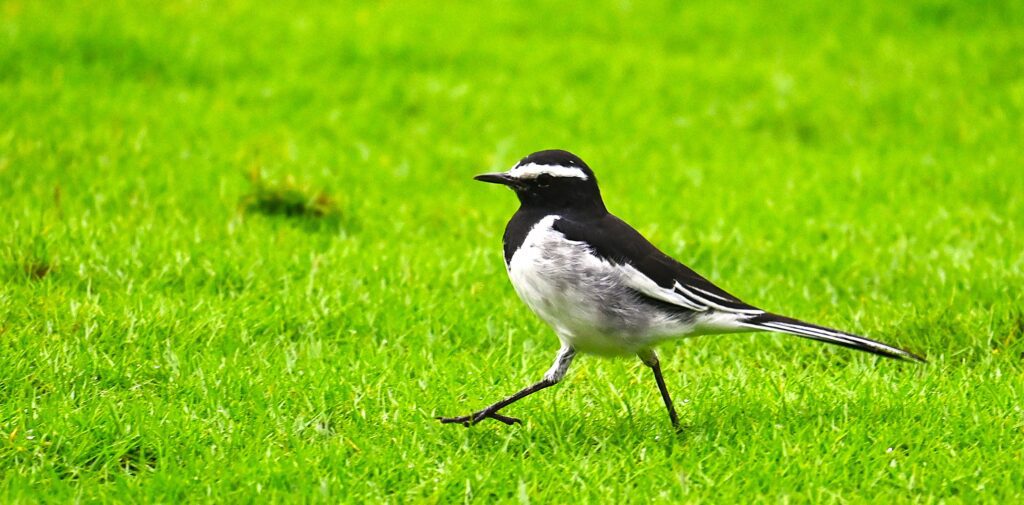
White-Browed Wagtail : Motacilla maderaspatensis scientific name

white wagtail

White-Browed Wagtail – India’s Graceful Grassland Bird in Motion

By TravelonTales • November 7, 2025

The White-browed Wagtail (Motacilla maderaspatensis) is one of India’s most charismatic grassland birds. With its sleek black-and-white plumage, rhythmic tail-wag, and confident stride, it adds life and motion to quiet riversides, lawns, and lake edges.

Habitat & Behaviour

White-browed Wagtails thrive in open habitats close to water — ponds, canals, and gardens. They are excellent insect hunters, often running short bursts to catch prey. The signature tail wag is believed to flush insects or signal alertness to other birds.

Distribution

This proud native of the Indian subcontinent can be found from city parks to remote riversides. Adaptable and resilient, it builds nests in crevices, bridge beams, and even building pipes, proving how well nature evolves around human presence.

Conservation Status

Currently listed as “Least Concern,” the species remains widespread, though pollution and habitat loss threaten its water-dependent lifestyle. Maintaining clean rivers and green corridors ensures this beautiful bird continues to thrive.

Fun Facts

  • It’s the largest wagtail species native to India.
  • Their tail never truly rests — even when perched!
  • They sing soft, melodious notes at dawn near water bodies.
  • Known for nesting on human-made structures like bridges and rooftops.
  • Nicknamed “Khiskoli” in Hindi, inspired by its wagging motion.

Conclusion

The White-browed Wagtail isn’t just a bird — it’s an emblem of balance and motion. Whether striding across lawns or skipping over ripples, it reminds us that beauty often lies in simplicity — and in the rhythm of life itself.

Tags: White-browed wagtail, Indian birds, grassland bird India, wildlife photography, Motacilla maderaspatensis, TravelonTales

For more beautiful wildlife stories and photographs — Click Here

Naming

The White Wagtail is Motacilla alba. Motacilla is the wagtail genus; alba simply means white. The genus name is itself an old misunderstanding — it was meant as a diminutive of “mover”, and the “-cilla” was mistakenly taken to mean tail.

Subspecies, and why it matters in India

White Wagtail has an unusually large number of subspecies, and several reach the subcontinent in winter. Sorting them is one of the more satisfying winter identification puzzles available to an Indian birder.

  • dukhunensis: the commonest wintering form across much of India. Grey back, clean white face.
  • personata: masked, with black extending over the crown and around the eye, leaving a white face patch. Distinctive.
  • alboides: Himalayan, black-backed, breeds in the north and moves lower in winter.
  • baicalensis and ocularis: scarcer, and worth checking any wagtail flock for.

Where to look

Wet edges. River sandbars, reservoir margins, canal banks, sewage ponds, wet fields and lakeside mud. They are also very willing to use concrete — dam walls, ghats and rooftops all get used as substitute open ground.

In winter they gather in loose flocks to roost, sometimes in reedbeds and sometimes in town trees, and the roosts can be large.

Behaviour

The White Wagtail hunts by walking briskly with the tail pumping, stopping abruptly, and taking insects off the surface. It also makes short sallies after flying prey, which few people expect from a ground bird.

The flight is strongly undulating with a thin, clear flight call, and once you know the call you will notice how often they pass overhead unseen.

Frequently asked questions

What is the scientific name of the White Wagtail?

Motacilla alba.

Is the White Wagtail resident in India?

Mostly a winter visitor. The Himalayan subspecies alboides breeds within the region and descends in winter.

How do I tell White Wagtail subspecies apart?

Look at the back colour and the head pattern. dukhunensis is grey-backed with a white face, personata is masked, alboides is black-backed.

What habitat does it prefer?

Open ground next to water — sandbars, mud, wet fields — and it readily uses concrete surfaces too.


Related: The Wagtail on the Rooftop and Grey Wagtail.

Scroll to Top